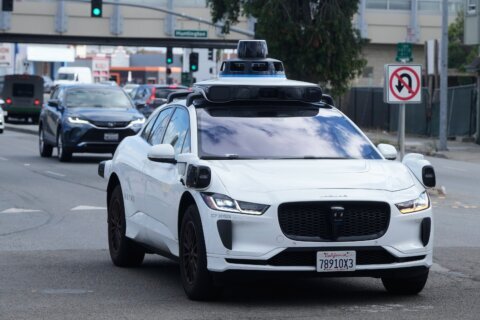
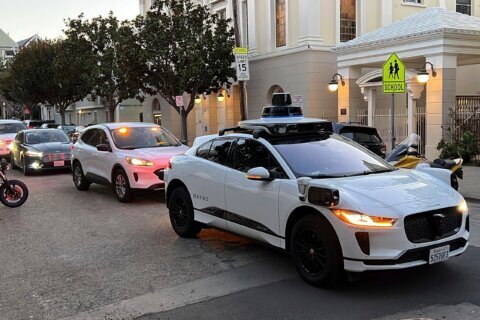
An hourslong D.C. Council hearing on a bill that would allow the commercial use of autonomous vehicles in the District included testimony from rideshare drivers concerned about their livelihoods if robotaxis join them on the streets, and disability advocates who said the vehicles represent independence and safety.
“I work a nine-hour shift every single day, and I still go to drive anywhere from five to six hours after I get off work. But I have the flexibility to do that with rideshare versus having two jobs,” said Crystal Middleton, a security officer who also drives for Uber and Lyft.
Middleton said she needs the extra work to pay her phone bill and for groceries after her company cut overtime and due to federal cuts.
The drivers were supported by a union-led protest before Monday’s hearing on the steps of the Wilson Building.
“If you do driving for a living, you should be concerned about Waymo coming into our city,” Jaime Contreras, executive vice president for Service Employees International Union Local 32BJ, said.
“Our members are security officers, commercial office cleaners, airport workers, and they work two, sometimes even three jobs. And one of those jobs is usually an Uber or Lyft driver,” he told WTOP.
“It’s a job killer. Make no mistake about it,” Contreras said.
Ward 6 Council member Charles Allen introduced the Autonomous Vehicle Deployment Authorization Amendment Act in May.
The bill would establish a commercial autonomous vehicle program within D.C.’s Department of Transportation. Companies would need permits, first responder interaction plans and contingency plans for challenges including power outages and network failures.
The vehicles would be phased in, with operators limited to 200 vehicles until Jan. 1, 2028.
The legislation would also impose a 15-cent-per-mile vehicle miles traveled, or VMT, tax aimed at encouraging operators “to minimize passenger-less operations and circuitous routing.”
The bill would create a workforce fund supported by commercial operators to provide education, vocational training and workforce development for taxi and rideshare drivers.
Eighty-one witnesses testified across 17 panels Monday, in addition to government officials.
Representatives from Waymo and Tesla were among those who kicked off the hearing.
As rideshare drivers expressed concerns that autonomous rideshare and robotaxi services would cull their income earning opportunity, Waymo said it would bring jobs to the District.
Matt Walsh, a public policy executive with Waymo, said in written testimony that the company has “recently committed tens of millions of dollars in Wards 5 and 7 to build service centers and charging facilities to support our fleet.”
“If the Council can provide additional regulatory certainty, our current local workforce will grow from dozens of people today to hundreds of personnel who will provide day-to-day operations support,” he said.
Walsh also said fleet maintenance would bring more business to the local automotive supply chain.
D.C. Chamber of Commerce President Chinyere Hubbard also supported bringing commercial driverless vehicles to the district, but recommended changes to the bill, including reducing fees and modifying rules governing fleet expansion.
“Remove the restrictive cap of 200 vehicles along with the city’s permanent authority to impose new caps later, and allow expansion based on safety milestones,” Hubbard said.
Others testifying in support of the bill included Conner Cummings, who was there on behalf of The Arc of Northern Virginia, a service and advocacy nonprofit for people with intellectual and developmental disabilities.
“People like me who can’t drive will be able to get around much easier,” Cummings said. “Many autistic individuals will feel far more comfortable inside a vehicle where we don’t have to share space with a stranger driving them.”
Sandra Neuzil, a Fairfax County resident who is legally blind, said her work and volunteering have been bringing her to the District more often.
“An on-demand ride in an autonomous vehicle would greatly improve my commute,” she said. “Without hours or days planning and coordinating, it would save a tremendous amount of time and significantly reduce frustration and stress for me.”
WTOP’s Neal Augenstein contributed to this report.
Get breaking news and daily headlines delivered to your email inbox by signing up here.
© 2026 WTOP. All Rights Reserved. This website is not intended for users located within the European Economic Area.