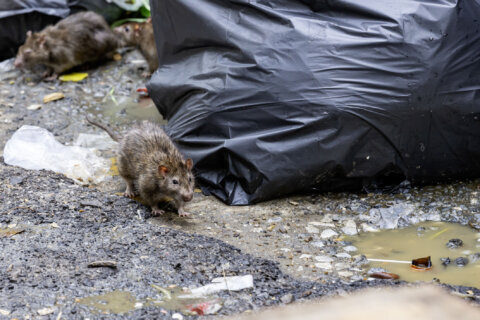
D.C. has been battling the rat population on two fronts.
Recently, the District introduced the use of birth control in a pilot program to reduce the rodent population. But rat poisons, or, more formally, rodenticides, remain a go-to for rodent control on private and public property in urban settings and in the suburbs.
Veterinarians said that poses a real concern, as incidences of pets ingesting rodenticides have increased.
Dr. Karena Joung, senior hospital director at VEG ER for Pets at its D.C. location on H Street and in Chantilly, Virginia, said, “Both cats and dogs can be exposed, but we’re seeing more dogs that get into rodenticide.”
“It’s a very effective way of controlling rodents,” Joung said. “Unfortunately, rodents are mammals, and so are dogs and cats, and they’re also getting exposed.”
Typically, rodenticides are contained inside rat bait boxes.
“Even though people say they’re pet proof, they are absolutely not,” Joung said, adding many dogs, especially the larger breeds, can break open the rat boxes. “We do see poisonings, even from those ‘pet-proof’ rat boxes.”
Joung said rats can also scatter the bait outside the box. Anyone who lives in an apartment or condo, Joung said, should ask about what type of rodenticide is used on their property.
“Knowledge is power,” she said, and in an emergency, being able to tell the veterinarian what type of rodenticide their pet ingested can help in treatment.
“There’s an anticoagulant rodenticide, which means that it causes bleeding,” Joung said.
The good news there, she said, is that there’s an antidote for that.
Another type of rodenticide uses bromethalin, a neurotoxin that does not have a specific antidote. In that case, Joung said, “We need to catch it early to try to get it out of their system.”
No matter what kind of rodenticide a pet may have ingested, Joung said, “Call your vet, or come to VEG ER for Pets immediately, because the biggest thing that we want to do is take that toxin out of their system as soon as possible.”
“We’ve got about a two-hour window where we might be able to get some of this out.”
Joung stressed that pet owners should call their vets if they think their pet has been exposed to any type of toxin. And in the case of VEG ER, she said, “Please give us a call, the doctors actually get on the phone with you,” and can offer information and guidance.
One positive note, Joung said, is that pet owners seem to be more aware of the threat that rodenticides can pose, and don’t delay in calling for help.
Get breaking news and daily headlines delivered to your email inbox by signing up here.
© 2026 WTOP. All Rights Reserved. This website is not intended for users located within the European Economic Area.