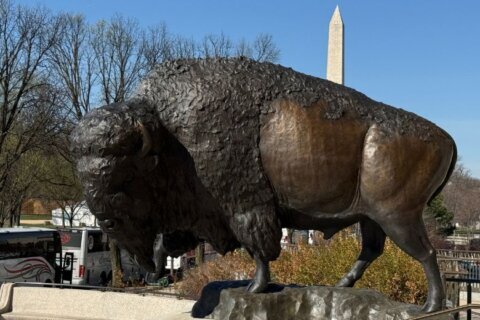
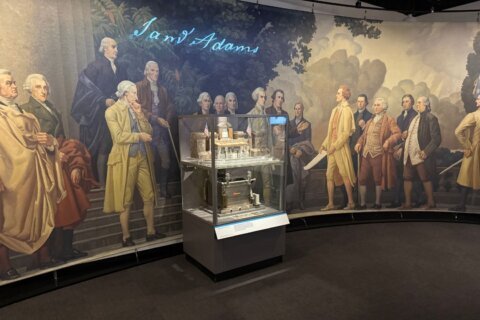
Move over bald eagle — another American symbol is taking center stage at the Smithsonian’s National Museum of Natural History in D.C.
A new exhibit, “Bison: Standing Strong,” explores the origins of the American bison, their near extinction and their comeback.
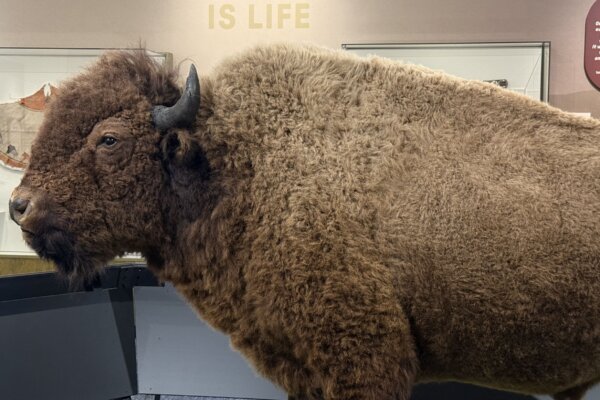
A large taxidermized bison greets visitors as they enter the exhibit, standing on ground that may have once been part of the animals’ historic range.
“There were bison all the way to the Potomac,” said Siobhan Starrs, a senior exhibition developer at the museum. “There were bison in New England, bison in Georgia, South Carolina, all the way down to Florida on the Panhandle. Bison really shaped this country in a profound way.”
Kirk Johnson, Sant Director at the Smithsonian’s National Museum of Natural History, said even George Washington is believed to have shot a buffalo in the 1770s in what is now West Virginia.
Bison are the national mammal of the United States, and Starrs said their presence still shows up across American culture.
“Buffalo Bills, Buffalo Sabres, even here in D.C., there are two universities with bison as their logo, both Howard University and Gallaudet. They’re on our postage stamps. They’re on our currency. Even the ‘America 250’ stamp this year will be a bison stamp,” Starrs said.
Hundreds of years ago, bison populations reached as many as an estimated 35 to 45 million animals roaming across much of North America. Starrs said their migratory patterns helped shape the land.
“They literally shaped the land that we now walk on today,” she said.
The exhibit also looks further back, spotlighting Bison latifrons, an ancient ancestor that lived alongside woolly mammoths and saber‑toothed cats. A fossil on display shows horns stretching nearly six feet across. Starrs said the animal stood about eight feet tall, roughly two feet taller than modern bison.
A central section of the exhibit details the bison’s rapid decline in the 19th century, including a towering image of piled buffalo skulls in Michigan from the late 1800s.
“That image shows the scale of devastation,” Starrs said, adding that the population “in the many millions (fell) all the way down to less than 1,000.”
She said westward expansion, railroad development, commercial hunting and government policies aimed at displacing Native Americans pushed the animals to the brink.
“And then, this amazing moment happened between 1885 and 1905: people realized, ‘wait a minute, we got to do something here. We can’t let the bison go extinct.’ And thus begins the story of the bison conservation and bison recovery.”
Today, bison are found in every U.S. state, including Hawaii, with a population of about 500,000. Most live in managed herds, though wild herds live in Yellowstone National Park, and parts of South Dakota and Wyoming.
The Smithsonian’s own history with bison is also featured in the exhibit. In the 1880s, Smithsonian taxidermist William Hornaday collected 22 bison for a groundbreaking diorama that later inspired the bison image on currency, stamps and the Interior Department seal.
In 1888, Hornaday opened up a diorama of a half dozen bison with Montana dirt and sagebrush on the National Mall, which Johnson called “his big magnum opus, if you will.”
That diorama remained in D.C. until 1957.
Johnson said the specimens led to the museum to some new discoveries about bison, and specifically about the bison that were collected in the 1880s.
“It gives us, actually a great genetic sample of what the bison were like when there were millions of them. Because now, all the bison that are alive today are the descendants of probably less than 100 or so animals that went through the bottleneck,” Johnson said.
Johnson said modern bison are from a “very small fraction of the genetic diversity that would have been present when there” when an estimated 40 million bison were on the plains.
“Bison: Standing Strong” is open now and runs through May 2029.
Get breaking news and daily headlines delivered to your email inbox by signing up here.
© 2026 WTOP. All Rights Reserved. This website is not intended for users located within the European Economic Area.