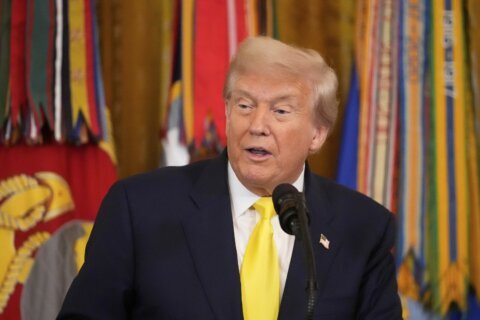
Last week, President Donald Trump warned he might “exert” his presidential powers to place the District under federal control.
And with his announcement of a press conference today on District matters, that has led to speculation that he is about to make good on that assertion.
Trump has previously suggested placing D.C. under the auspices of the federal government.
His latest push followed an Aug. 3 carjacking attempt involving Edward Coristine, a former employee of the Department of Government Efficiency, a Trump administration agency tasked with cutting federal spending.
Trump posted about the incident on Tuesday, appearing to share a photo of Coristine and claiming crime in the District was “totally out of control.” He warned that if the city’s local government “doesn’t get its act together, and quickly,” a federal takeover could follow.
“Nobody in D.C. is going to feel safer with Donald Trump in charge of the local police,” said District Shadow Senator Paul Strauss, adding that he believes what’s wrong with local law enforcement is the federal components.
“We have judicial vacancies at record highs,” Strauss said. “We have vacancies in the U.S. Attorneys Office because 60 career prosecutors who know the system, know the community, know the law were all fired by the incumbent’s predecessor.”
Trump has posted on social media that D.C. is “one of the most dangerous places in the world.”
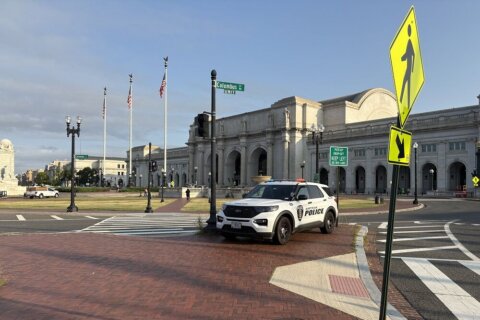
But, federal and local police crime statistics do not bear out that claim.
According to local police data, violent crime in D.C. has been falling for the past 18 months after a sharp rise in 2023. As of Aug. 6, robberies were down 29% and overall violent crime had dropped 26% this year.
The Justice Department reported in January that last year, the city recorded its lowest violent crime rate in more than three decades.
“D.C. has crime; it’s not a crisis,” said George Derek Musgrove, an associate professor of history at the University of Maryland, Baltimore County and co-author of the book “Chocolate City: A History of Race and Democracy in the Nation’s Capital.”
The president likely lacks the authority to fully federalize D.C., unless Congress overturns a 1973 law granting residents the right to elect their own mayor and city council.
He does have the power to temporarily assume control of the D.C. Metropolitan Police Department if he “determines that special conditions of an emergency nature exist,” requiring the department’s use for federal purposes. However, it’s unclear whether those legal criteria have been met.
“This is not a conflict between federal interests and the people of the District,” said Musgrove. “It’s a conflict between the whims and partisan sensibilities of the president.”
“I do think, though, that we should pull back in this moment and talk about whether or not it’s right,” he said referring to the framers of the D.C. home rule charter and their intent to give the residents of the District of Columbia the right of self-governance.”
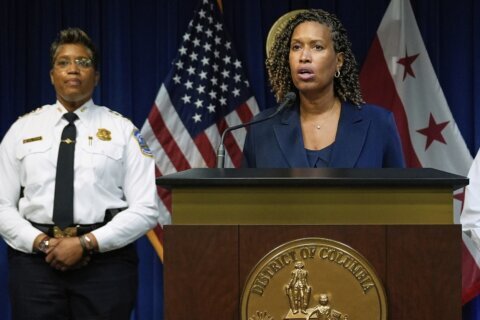
Speaking over the weekend, D.C. Mayor Muriel Bowser said she had no idea what the president’s announcement was going to be, and she has not spoken with him regarding his statements on a federal takeover of the city.
On MSNBC, the mayor defended how local officials have addressed crime, telling the cable network that police and their federal partners “have spent the last two years driving down violent crime in this city.” She acknowledged, however, that federal support is necessary, noting that D.C. prosecutors fall under the Justice Department and local judges are appointed by the president.
Get breaking news and daily headlines delivered to your email inbox by signing up here.
© 2025 WTOP. All Rights Reserved. This website is not intended for users located within the European Economic Area.