The Washington Commanders have presented what team President Mark Clouse calls an “aggressive” timeline for developing the RFK Stadium campus, if the D.C. Council approves the deal to bring the team to a new stadium at the site.
Inside the proposed agreement with the city, worth $3.7 billion, the team would take the lead in developing not only the stadium, but also the planned mixed-use development, which includes a hotel, retail, restaurants, public spaces and housing.
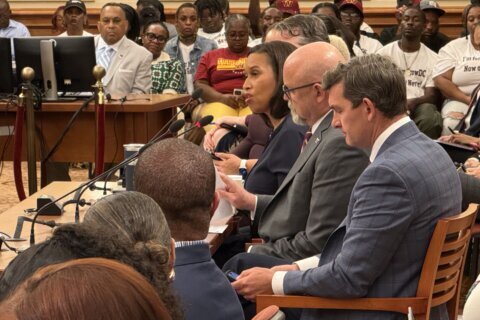
“You will see a commitment from us attached to legislation on a timeline of development that essentially will start in 2030 with meaningful progress and will continue over the next 10 years,” Clouse told the council Wednesday.
Clouse said the team hasn’t chosen a developer but intends to continue that process if the council’s first vote on Friday is successful.
He said the goal is to have some of the mixed-use development in place by the time the stadium opens in 2030.
“We’re anticipating having three of our first projects, including some housing, as part of that delivery,” Clouse said.
The deal calls for 6,000 housing units, and 30% of those must be labeled as affordable housing.
A proposed agreement provided after Wednesday’s hearing showed a square footage deadline schedule that the team and its developer must follow, otherwise the team could face a penalty of paying rent on the undeveloped mixed-use land.
The first deadline arrives at the end of 2030 and requires a completed development of 415,000 square feet. There are nine additional deadlines between then and 2040, with hundreds of thousands of additional square feet of development required at each one.
Clouse said the team is ready to meet the schedule and would begin the design phase in earnest and secure contracts for the projects as soon as this fall.
“This is a realistic timeline, albeit aggressive, but one we can achieve,” Clouse said.
On Wednesday, he received questions on whether the housing piece could happen faster. Clouse said certain other projects must be completed before the housing.
“One of the things that is extremely important in building these communities out is that we don’t do the housing in isolation of many of the services,” he said.
He said it’s important to make sure the services that the new community would need are in place before finishing the housing
“There are many examples of housing developments that are done rapidly that don’t contemplate the building of a grocery store, medical services or other support in the community,” Clouse said.
Andy VanHorn, head of real estate for the Washington Commanders, said it would also be difficult to lease all the mixed-use development at one time.
VanHorn said the current schedule would have construction on the final housing beginning in 2038.
Speaking to the stadium deal, D.C. Council member Charles Allen told WTOP that the deal still needed some alterations.
“From prioritizing Metro over parking lots, to guarantees that housing promises get delivered, to protecting the Anacostia River and smart sustainable development — there are several changes that need to be made to this deal,” Allen said in a statement, adding that the public could “expect to see amendments offered.”
Offering some insight on how the D.C. Council is currently leaning on the stadium deal, at-Large Council member Robert White earlier told WTOP that he intends to vote against the legislation, noting that “there are enough votes to turn it down.”
At least eight D.C. council members are needed to vote in favor of the deal in order for the proposal to move forward.
Get breaking news and daily headlines delivered to your email inbox by signing up here.
© 2025 WTOP. All Rights Reserved. This website is not intended for users located within the European Economic Area.