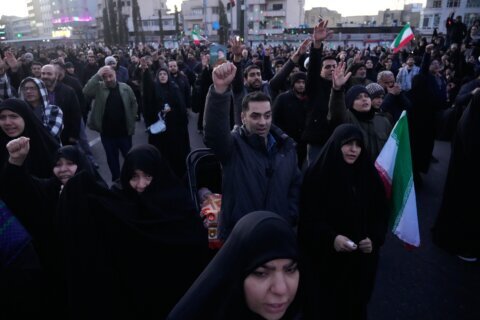
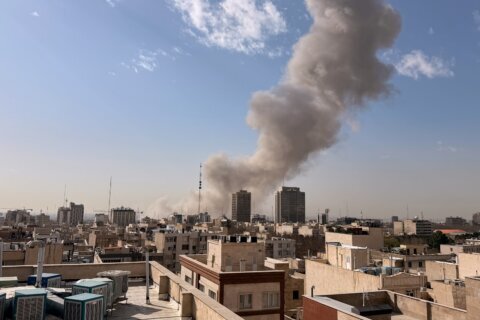
The combined U.S.-Israeli military action Saturday against Iran, that took out the country’s supreme leader and numerous other government officials, will almost certainly result in higher gasoline prices in the U.S. and other countries.
Gasoline prices were already going up because of seasonal increases, but those hikes will now be higher. Typically, prices begin to increase in late winter and early spring as oil companies and refineries shift to more expensive-to-produce summer blend gasoline.
Oil industry analyst Tom Kloza said his earlier forecast, without a war in Iran, was for at least a 5-cent-a-gallon increase in gasoline prices, but now we could see a much larger jump within days.
“We’re going to go higher. That’s pretty clear,” Kloza said. “I see it adds to the increases, and I think it also may mean it will stick around a little bit longer.”
Global oil prices sparked on Sunday as trading resumed and concerns grew about the potential for disruptions through the world’s energy supply chain.
According to data from CME group, the Chicago-based financial services and derivatives trading company said West Texas Intermediate crude, the light sweet oil produced in the U.S. was up 8% to $72 a barrel Sunday night after it closed Friday at $67 a barrel.
FactSet, the financial data company based in Norwalk, Connecticut, said Brent crude, the international oil standard, also jumped by 8% to $79 a barrel, up from its Friday close price of $72.87 a barrel. That price had been a seven-month high.
Kloza said oil traders believe oil supplies from Iran and other parts of the oil-rich Middle East could diminish or be halted temporarily, especially with the possibility of expanded military action in the critical Strait of Hormuz, the 21-mile-wide waterway between the Persian Gulf and Gulf of Oman. It is the only water passage from the Persian Gulf to the open ocean.
Prolonged attacks would likely result in higher prices for crude oil and gasoline, according to energy experts.
“The Strait of Hormuz is critical to shipping,” Kloza said. “I mean this really returns the notion of inflation to crude oil and refined products in the U.S. and in Europe.”
An estimated 15 million barrels of oil, or 20% of the world’s oil, is transported through the Strait of Hormuz, much of it to China, Japan, India and South Korea.
According to the Oslo, Norway independent energy group Rystad Energy, tankers traveling through the strait, which is bordered in the north by Iran, carry oil and gas from Saudi Arabia, Kuwait, Iraq, Qatar, Bahrain, the UAE and Iran. Iran exports 1.6 million barrels of oil a day, mostly to China.
Meanwhile, eight nations, which are part of the OPEC+ oil cartel, said they plan to boost oil production. The oil leaders had a scheduled meeting before the fighting began.
Production is expected to increase by more than 200,000 barrels per day beginning in April. That amount is more than what many analysts had been forecasting.
Saudi Arabia, Russia, Iraq, the United Arab Emirates, Kuwait, Kazakhstan, Algeria and Oman are also boosting output.
Get breaking news and daily headlines delivered to your email inbox by signing up here.
© 2026 WTOP. All Rights Reserved. This website is not intended for users located within the European Economic Area.