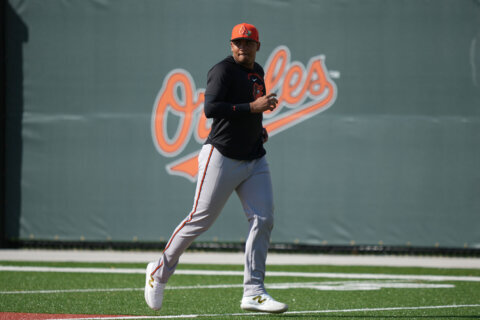
It was 30 years ago Friday that Baltimore Orioles legend Cal Ripken Jr. officially became MLB’s “Iron Man” by playing in his 2,131st consecutive game to surpass Lou Gehrig’s record.
During the iconic game, Ripken received a 22-minute standing ovation from the Baltimore crowd and swatted a home run on the way to a 4-2 Orioles win, cementing the night as one of the most special in the game’s storied history.
The Orioles will hold a ceremony Saturday in honor of Ripken’s record during their home game against the Dodgers.
Ripken joined WTOP’s Shawn Anderson and Anne Kramer to reflect on that night. Listen to the conversation or read the transcript below.
The following transcript has been lightly edited for clarity.
- Anne Kramer:
So take us back — 30 years! What is going through your mind right now?
- Cal Ripken Jr.:
That I’m older. I’m 35, that happened, now I’m 65.
No, in some ways, these memories just come flooding through you. I mean, Bobby Bo and Raffy pushing me down the line; me catching my dad’s eye up in the box one of the times that I came out for a curtain call; my kids throwing out the first pitch, showing them that I had a T-shirt on that they gave me — a lot of really cool things.
We played really well. I really enjoyed the fact that we weren’t just celebrating showing up and playing the game, it was still about winning the game and excellence in which you play. I played well, and we won. We won that series. So a lot to be proud of.
- Shawn Anderson:
To get to 2,131 games, and then the 500-plus, you kept going for the next three years after that. Obviously, it was a day-to-day thing. Now that you’ve had a chance to look back on it, on all this time, are you amazed at yourself? Can you give us some more perspective on just how incredible that was?
- Cal Ripken Jr.:
Well, I didn’t want to think about it when you’re doing it. Granted, now that you’re out of the game, and you’ve had time to sit down and analyze what happened and how it happened, it does seem a whole lot bigger accomplishment now than it did when I was doing it. That’s why I say that if I can do it, certainly someone else can.
It has to be a certain set of circumstances. It’s over a long period of time. There’s a little bit of luck involved in doing it, but there’s a lot of desire to play, and I think physically, the athlete probably can do it now. Mentally is probably the challenge of, when you get nicked up a little bit, can you still compete? Can you still play? Do you feel that you can give something to the team? And I always felt like I could.
And I laughed internally a lot of times, when some people think that I had total control over whether I played or the streak, and I was thinking, well, the managers created this thing called the streak. They kept writing my name in the lineup. I just kept performing. Granted, at some point, maybe it became too big for the manager, but certainly it was created by the managers wanting me to play.
- Anne Kramer:
Cal, I’ve always wondered this, so many of us were watching that night. We were there for the lead up. We were in the news business. Some of us, meaning myself, were in Baltimore. But I often think about, all these years later, 30 years later, what would you say to 35-year-old Cal then?
- Cal Ripken Jr.:
Maybe I would think about what my dad’s advice always was: You approach the game a certain way. You show up ready to play and that’s the best thing you can do for your team, is that they can count on you. You try to meet the challenge of the day, and then when all that’s over, you absorb whatever learning is from that, and you go on to the next day. So it is truly taking it one game at a time.
I remember dad saying, we can’t replay yesterday’s game. So take some education, probably some wisdom from what happened yesterday. And you can’t play tomorrow’s game until it gets here. So you might as well play this game today. And I think that single minded approach allowed the games to add up.
And after the record was broken, the 2,131 games, I didn’t want to change that approach. I thought it was the right approach, and so it just happened to go on another 500 games. So I thought you would bring more tribute to the authenticity of wanting to play every day if you just continue that same approach.
- Shawn Anderson:
Cal, I don’t know if you think of yourself this way, but you’ve become the modern day Joe DiMaggio now. I mean, when Joe DiMaggio was alive, he was considered the greatest player of all time. He was always introduced that way.
You are perhaps the most beloved figure in baseball. Talk about the connection between you and the fans and that love.
- Cal Ripken Jr.:
Oh, my God, that’s a complicated question. Joe D was at that game, 2,131, and I thought it was the coolest thing that there was a link between Lou Gehrig and me. I often wondered, if you ever had a chance to have a conversation with Lou, what would you ask him? And I was thinking, I’d want to know that he approached the game the same way I did, that it wasn’t about a streak.
I know there were a couple of times where he continued the streak by just playing an inning or doing something like that on an injury, but I think for the most part, he played the game because they wanted to be out there, and he was in the middle of the lineup, and the team counted on him to be there. And that’s how I think about it.
As far as the fame and all that kind of stuff, that drew a lot of attention, and I think a lot of fans relate to the concepts of persevering and getting yourself back up and showing up after things aren’t going so well. I’ve had a lot of people relate their streaks to me in their own lives, and I think that’s a really cool thing.
I always try to keep things in perspective. I always try to involve the fans in the game. Try to bridge the being in the stands to the field. And 2,131, after the strike, was an opportunity to kind of say, I’m sorry, I know the business side showed itself, but baseball is a great game. Let’s all get back together again. The popularity, I don’t know all those things. I just tried to do what I thought was right.
- Anne Kramer:
Cal, it is going to be a packed Camden Yards there where you made the magic happen 30 years ago. What’s going to be going through your mind? And tell us about who’s going to be there with you?
- Cal Ripken Jr.:
Rumor has it that Bobby Bo and Raffy are there, so I suspect, redo the lap without the lap, and a lot of people coming back for it. There’s some little surprises that the Orioles have in store to enhance the celebration. I’m looking forward to it.
I mean, it’s the Dodgers, and the Orioles have a nice, young team, and I’m looking forward to the actual game itself, and that creates its own environment, its own atmosphere. It’ll be a little bit like a playoff atmosphere, or a combination of playoffs and an opening day, and the festivities will be pretty cool. I think it’ll touch a few emotions that happened 30 years ago.
I know I’ve been thinking about my mom and dad a lot more lately, and so they always seem to come up when you reflect on the good things in your life. I’ve got to be prepared, in case the emotion comes over me, but I’m really looking forward to it. I’m not someone that really liked anniversaries or looking back when I move forward. But at this age, you kind of realize that you look back on them, and it’s not the moment itself, it’s the people that you did it with.
Get breaking news and daily headlines delivered to your email inbox by signing up here.
© 2025 WTOP. All Rights Reserved. This website is not intended for users located within the European Economic Area.