A newly unveiled Virginia State Historical Marker is just part of an ongoing effort to tell the story of a once-vibrant Alexandria community whose descendants proudly refer to it by the name it was given in the 1920s: “Colored Rosemont.”
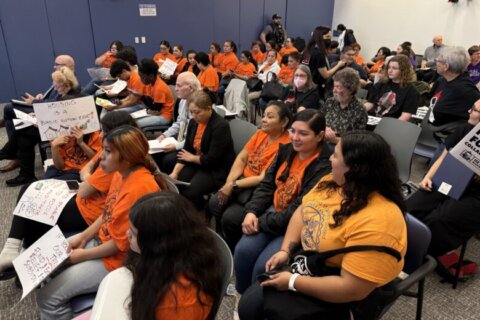
On Saturday, Alexandria City officials, community leaders, historians and the descendants of Colored Rosemont gathered near the intersection of Wythe and West Streets to celebrate the new marker and the history of the neighborhood that most people would know today as West Braddock.
Audrey P. Davis is the director of the Division of African American History for the Office of Historic Alexandria. Davis explains that Colored Rosemont evolved as a local white landowner, Virginia F.W. Thomas, sold off parcels of land to Black families, ignoring the restrictive covenants of the time that often barred those families from buying in certain neighborhoods.
“She was really an early advocate for these African American families and so she helped to create this neighborhood that we now call Colored Rosemont,” said Davis.
The white neighborhood was known simply as Rosemont and the two were divided by what is now the Braddock Road Metro station, said Davis, who has been researching the community history.
“What you hear are just wonderful family stories of holidays celebrated together with their neighbors, families who looked out for each other, who looked out for the children who were around,” Davis said. “It was a vibrant community, even though they were facing segregation and there were places they couldn’t go.”
Eminent domain impacted the community
The neighborhood splintered in the mid-20th century, said Davis, who noted that a vibrant and active community was broken up.
“It’s not something that the city is proud of, but these families were displaced by eminent domain so that public housing could go in.”
Davis said the Office of Historic Alexandria is now working with descendants to collect an oral history of the community.
“And really, it’s community history at its best. It’s letting the descendants help guide us in the interpretation, it’s not us forcing an interpretation on the families on what their community was,” she said.
The descendants of Colored Rosemont are also involved in more preservation efforts.
“Some of them have actually donated clothing and artifacts to the Black History Museum,” Davis said. “So we’re hoping one day that we can have an exhibit on Colored Rosemont and other neighborhoods in Alexandria where African American families were displaced.”
More information about the Colored Rosemont Community History Initiative can be found on the City of Alexandria’s website.
Get breaking news and daily headlines delivered to your email inbox by signing up here.
© 2025 WTOP. All Rights Reserved. This website is not intended for users located within the European Economic Area.