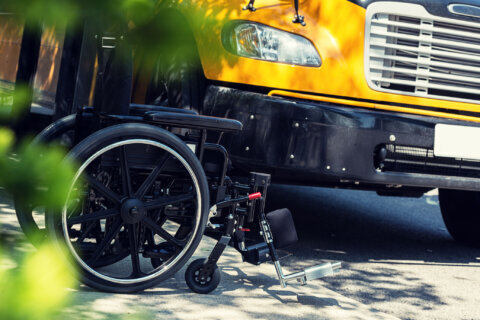
For over a decade, Elizabeth Daggett has had to wonder when, or if, a bus would arrive to take her son to school.
Sometimes, she wouldn’t know whether the bus would actually come in the morning. In other cases, she didn’t know when it would drop him off.
As a student who has autism, the inconsistent schedule is challenging, she said. He also has medications that must be taken at a specific time.
Daggett’s son, who attends St. Coletta of Greater Washington in Southeast D.C., is one of about 4,000 students who use city-organized school buses to get to class each day. The program is run through the Office of the State Superintendent of Education.
The service, she said, briefly improved after her family filed a lawsuit and was named as a plaintiff.
“But even then, it’s not perfect,” Daggett said.
A federal judge recently ruled that a class-action lawsuit seeking to overhaul the transportation system and address some of the issues Daggett has experienced can move forward.
“Parents of kids who are disabled or special needs are probably some of the most forgiving people, because they understand how life happens,” Daggett told WTOP. “But OSSE has failed us way too many times.”
The lawsuit aims to change how the bus routes are developed, and how drivers and aides are trained to work with students with disabilities, according to Kaitlin Banner, the deputy legal director at the Washington Lawyers’ Committee for Civil Rights and Urban Affairs.
In Daggett’s case, her son has to wear a harness whenever he’s in a car. Sometimes he couldn’t board the bus, because it didn’t have the necessary safety equipment.
“Everyone in D.C. should really be outraged at how little progress forward D.C. has made in helping some of our most vulnerable students do the most basic thing of getting to school to get an education that they are legally entitled to and which they … should be getting,” said Kathy Zeisel, director of special legal projects at Children’s Law Center.
Instead of fixing an individual student’s problem, the lawsuit hopes to create a system that’s effective and reliable for all students, Banner said.
Daggett hopes the process results in a system that creates a reliable way for parents to track the buses in real time.
“You can track your food delivery, but you can’t track your special needs child who is nonverbal and is strapped into a seat for safety reasons,” Daggett said.
When the buses don’t operate the way they’re supposed to, Daggett said kids “don’t get the education that they also deserve, just like every other neurotypical child out there.”
WTOP has contacted the Office of the State Superintendent of Education for comment on the lawsuit.
Get breaking news and daily headlines delivered to your email inbox by signing up here.
© 2026 WTOP. All Rights Reserved. This website is not intended for users located within the European Economic Area.