As the United States marks its 250th anniversary, WTOP presents “250 Years of America,” a multipart series examining the innovations, breakthroughs and pivotal moments that have shaped the nation since 1776.
AAR is proud to partner with WTOP to bring you this series.
If there is one name tied to the birth of the nation’s air traffic control system, it’s Archie League.
In the late 1920s, at what is now Lambert-St. Louis International Airport, League stood on the airfield directing planes with flags — red for stop, a checkered flag for go. In winter, he wore a padded suit to fight the cold.
By the early 1930s, a control tower had been built. League became the airport’s first radio-based controller.
He would go on to push for stronger aviation safety standards and later served in senior federal roles tied to what became the FAA. Today, the National Air Traffic Controllers Association names its highest honor after him — the Archie League Medal of Safety.
In aviation’s early years, safety systems were basic.
Airlines ran many of their own towers. Flights were tracked with paper strips. Controllers relied on pilot reports and rough calculations to keep planes apart.
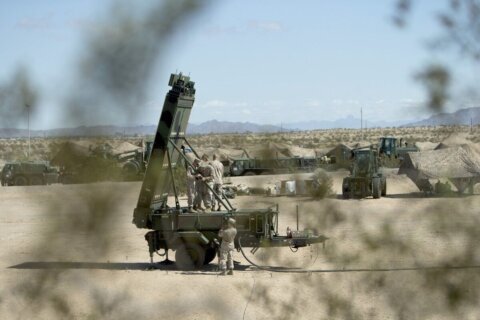
Radar, developed during World War II, didn’t become widely used for civilian air traffic until the 1950s.
Then came a disaster that changed everything.
On June 30, 1956, two airliners collided over the Grand Canyon, killing all 128 people on board.
Trans World Airlines Flight 2 and United Airlines Flight 718 had departed Los Angeles minutes apart — one headed to Chicago, the other to Kansas City. They were flying in uncontrolled airspace, where pilots were responsible for maintaining separation.
They never saw each other.
Both aircraft broke apart and fell into the canyon from about 21,000 feet.
The crash stunned the country and exposed serious gaps in the nation’s air traffic control system.
“The American public is shocked by this terrible tragedy,” then-Rep. Oren Harris, of Arkansas, said at the time. “We are ready to act to find out what caused it and prevent it from happening again.”
Stephen Creamer, president and CEO of the Air Traffic Control Association, said the moment forced a broader shift in how aviation was managed.
“The federal government expanded after the (Great) Depression and World War II to take on a larger role in developing industries,” Creamer said. “Aviation was part of that evolution.”
Within months, Congress boosted funding to modernize the system — hiring and training more controllers and installing radar, much of it adapted from military technology.
In 1958, Congress passed the Federal Aviation Act, creating a unified, federally-managed air traffic control system and establishing what became the Federal Aviation Administration.
“The techniques had been refined during World War II,” Creamer said. “That helped transition to a unified, national system and really drove the political momentum.”
It took years to fully build out. By 1973, the 48 contiguous states were connected by radar, with computers helping manage aircraft in the air and on the ground.
More than 50 years later, aviation leaders say the system is again under pressure.
After years of delays and incremental upgrades, a deadly midair collision on Jan. 29, 2025, over the Potomac River near Reagan National Airport — involving an American Airlines regional jet and an Army Black Hawk helicopter that killed 67 people — has renewed calls for a multibillion-dollar overhaul.
Creamer said history suggests tragedy can force progress.
“A good day is when nobody knows you’ve done the job,” he said. “Controllers go to work, solve the problem, and go home without making the news. That’s the goal.”
Get breaking news and daily headlines delivered to your email inbox by signing up here.
© 2026 WTOP. All Rights Reserved. This website is not intended for users located within the European Economic Area.