EVIAN-LES-BAINS, France (AP) — Leaders at the Group of Seven summit on Wednesday threw their support behind U.S. President Donald Trump’s tentative agreement with Iran to open the Strait of Hormuz and extend a shaky ceasefire.
Closing the three-day summit, French President Emmanuel Macron called it a “very good deal,” adding that U.S. allies in the G7 support it “because it’s an agreement that puts a stop to a situation of great instability that had terrible consequences for our economies.”
At his own press conference, Trump hailed the deal as “historic” and said other G7 leaders say “they love this deal because they want to see it over.”
U.S. officials meanwhile dictated the text of the deal to journalists, with details released after the summit ended.
The accord, due to be formally signed in Switzerland on Friday, lays out that the U.S. would work to end all U.S. and United Nations sanctions imposed on Tehran if a final agreement addressing Iran’s nuclear program is reached.
“I think it’ll be done. They want to sign. They want to get back to a normal life,” Trump said earlier Wednesday.
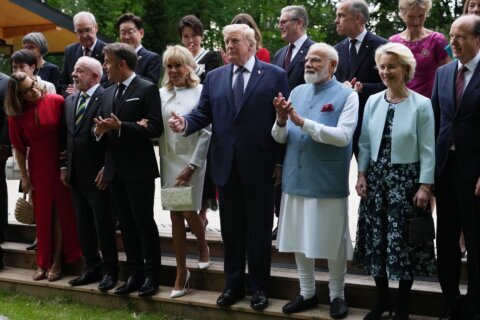
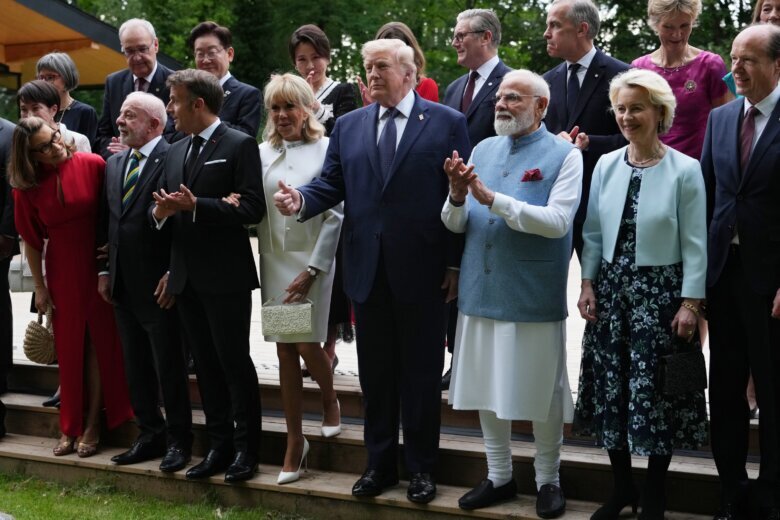
The final day of G7 talks at a lakeside resort in the French Alps started late with Trump, the last to arrive, saying “I’m the boss” as he entered and sat next to Macron. The assembled leaders laughed, and Trump grinned.
The formal talks of the leading industrial democracies closed with sessions on the future of artificial intelligence and fostering economic growth. They discussed concerns that China is flooding export markets with subsidized products, unfairly out-competing their own industries and destroying jobs. Leaders of India, South Korea, Kenya and Brazil joined the meeting.
Trump later attended a glitzy dinner at the Palace of Versailles outside Paris before he was scheduled to return to Washington. Before entering the palace, Trump complimented both Macron and his wife, Brigitte, whom the U.S. president greeted with a kiss on the cheek and called “amazing.”
Resuming traffic on the Strait of Hormuz is key
Trump still has to sell the deal to some members of his own Republican party who doubt it will defang Iran’s nuclear program. At the same time, he faces an anxious international community looking for him to follow through on his promise that the deal will reopen the Strait of Hormuz to oil tanker traffic and keep it open.
The G7 leaders said an international maritime mission led by France and the U.K. “can play an important role to facilitate the resumption of maritime traffic in the Strait of Hormuz by protecting merchant vessels, reassuring commercial shipping operators, and supporting verification that all mines are removed.”
Iran effectively closed the strait early in the war that began on Feb. 28 with U.S. and Isreali attacks.
The deal also calls for an immediate end to all fighting in Lebanon between Israel and the Iranian-backed militia Hezbollah. That is one of the most delicate parts of the agreement because Israel has maintained it will continue to defend itself and to occupy vast swaths of Lebanon.
The agreement that U.S. officials dictated to journalists on Wednesday also has provisions to ensure “territorial integrity” of Lebanon after Israel’s latest attacks against Hezbollah in Lebanese territory.
In their declaration, G7 leaders said they supported “through an immediate robust ceasefire” Lebanese efforts to disarm Hezbollah, and protect Lebanon’s territorial integrity and sovereignty.
Israeli strikes in Lebanon have killed nearly 4,000 people and displaced more than 1 million since fighting there began on March 2.
“Israel’s fighting Hezbollah too long, and too many people are being killed,” Trump said.
Leaders vow to support Ukraine, tackle global drug gangs
In a flurry of unanimously agreed declarations, the G7 leaders stressed their support for Ukraine as it battles Russia’s invasion and agreed to increase deliveries of air defense systems. They also said they would bolster sanctions on Moscow, including on Russia’s oil and gas industries.
Trump called the conversations on ending the war in Ukraine “productive” and said both Russian President Vladimir Putin and Ukrainian President Volodymyr Zelenskyy want to “do something.”
“They just don’t know how,” he said.
Leaders also pledged to step up the fight against the multibillion-dollar international drug trade.
Trump has been waging his own battle against drug traffickers. United States military strikes on alleged drug-carrying boats transiting in Latin America have killed more than 200 people since September, when the Trump administration began an operation it has justified as necessary to stem the flow of drugs.
Critics have questioned the legality of the strikes.
In a separate declaration, the G7 leaders reaffirmed their efforts to halt migrant smuggling and human trafficking, which they said “constitute serious transnational crimes that erode the sovereign right of States to control their borders and expose smuggled and trafficked persons to life-threatening risks.”
Trump calls Modi ‘most beautiful-looking man’
Trump said Wednesday after meeting with Indian Prime Minister Narendra Modi that the U.S. is “very close” to reaching a trade deal with India, and then went on to lavish praise on Modi as “a very tough negotiator.”
“He’s the most beautiful-looking man. He looks so nice. He’s like an angel. But actually, he’s as tough as he’s a killer,” Trump said.
The meeting with Modi came at a choppy moment in the U.S.-India relationship, in part because of the war in the Middle East. On June 10 three Indian sailors were killed in a U.S. military strike on a tanker in the Gulf of Oman in the midst of the U.S. blockade of Iranian ports.
Modi alluded to the incident at their meeting, saying the safety of Indian mariners “is of utmost importance to us.” He added he was “confident” the issue of seafarers” will be a top priority during implementation of the agreement between the United States and Iran.
___
Superville reported from Geneva. AP writers John Leicester in Evian-les-Bains, Jamey Keaten in Geneva, Mike Corder in The Hague, Netherlands, and Seung Min Kim and Collin Binkley in Washington contributed reporting.
Copyright © 2026 The Associated Press. All rights reserved. This material may not be published, broadcast, written or redistributed.