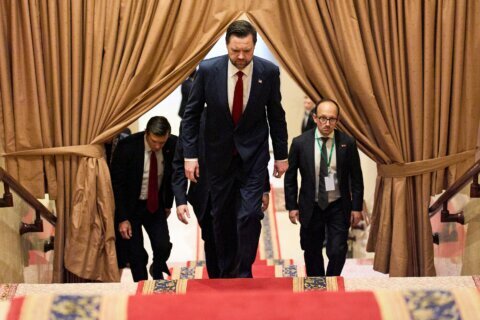
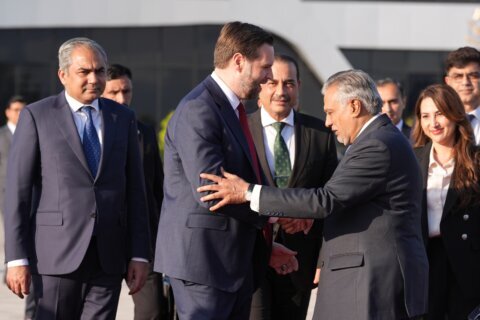
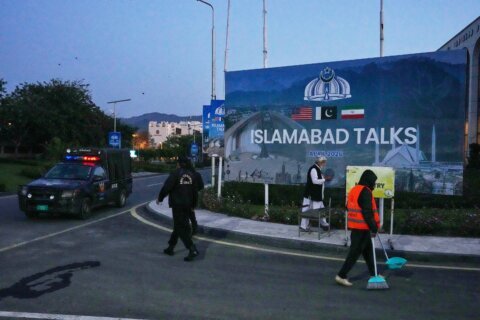
Talks in Pakistan between American and Iranian representatives ended without an agreement after 21 hours of negotiations, leaving a two-week ceasefire in doubt.
Vice President JD Vance, who led the U.S. delegation in Islamabad, said talks came to a close after Iranian counterparts refused to agree to terms that stipulated Iran would cease its nuclear development efforts.
After the talks, Iranian ambassador to Pakistan, issued a statement saying the talks were not a one-off event, but the beginning of a “process.”
Not long after news broke of the stalemate, President Donald Trump announced the U.S. Navy would stop any vessel that attempts to enter or leave the Strait of Hormuz.
WTOP National Security correspondent J.J. Green joined Sandy Kozel to discuss the latest development, and what it could mean for future negotiations.
The interview was lightly edited for clarity.
- Sandy Kozel:
Is this a surprise that the sides could not reach an agreement?
- J.J. Green:
This outcome was always very likely. Trust is what the Iranians say was the reason. And when you think back to the last two times they’ve been negotiating with the U.S., the U.S. launched attacks on them and the U.S. saying, essentially, Iran has to agree with what the U.S. wants Iran to do.
So, both sides not being able to find any common ground is no surprise at all in this situation. Those positions were never reconciled and what we saw over the past few days was not convergence. It was just managed tension. Once deadlines and pressure tactics entered this equation, the talks were vulnerable to collapse, which is what we’ve seen.
- Sandy Kozel:
Talk about President Trump’s threat now to put control of the Strait of Hormuz in the hands of the U.S. Navy. Does this just invite conflict with the Iranian vessels there, if there are any left that haven’t been bombed into the water?
- J.J. Green:
Well, this is a real risk, because it’s important to define what a blockade actually means here. The Strait of Hormuz is not something Iran can easily shut down in the traditional sense.
The U.S. Navy and allied forces have overwhelming conventional superiority. A sustained total blockade where no ships can get through is unlikely to hold. But, that’s not how Iran operates.
This would be a disruption campaign, not a classic blockade. Iran’s strategy is asymmetric. It doesn’t need to close the Strait completely. It just needs to make it dangerous enough that global shipping hesitates, and that can include fast attack boats harassing tankers, naval mines being placed in key transit lanes, anti-ship missiles off the coastline, drone surveillance.
That’s just a few of the things that they can do to highlight the risk that the U.S. can do this, but it’s going to be a big lift, and it’s going to be a big gamble.
- Sandy Kozel:
Is it possible to predict the next steps in any negotiations?
- J.J. Green:
Yeah, you can predict it, but based on what we’ve seen, there’s no guarantee that that prediction is going to be correct.
But, I can say that there’re probably — from the people I’ve spoken to — three possible scenarios. This course, if pause continues, backchannel talks resume quietly, through intermediaries, and public rhetoric stays hostile, but both sides test the off ramps.
Number two, there is an escalation cycle — limited strikes, maritime incidents or proxy activities might increase the pressure. This is the most immediate risk window.
And the third thing, I suppose, is forced diplomacy under pressure. If economic or military pressure mounts fast enough, both sides could return to the table, but from more rigid and hardened positions.
Where we are right now, unless there is some dramatic shift or something happens to create a dramatic departure from the two sides’ views, we’re stuck in this situation.
Get breaking news and daily headlines delivered to your email inbox by signing up here.
© 2026 WTOP. All Rights Reserved. This website is not intended for users located within the European Economic Area.