The year’s best meteor shower will send streaks across the Saturday night and early Sunday morning sky. The Geminids meteor shower has proven to reliably produce around 120 meteors per hour in a dark sky, and many of them are bright.
Plus the Geminids is the only major meteor shower where you can see a good number of meteors starting at 10 p.m., instead of the hours just before dawn.
This year, the moon will not interfere with the Geminids, but the weather most definitely will. Our forecast for the Geminids’ peak includes cloudy skies, snow and bitter cold temps.
The good news is that Friday night into early Saturday morning, and Sunday night into early Monday morning, our skies should be mostly clear and there should be Geminids meteors visible.
For those planning on viewing the shower, it’s imperative to prepare for frigid, single-digit wind chill temperatures. (I plan on bundling up in layers and viewing the sky in a lounge chair while wrapped up in a sleeping bag.)
You do not need any equipment or know-how to enjoy the show. Just find a place where you can put a lounge chair or blanket down to see the sky.
If you are in a location where it is going to be clear on the night of the peak, or are planning on the night before or after, start at 10 p.m., looking to the east for the constellation Gemini, for which this meteor shower is named.
The bright planet Jupiter will act as your guide, as it is near the radiant — the point from which the Geminids appear to come from in the sky. A meteor that is part of the shower can be traced back to Gemini. Sporadic meteors that are not part of the shower can be seen during the night as well.
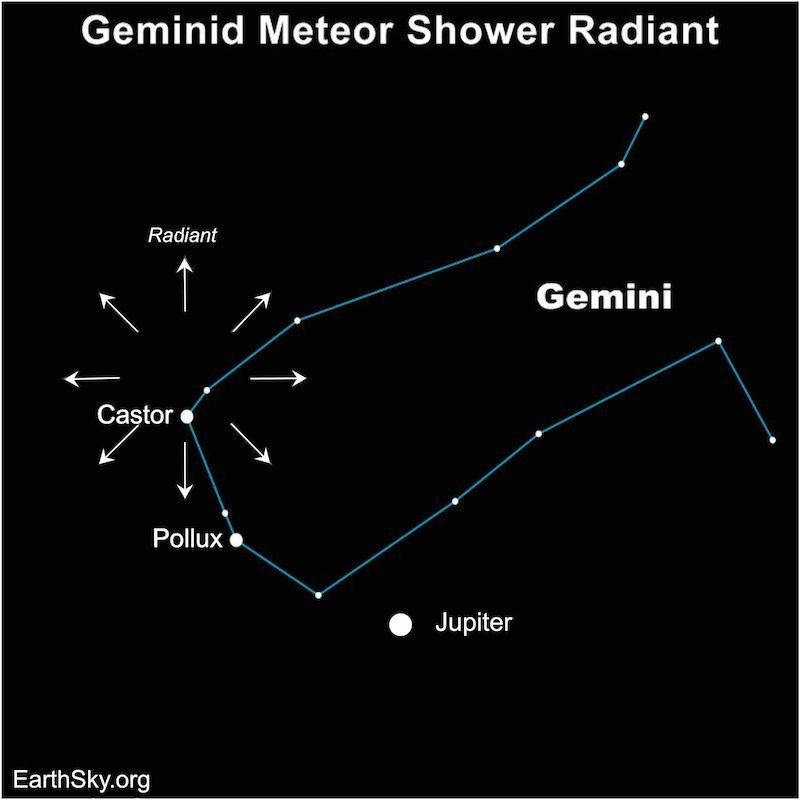
The predicted peak of the 2025 Geminids meteor shower is Saturday night into Sunday morning, but you can see Geminids from Nov. 19 to Dec. 24.
Each year at this time, our planet encounters a debris stream of rock particles made by asteroid 3200 Phaethon. The Geminids is the only meteor shower caused by an asteroid, or what astronomers call a rock or extinct comet; all others are due to cometary debris.
As Earth moves in its orbit around the sun, it collides with this rocky debris stream and the particles hit our atmosphere at 22 miles per second to become “shooting or falling stars.” It is thought that the Geminids are brighter than other meteor showers because they involve larger and heavier debris than normal cometary dust and penetrate deeper into the atmosphere.
The best place to see the Geminids is a location away from lights and obstructions, such as trees and buildings. If you are a city dweller, you still may see the brightest Geminids, as long as you are not staring into a street light or nestled among tall buildings.
The view of the Geminids is worth it from the suburbs as long as lights and obstructions are minimized. Out in the country or along the beach is the best place to be.
The shower will continue all night until about 4 a.m. The crescent waning moon will be in the sky to add to the view. The key to watching the shower is being comfortable and, most importantly, warm.
The Geminids can appear anywhere in the sky, but looking straight up gives you the widest viewing area — this is where the lounge chair or blanket comes in handy.
You can photograph the Geminids, but you need to check the users manual for your camera and lenses to see if there are cold temperature limits, which your equipment will definitely be subjected to.
If you want to observe the Geminids in the comfort of being indoors, I have the solution for you. As I am writing this, I am listening to “LiveMeteors.com” and hearing the delightful “pings” of meteors.
As explained by the website:
“When a meteor enters the Earth’s upper atmosphere it excites the air molecules, producing a streak of light and leaving a trail of ionization (an elongated paraboloid) behind it tens of kilometers long. This ionized trail may persist for less than 1 second up to several minutes, occasionally. Occurring at heights of about 85 to 105 km (50-65 miles), this trail is capable of reflecting radio waves from transmitters located on the ground, similar to light reflecting from a mirrored surface. Meteor radio wave reflections are also called meteor echoes, or pings. The meteor detector at LIVEMETEORS.com is located in the DC Metropolitan area and is currently pointing its Yagi antenna at a TV tower in Canada.”
However you chose to do so, enjoy the Geminids show and our other sky delights this December.
Still shopping for your stargazer? Check out our tips for doing so.
Oh, one last thing. I will reveal my top space story for 2025 on New Year’s Eve. What do you think it will be?
Follow my daily blog to keep up with the latest news in astronomy and space exploration. You can email me at skyguyinva@gmail.com.
Get breaking news and daily headlines delivered to your email inbox by signing up here.
© 2025 WTOP. All Rights Reserved. This website is not intended for users located within the European Economic Area.