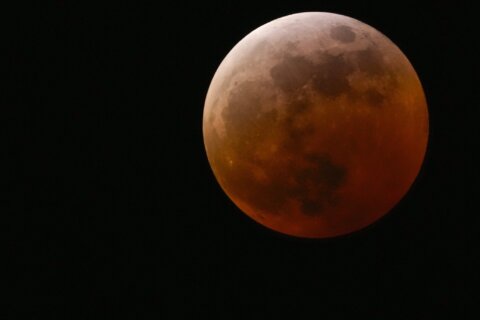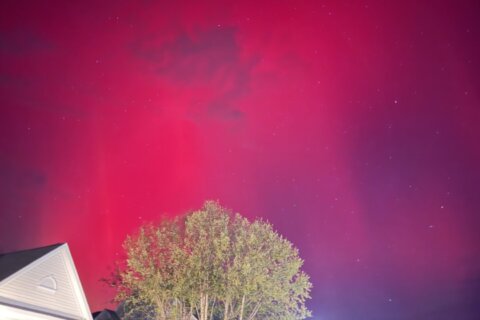
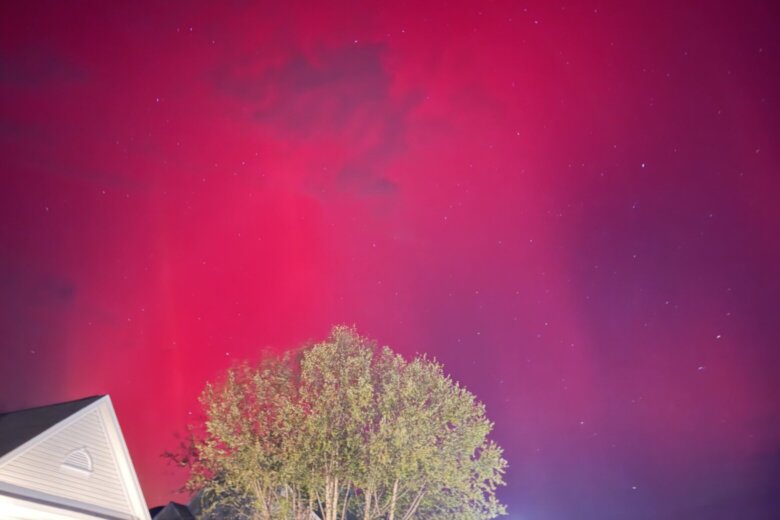
If December night skies weren’t already putting on a show with a meteor shower and a supermoon — just to name some — northern lights could possibly grace the D.C. region just after midnight toward dawn Tuesday.
On Sunday, the National Oceanic and Atmospheric Administration Space Weather Prediction Center issued a forecast for a strong (G3) geomagnetic storm for Tuesday.
This event will not be like what the D.C. region experienced in November, when aurora borealis was visible for several nights.
This forecast G3 geomagnetic storm was caused by a coronal mass ejection, or CME, which in turn was caused by a strong solar flare.
The possible aurora sighting, if the lights do indeed appear, would not reach the level of the historic aurora event that took place on May 10, 2024, but if you want to catch a glimpse, then turn your eyes and your camera to the northern skies just in case.
With clearing skies in the D.C. region, the possible lights would be to the north for the next two days.
As I write this at noon Monday, the NOAA forecast indicates the best time to look for aurora is between 1 a.m. and 6 a.m. Tuesday.
If the SWPC forecast holds, aurora conditions for the D.C. region may be strong enough to detect aurora visually and with cameras.
You might be able to visually detect some color in the sky if bright aurora are present, but they will likely be low on the northern horizon. Even if it is partly cloudy, aurora, if present, can be detected in the gaps.
Your camera and/or smartphone significantly improves your chances of detecting and imaging the aurora due to their digital sensors. Even if you do not see aurora, image the northern horizon to possibly get an image of them.
Use a camera or smartphone that can take exposures of several seconds — including using “Night Sky” or “Low Light” settings if your camera has them — of the northern horizon. Steady the camera or use a tripod for best image results. The camera likely will capture aurora that your eyes did not.
Our best bet is to monitor Clear Sky Chart (input your location) for sky conditions and space-related sites, such as EarthSky.org and NOAA’s Space Weather Prediction Center, for aurora viewing updates. There are aurora apps available as well to help you.
On NOAA’s aurora forecast webpage, you will see times listed as UT, so you need to convert them to your time zone.
With our terrestrial weather being such a factor in our daily lives in the D.C. area, and frankly, the rest of the world, we are also directly affected by space weather, which can produce a variety of events, including geomagnetic storms and aurora.
Besides the Space Weather Prediction Center, I check spaceweather.com every day, just as I do my local weather, as it has a daily snapshot of what the space weather in the solar system is going to be like and a current image of the sun.
Space weather, like our terrestrial weather, is caused by Earth’s interaction the sun. We know it will be there every new day and count on it for life-giving warmth and energy. We also have become accustomed to it being well behaved.
What many people may not know is that our sun undergoes an 11-year solar cycle that can affect space weather throughout our solar system.
The sun is a 4.5 billion-year-old star that we have been monitoring since the time of Galileo.
The sun had an episode of disturbed behavior in 1859 that, if it were to occur today, could adversely affect us if we were not prepared.
On Sept. 1, 1859, the sun experienced a solar storm episode that was observed by solar astronomer Richard Carrington that ended up bearing his name — the Carrington Event. This was a watershed event in solar astronomy and also the sun’s effect on Earth, as nothing like it has been seen since — thankfully.
If a Carrington-level solar event were to happen today, the effect on modern society’s infrastructure (especially the electrical grid, which powers nearly everything) could be potentially catastrophic. If you think this is unlikely or too sci-fi to be true, I suggest you read the report by the National Academies of Science published in 2008.
Good luck, aurora chasers.
Follow my daily blog to keep up with the latest news in astronomy and space exploration. You can email me at skyguyinva@gmail.com.
Get breaking news and daily headlines delivered to your email inbox by signing up here.
© 2025 WTOP. All Rights Reserved. This website is not intended for users located within the European Economic Area.