“What’s up in the sky?” is a recurring feature and publishes on the first of every month. You can find it on WTOP’s The Space Place. Email Greg your space questions and he might answer them in the next edition.
Welcome to WTOP’s monthly feature: “What’s up in the sky?” Each month it features the best the sky has to offer stargazers regarding the moon, planets and stars. Space-related events that might interest you taking place in the D.C. area are included as well.
Let’s get to the sky for August 2025!
Must-see sky sights for August
During August 2025, Venus continues to be the “Morning Star” in the east before dawn, albeit it has become dimmer — but still bright — as it moves away from Earth.
Jupiter will be visible in the east well before dawn to the lower left of Venus, and the two bright planets will move closer together each morning. By Aug. 12, when the annual Perseid meteor shower peaks, both Venus and Jupiter will be less than a degree apart.
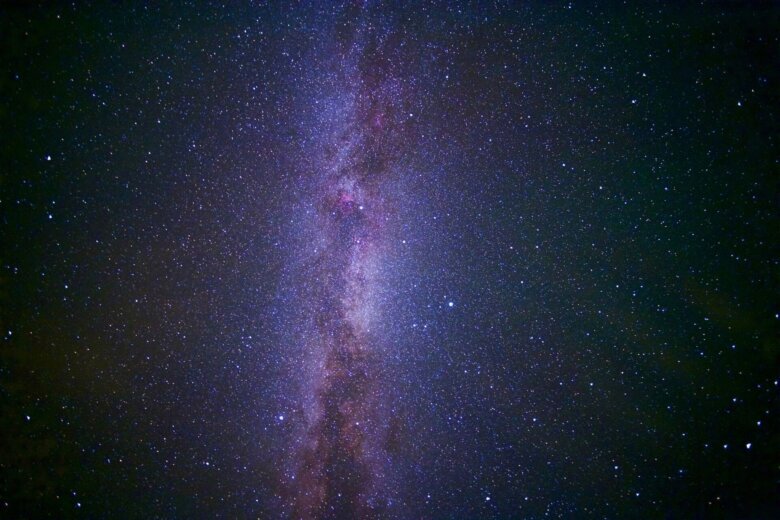
August will mark Milky Way month in the Northern Hemisphere. The moon has some close pairings with stars and planets and will actually occult, or cover, some stars.
Star of the month: Altair
In August, in the eastern sky, Altair, the 12th brightest star in the sky, easily catches our eyes and attention. It is in the Aquila constellation, and forms part of the “Summer Triangle,” an asterism proven to be a summer night favorite.
Highlights of the month
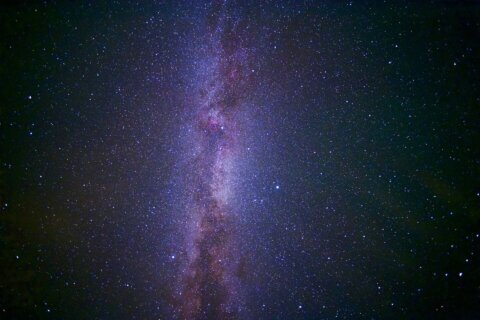
As we go through August, each night in the south after it gets dark, our galaxy, the Milky Way, is absolutely resplendent and sprawling as it flows across the sky to the northeast. You need a dark sky site to see the Milky Way at its best.
As August begins, the Milky Way is well up in the sky — look for the “Summer Triangle.” As the night heads into the hours before dawn, the “summer Milky Way” in the west meets the much fainter “winter Milky Way” in the east and forms a magnificent arc across the whole sky.
You can capture the Milky Way with a smartphone and/or camera by taking time exposures. For best results, use a tripod.
Aug. 2: The star Spica and the one-day past first quarter moon form a nice conjunction in the southwest as it gets dark.
Aug. 3: The red supergiant star Antares and the waxing gibbous moon rise very close together in the southeast after dark.
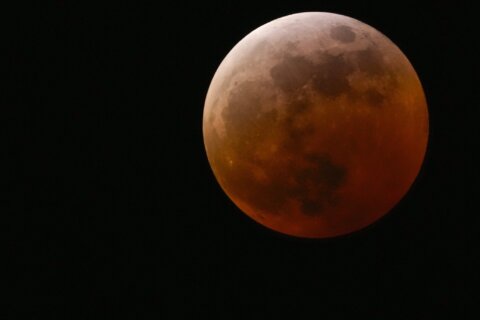
Aug. 9: The full sturgeon moon rises at sunset in the southeast. The moon will likely display some lovely yellow-orange color as humidity is more prevalent this time of year. Definitely a smartphone or camera possibility.
Aug. 11: In the east, Saturn and the waning gibbous moon form a close conjunction with each other and the planet Neptune — you need a telescope to see Neptune.
Aug. 11-12: On both nights, the Perseid meteor shower will be best seen from 11 p.m. local time toward dawn. The 12th is the expected peak date when most Perseids are predicted to occur. The moon will be bright so try to view the sky away from the moon.
Aug. 12: While up for the Perseids, see the spellbinding encounter of Venus and Jupiter in the east before dawn. Get out your smartphone or camera for this one.
Aug. 16: Once again, the moon — at last quarter phase — is keeping company with the Pleiades star cluster in the hours before dawn in the east.
Aug. 19: The waning crescent moon is in the east-northeast before dawn, keeping beautiful and bright Venus and Jupiter company, all in the lovely constellation of Gemini the Twins. Look for earthshine on the moon. Try taking a smartphone or camera picture.
Aug. 20: We get a nice repeat of the 19th with the same players but in different positions in the sky. Try taking a smartphone or camera picture and compare to the one you (hopefully) took on the 19th.
Aug. 21: The waning and very slim crescent moon will be to the upper left of Mercury in the east-southeast before dawn, both below and to the left of Venus. Binoculars will help the view. Look for earthshine on the moon.
Aug. 26: The waxing crescent moon in the west at dusk joins Spica and Mars in a nice celestial triangle. You need to look as soon as twilight fades. Look for earthshine on the moon.
Aug. 27: Another “skypeat” as the waxing crescent moon is in the west at dusk and close to Spica with nearby Mars. Look again for earthshine on the moon.
The moon
Aug. 1: First quarter
Aug. 9: Full moon
Aug. 16: Last quarter
Aug. 23: New moon
Aug. 31: First quarter
Planets
On Aug. 15, Mercury is to the lower left of Venus and Jupiter and half a vertical fist-width above the eastern horizon before dawn. The next several days will be the best time to see the elusive “winged messenger,” as it will start getting lost in the sun’s glare.
Venus has dimmed to about half its brightness compared to the last few months but is still very bright above the eastern horizon before dawn — you can’t miss it, especially with Jupiter closing in.
Mars will be low in the western sky as it gets dark, and will be getting closer to the glare of the sun at month’s end.
Jupiter is well up in the east before dawn by mid-month and is in the company of Venus all month.
Saturn is in the eastern sky after dark. A great view in a telescope, as the rings cast a thin line across the planet.
Uranus is emerging in the eastern sky after being in the sun’s glare.
Neptune is in the eastern sky rising around midnight and near Saturn. You need a telescope to observe the planet.
Pluto is way out there in the solar system and requires taking images through a telescope spaced days apart to hunt it down.
DC-area events
Smithsonian National Air and Space Museum
- There are some exciting new additions to the Smithsonian National Air and Space Museum, including five new galleries and a renovated theater. Check out WTOP’s full story on what’s new and how to visit.
Shenandoah National Park
- Shenandoah National Park’s Big Meadows is an excellent dark sky site and there are a variety of activities for you to enjoy throughout the park. I will be conducting my “Let’s Talk About Space” events, so hope to see you there. If you visit the park be sure to check out the ranger’s schedule as they host astronomy events as well.
- NOVAC General Meeting, George Mason University. Check the calendar for the date and other August astronomy events.
- National Capital Astronomers
- The Analemma Society is pausing operations and work with Fairfax County Park Authority regarding Friday night public viewing sessions at Turner Farm in Great Falls, Virginia, temporarily. Check their calendar for other astronomy activities in August.
Smithsonian Air and Space in D.C. and Chantilly has loads of astronomy stuff in August.
You can also check here and here for astronomy clubs that are outside the D.C. area.
Bonus!
Download NASA’s 2025 Science Calendar that features out-of-this-world pictures and information.
The Planetary Society’s Space Events 2025 Calendar is another resource for tracking space missions.
Use this useful tool to create a custom star chart for your location to help you find your way around the stars.
You can also send in any space related questions to my email address. Suggestions about this feature are also welcome.
Follow Greg Redfern on Facebook, Bluesky and his daily blog to keep up with the latest news in astronomy and space exploration.
Get breaking news and daily headlines delivered to your email inbox by signing up here.
© 2025 WTOP. All Rights Reserved. This website is not intended for users located within the European Economic Area.