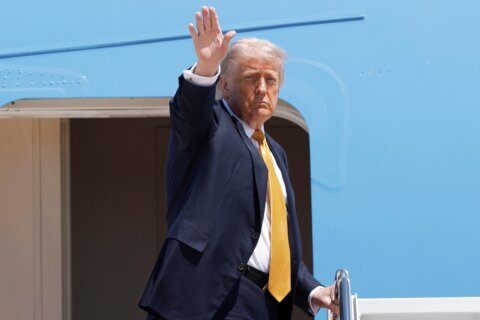
NEW YORK — Donald J. Trump was projected to become the 45th president of the United States on Wednesday in a stunning upset of Hillary Rodham Clinton, the first major party female nominee for the White House, who polls showed as the clear favorite heading into Election Day.
Trump’s historic and shocking victory is the culmination of an exhausting, astonishing and at times, depressing 19-month campaign that often centered around the least desirable aspects of two polarizing candidates that were each viewed unfavorably by a majority of Americans.
At the same time, the 2016 election result will be remembered as a transformative moment in American politics: Trump is the first person in the country’s 240-year history to have ascended to the presidency without having prior elected or military service. And he was the underdog throughout the entire general election campaign, never attaining a lead in a national polling average and counted out by Washington pundits, political prognosticators and a spate of Republican politicians and strategists.
He proved them all wrong, sweeping away a cluster of battleground states that have served as Democratic bulwarks during the past two presidential elections of Barack Obama and preventing Clinton’s lifelong ambition of shattering the ultimate glass ceiling in American life.
“I just received a call from Secretary Clinton,” Trump told a crowd in midtown Manhattan about a quarter to 3 a.m. Eastern Time on Wednesday. “She congratulated us — it’s about us — on our victory. And I congratulated her and her family on a very, very hard fought campaign.”
Just moments before that, networks called Pennsylvania for Trump, placing him over the 270 electoral votes needed to attain the presidency.
Trump won Ohio, Florida and North Carolina — three states he had to carry to have a chance — and then added to that tally a pair of states that have eluded Republicans for decades: Wisconsin and Pennsylvania.
The 70-year-old Trump, a Queens, New York, native, built his controversial media-driven brand around glitzy real estate deals and a popular celebrity reality television show.
He had little prior political experience and was an erratic, undisciplined and often self-immolating candidate. This is also what made him a singularly captivating figure, attracting massive crowds and often tossing aside a stage-managed script for the impulsive, humorous riff. A charismatic billionaire, the irony is that he appealed directly to members of the often-overlooked white, disenchanted working class, who were fed up with career politicians and systems — political, governmental, financial, media — that they saw as increasingly stacked against them, or as he would put it, were “rigged.”
Many of Trump’s supporters fully understood he was a flawed candidate who harbored unrealistic ideas and blurted out cringe-worthy statements. But they looked past those warts because they saw him as a powerful vessel for their anger and a unique figure willing to take great risks to disrupt accepted political norms.
Trump’s election amounts to a dramatic realignment not only within the Republican Party but in national politics. For Trump’s feat is not an ideological victory for conservatism — he failed to win the support of the last Republican nominee and last Republican president. It is, rather, a seminal cultural movement driven by geographic, ethnic and economic fault lines.
It also cannot be read as anything other than a staggering repudiation of Clinton.
Whereas Trump’s ascendance through a crowded and accomplished Republican primary field jolted the party, Clinton’s re-emergence as a White House candidate following her 2008 loss to Barack Obama was always expected.
While she outraised Trump and assembled a larger, more sophisticated campaign operation, she lacked a natural charisma and an ability to connect with voters on a personal level, even after all her years as a public servant. She was dogged by a messy, sustained controversy over her use of a private email server as the country’s chief diplomat and stung by a foreign hacking of her campaign chairman’s private email account. At some points, she seemed jarringly out of touch, like when she dubbed a group of Trump enthusiasts “a basket full of deplorables.”
Throughout, she was saddled with pervasive fears among Americans that she’s untrustworthy. Trump poured gasoline on those simmering political embers, by battering her incessantly as secretive and corrupt, labeling her with the catchy nickname, “Crooked Hillary.” A late October surprise reopening of the inquiry into Clinton’s email practices will also be cited by Democrats as a reason her candidacy lost steam. Because of all this, the election result — a undoubtedly narrow one — will be seen almost as much a rejection of Clinton as it is an affirmation of Trump.
Much of Clinton’s campaign strategy was to disqualify Trump in the eyes of voters. She repeatedly portrayed him as as unfit for the Oval Office and as lacking the level-headed temperament to preside over the nuclear codes. But her message was devoid of the magnetism that motivated the diverse Obama coalition over the past two elections. “Stronger Together” was an attempt at a united front against Trump, but it turned out to be insufficient to the “Hope and Change” that produced two terms for Obama.
At Clinton’s election night party at the Javits Center — under a literal and symbolic glass ceiling — the night started out with a near-giddiness that after a long, arduous struggle, Clinton would finally attain the prize of becoming the first female to achieve the presidency. But as the results started to pour in, the mood turned puzzling and then downright dour as revelers considered what they had thought was impossible — a Trump victory.
Then came the calls, the first one being Ohio, which the networks projected for Trump just before 10:30 p.m. Eastern Time. A half-hour later, both North Carolina and Florida fell to Trump.
At that point, inside the New York Hilton in midtown Manhattan at Trump’s election night party, cheers burst out of “President Trump! President Trump!”
But it was the calls by Fox News of Wisconsin and Iowa for Trump near the 11:30 p.m. Eastern Time hour that shook the room. His path to 270 electoral votes suddenly looked almost inevitable.
Back inside the Javits Center, word emerged that Clinton would not appear in person.
Instead, her campaign chairman, John Podesta, took the stage in an attempt to delay any decision on a concession until later in the day.
“It’s been a long night and it’s been a long campaign. But I can say, we waited a long time, we can wait a little longer, can’t we? They’re still counting votes and every vote should count,” Podesta said.
But with Clinton trailing in both Pennsylvania and Michigan, remarkably, it was she who faced an almost insurmountable numerical hurdle in the Electoral College.
At Trump’s headquarters, supporters donning “Make America Great Again” caps chanted at the Fox News broadcast on large overhanging screens to “Call it! Call it!”
And moments after Trump entered the Hilton, but minutes before he took the stage, the network did. Pandemonium erupted as first Gov. Mike Pence of Indiana took the stage, followed by Trump, who gave a gracious and tempered speech.
“Ours was not a campaign,” he said, his voice noticeably hoarse from a long night and grueling year-and-a-half endeavor, “but rather an incredible and great movement.”
More from U.S. News
Hillary Clinton Focuses on Healing, Trump on Emails in Final Hours
Donald Trump Wins Battleground North Carolina
3 Financial Lessons to Learn From Donald Trump’s Victory
Donald Trump Wins Presidency in Jolting Upset of Hillary Clinton originally appeared on usnews.com