Charlton Heston's famous line in "Soylent Green" is also the plot twist in this provocative social commentary.
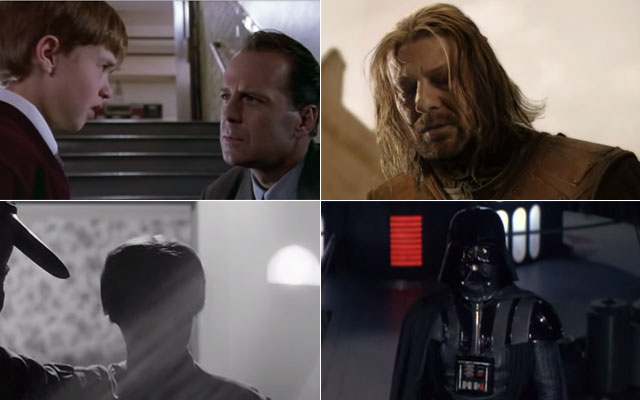
As if offing the main character in a shower stabbing wasn't enough, Alfred Hitchcock had another stunning secret up his sleeve for the climax of "Psycho," involving the ultimate momma's boy Norman Bates. Hitch went to great lengths to keep his twist a secret, buying up all the copies of the source novel, holding fake casting sessions and locking the theater doors once each screening started. "It was the original 'Sixth Sense," Steven Spielberg tells the AFI, and for that reason, Hitchcock edges out Shyamalan for the No. 1 spot.
Many movies yank the rug out from viewers' feet, but rarely do the twists hold up on repeat viewings. M. Night Shyamalan did it pitch perfect in "The Sixth Sense," rocking the movie world with Bruce Willis and Haley Joel Osment. Unfortunately, Shyamalan repeatedly tried to outdo himself, twisting his movies into knots from "Signs" to "The Village" to "The Happening." Still, for one shining moment, he told one of cinema's greatest ghost stories, and no one can take that away from him.
"Vertigo" is proof that you need to see movies more than once. Not until you know its secrets can you understand the genius foreshadowing that Alfred Hitchcock unfolds in his framing, color palette, character blocking and symbolic imagery. It's a cocktail of lost love and tragic fate that moved international critics to vote "Vertigo" the Greatest Film of All Time.
Tim Robbins' Andy Dufresne transformed Shawshank Prison by routinely defying his captors in classic "Cool Hand Luke" and "Cuckoo's Nest" fashion. Little did we know it was all building to a final act of magic that would make "The Shawshank Redemption" the top voted movie on IMDB. Expect this one to keep rising best lists, so long as its many fans keep up the pressure over time. As Morgan Freeman said, "That's all it takes sometimes. Pressure and time."
"Se7en" wasn't the only massive twist ending that Kevin Spacey had that year. He also won an Oscar as Verbal Kint in "The Usual Suspects," orchestrating one of the greatest surprises we've ever seen on screen.
"What's in the box?" In just four words, David Fincher's "Se7en" landed one of cinema's greatest twists, as Brad Pitt and Morgan Freeman realized that John Doe truly had the upper hand.
With a script by Rod Serling, "Planet of the Apes" was bound to have a wild sci-fi twist. Sure enough, it came as Charlton Heston dropped to his knees with an earth-shattering revelation.
Roman Polanski burst onto the scene with the horror classics "Repulsion" and "Rosemary's Baby." But his neo-noir "Chinatown," from Robert Towne's script, offered a twisted twist, as Jack Nicholson told Faye Dunaway, "I want the truth," decades before "A Few Good Men," and got more than he bargained for.
Orson Welles kicked off his legendary directorial debut by posing a mystery with Charles Foster Kane's dying word. After two hours of groundbreaking cinema -- both in symbolic visual compositions and fractured narrative structure -- the "Rosebud" revelation wasn't a cheap jaw-dropping surprise, but rather a contemplative image that spoke volumes about the tragic loss of our youthful innocence.
After awesome twists in "Se7en" (1995) and "The Game" (1997), David Fincher stunned us again as Brad Pitt's Tyler Durden took Ed Norton under his wing. The first rule of "Fight Club?" Do not talk about the end of "Fight Club." The second rule of "Fight Club?" Do not talk about the end of "Fight Club."
In Season 1 of "Game of Thrones," Cersei Lannister tells Ned Stark, "When you play the game of thrones, you win or you die. There is no middle ground." This was never more true than the shocking conclusion of Episode 9 ("Baelor"), which proved that no character was safe.
The ending of Neil Jordan's "The Crying Game" was such a shocker that Gene Siskel and Roger Ebert argued over whether to give it away.
"Omar comin'!" With those two words, and a whistled nursery rhyme, Omar Little became a big fan favorite of HBO's "The Wire." His role in the eighth episode of the final season ("Clarifications") was a stunning, "City of God" style moment that proved once and for all "it's all in the game."
After revealing "Rosebud" in "Citizen Kane," Orson Welles offered another twist by appearing in Carol Reed's masterpiece "The Third Man." The revelation unfolds masterfully with an alley cat, a zither score and a sudden burst of light illuminating a doorway.
Christopher Moltisanti was the son Tony Soprano wished he had instead of his own son, Anthony Jr. This bond memorably played out in the fourth-to-last episode of the entire series, deceptively titled "Kennedy and Heidi."
Rod Serling's "The Twilight Zone" thrived on twists, but the best may have been Season 2's "The Eye of the Beholder," which turned our perception of beauty upsidedown.
The ending of this 1991 Best Picture winner featured an awesome Buffalo Bill parallel action twist, but the film's best twist came midway through with Hannibal Lecter's clever use of an elevator, jail cell and ambulance.
Walter White's ultimate showdown with meth-dealing Gus Fring in the episode "Face Off" was a real "bell ringer."
Otto Preminger's film noir classic features a midpoint twist that will knock your socks off, as Dana Stevens investigates the murder of Gene Tierney, whose face looms over the film in a giant framed portrait.
This 1973 Best Picture winner is filled with con jobs, not only between the characters, but also on the audience. The ending with Robert Redford, Paul Newman and Robert Shaw is a riot.
Joss Whedon's "Buffy the Vampire Slayer" cemented its legacy in the Season 5 finale "The Gift," which featured the ultimate sacrifice.
Few thrillers are as chilling as this tale of a tourist whose girlfriend goes missing at a gas station. The search builds to a shocking climax that's far creepier than the Hollywood remake.
Before "The Dark Knight," Christopher Nolan burst on the scene with "Memento," a tale of a man with amnesia seeking his wife's killer, only to find the truth in a shocking climax.
Don Draper remains one of TV's most complex characters, and the true extent of his masquerade was made clear in the second to last episode of Season 1 titled "Nixon vs. Kennedy."
With echoes of "Chinatown," the finale of Chan-wook Park's "Oldboy" may be the most twisted twist on our list. This one is not for the weak of stomach.
The finale of the 1979-1980 season left one question: "Who shot J.R.?" The answer arrived the next season in the episode "Who Done It?", featuring one of TV's most famous reveals.
The twist to this slasher flick revealed the face of evil at Camp Crystal Lake, offering a piece of trivia that got Drew Barrymore killed in "Scream."
The bond between politician Frank Underwood and journalist Zoe Barnes carried much of Season 1 of "House of Cards," but when it came to a head in the Season 2 premiere, our jaws dropped at Cathedral Heights.
SPOILER ALERT: The following is a countdown of the most shocking spoilers in TV and movie history. Not to worry; the captions on each slide are spoiler-free. Only by clicking the videos might you spoil anything. What's the greatest twist in TV or movie history? To the victor goes the spoils.