The operator of the massive cargo ship that struck Baltimore’s Francis Scott Key Bridge is now facing criminal charges for actions leading up to and after the crash that killed six people more than two years ago.
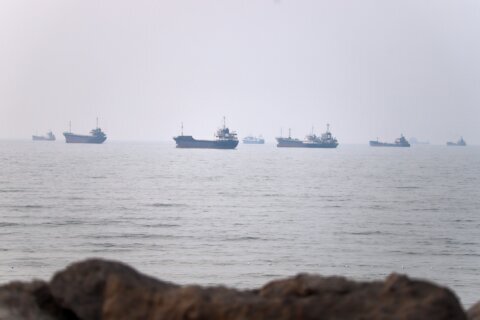
The Dali container ship’s power loss caused it to lose propulsion and steering and ram into the bridge’s supports, leading to the deadly collapse and closing Baltimore’s port for months.
In addition to the new charges announced Tuesday, the companies that own and operate the ship have faced a slew of legal challenges, many of which have been resolved with settlements.
Maryland officials have projected it will cost $4.3 billion to $5.2 billion to replace the heavily trafficked bridge, which isn’t expected to reopen to traffic until late 2030.
Here’s a timeline of what happened in the crash and significant developments since then:
March 26, 2024
12:39 a.m.: The ship left the Port of Baltimore for Sri Lanka. Flying under a Singapore flag, the massive container ship measured about 985 feet (300 meters) long and 157 feet (48 meters) wide.
Between 1:25 a.m. and 1:28 a.m.: The ship lost power and its crew issued a mayday call as it traveled toward the Francis Scott Key Bridge at about 9 mph (15 kph).
Police officers had about 90 seconds to stop traffic from driving onto the bridge in both directions.
Around 1:29 a.m.: The cargo ship rammed into the Francis Scott Key Bridge, striking one of its supports and plunging it into the river within seconds.
March 27, 2024
Federal investigators began collecting evidence from the ship.
March 30, 2024
Teams of engineers and a slew of floating cranes removed the first piece of steel wreckage, part of a long and complicated process to stabilize the site to allow divers to search for the still-missing construction workers and to open alternate shipping channels for the Baltimore port.
April 1, 2024
Singapore-based Grace Ocean Private Ltd., which owned the ship, and Synergy Marine PTE Ltd., the ship’s operator, filed a court petition seeking to limit their legal liability.
May 7, 2024
The body of the sixth missing construction worker was recovered. All of the victims were Latino immigrants working an overnight shift filling potholes on the bridge.
May 14, 2024
Federal investigators released preliminary findings related to the ship’s electrical blackouts while it was docked in Baltimore but stopped short of saying those were related to another power loss in the moments before the ship crashed into the bridge.
September 2024
National Transportation Safety Board documents showed investigators had found a loose cable in a transformer and breaker system that had been switched on by crew members before departing the Baltimore port.
Federal officials on Sep. 18 filed a lawsuit accusing the ship’s owner and operator of ignoring known electrical problems and seeking to collect $100 million.
The state of Maryland followed, as did a group of Baltimore longshoremen who filed a class action lawsuit arguing the companies should reimburse them for wages lost while the port was closed.
Oct. 24, 2024
The owner and operator of the cargo ship agreed to pay more than $102 million in cleanup costs to settle the lawsuit brought by the Justice Department.
Feb. 4, 2025
Maryland officials unveiled designs for a new Francis Scott Key Bridge to be built taller than the original, costing $1.9 billion.
March 20, 2025
Federal investigators said Maryland’s transportation agency had not completed a recommended vulnerability assessment of the Francis Scott Key Bridge before its collapse, which would have shown the risks of a ship strike.
July 31, 2025
The ship’s owner and operator filed a lawsuit in U.S. federal court against the company that built the ship, Hyundai Heavy Industries, alleging negligence in the design of a critical switchboard on the ship.
Nov. 17, 2025
Maryland officials more than doubled the estimated cost of replacing the Francis Scott Key Bridge, forecasting it at between $4.3 billion and $5.2 billion.
Nov. 18, 2025
The National Transportation Safety Board said the blackout that led the ship to lose propulsion and steering before it crashed was caused by a loose electrical wire. Investigators believed the crew might have discovered the loose wire ahead of time using infrared thermal imaging.
April 9, 2026
The ship’s owner and operator said they were making settlement agreements with Maryland and ACE American Insurance Co. The $350 million settlement with the insurance company matched the amount ACE paid to Maryland, an amount that represented the limit of the state’s policy.
May 12, 2026
Federal prosecutors announced criminal charges against the ship’s operator and a senior employee accused of making decisions that led to the crash and covering up what happened.
Also Tuesday, Maryland’s attorney general disclosed the amount — $2.24 billion — of the previously announced settlement between the state and the ship’s owner and operator
Copyright © 2026 The Associated Press. All rights reserved. This material may not be published, broadcast, written or redistributed.