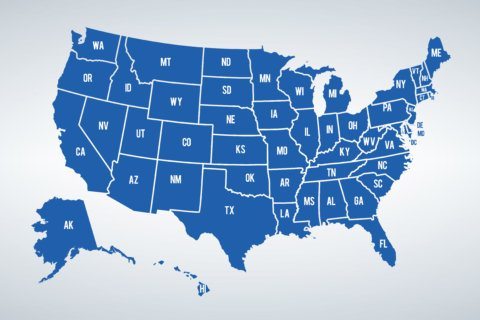

INSTITUTE, W.Va. (AP) — A chemical leak at a West Virginia silver recovery business on Wednesday killed two people and sent about 30 others to hospitals, including one in serious condition, authorities said.
The leak occurred at the Catalyst Refiners plant in Institute as workers were preparing to shut down at least part of the facility, Kanawha County Commission Emergency Management Director C.W. Sigman said.
A chemical gas reaction occurred at the plant involving nitric acid and another substance, Sigman said at a news briefing. He added that there was “a violent reaction of the chemicals and it instantaneously overreacted.”
“Starting or ending a chemical reaction are the most dangerous times,” Sigman said.
The chemical reaction that was believed to have occurred during a cleaning process produced toxic hydrogen sulfide, Kanawha County Commission President Ben Salango said.
Among the injured were seven ambulance workers responding to the leak, officials said.
“We know that the first responders, they always run to the fire. They put themselves in harm’s way,” Gov. Patrick Morrisey said at an evening news conference. “We’re very grateful to these brave men and women and what they do. And they’re in our prayers, and we’re monitoring the recovery of those transported to our local hospitals.”
Other people were taken to the hospitals in private cars or even in one case a garbage truck, Sigman said.
Morrisey said one person was in serious condition.
Vandalia Health Charleston Area Medical Center, one of several hospitals in the area, was treating multiple patients, some brought by ambulance, while members of the community were arriving Wednesday afternoon asking to be checked, hospital spokesman Dale Witte said.
Witte said patients were experiencing respiratory symptoms including cough, shortness of breath, sore throat and itchy eyes. They were being evaluated in the emergency room.
WVU Medicine Thomas Memorial Hospital in South Charleston said in a statement it has cared for a dozen patients, including eight who arrived by personal vehicle and were not at the scene but were in the area at the time. It said those injuries were not considered life-threatening.
A shelter-in-place order was issued for the surrounding area and lifted more than five hours later. Officials said all the deaths occurred on the plant site.
“You had to get really close to the facility to smell it,” Sigman said.
The leak required a large-scale decontamination operation in which people had to remove their clothes and be sprayed down, authorities said.
Morrisey said it’s believed the local air quality and water supply were unaffected.
Catalyst Refiners works to remove silver from what remains of chemical processes. Ames Goldsmith Corp., the owner of Catalyst Refiners, said it is saddened by the deaths and its thoughts were with all those impacted and their families.
“This is an unfathomably difficult time,” company President Frank Barber said in a statement released at the briefing. “Our thoughts and prayers are with our colleagues and their families.”
Ames Goldsmith promised to work with local, state and federal officials as they investigate the leak. The federal Occupational Safety and Health Administration has opened an investigation into what happened, a spokesperson said, adding that the agency has six months to complete its examination.
Silver is in a number of items ranging from circuit boards and other electronics, photographic and X-Ray films and jewelry. Nitric acid is used to dissolve materials, leaving behind silver nitrate that can be processed to recover pure silver. Recovery businesses can also crush or sandblast items with silver and use magnets or differences in density to sort out the precious metal.
Sigman said Ames Goldsmith recovers silver from the various plants at the Institute complex “and they’ll use it again. When they vacuum their carpets in their office, they recover so many thousands of dollars’ worth of silver out of it just vacuuming their carpets.”
The plant is located near Institute, a community about 10 miles (16 kilometers) west of Charleston, the state capital. The plant is in a region known as West Virginia’s “chemical valley,” although many plants that lined the area along the Kanawha River and produced hazardous materials have closed or changed ownership in the past several decades.
___
Associated Press writers Jeffrey Collins in Columbia, South Carolina, Gary D. Robertson in Raleigh, North Carolina, and Kristin M. Hall in Nashville, Tennessee,.contributed to this report.
Copyright © 2026 The Associated Press. All rights reserved. This material may not be published, broadcast, written or redistributed.