The U.S. launched airstrikes Wednesday against Iran, and President Donald Trump said more are coming, as Tehran fired back at countries in the region. The U.S. military said it fired on a tanker trying to transport oil from Iran in violation of its blockage on Iranian ports, the eighth merchant vessel disabled in the waters off Iran.
Trump would not say if he planned to follow through on threats he made earlier in the war to attack bridges and utility plants. He urged Iran to sign a deal with the U.S.
Also Wednesday, the president signed a $70 billion immigration enforcement bill that aims to ensure uninterrupted funding for the administration’s deportation agenda through the end of his term.
The Latest:
$60M and 7 federal agencies required to stage Trump’s UFC fight at White House
The president’s planned UFC fight on the South Lawn has required a monumental effort from more than seven federal agencies, hundreds of staff working on-site daily and at least $60 million, according to a legal filing that offers a glimpse into the preparations.
The event is part of the 250th anniversary of America’s founding, and it is scheduled for the weekend with the main attraction — seven mixed martial arts matches — on Sunday.
That is, if a judge doesn’t halt the proceedings, something sought by two Virginia residents in a federal lawsuit against the National Park Service, which oversees the South Lawn.
The agency filed a rebuff of the request Tuesday in court and in it laid out the operations for the event.
“Well over $60 million and tens of thousands of hours of labor have been expended,” the document reads, adding that the money came from the UFC and affiliated groups.
OB-GYN group makes vaccine recommendations for the first time
A prominent OB-GYN group announced vaccine recommendations Wednesday that differ from what the U.S. government advises.
The schedule is specifically for pregnant, postpartum and breastfeeding women. It aligns with prior recommendations from the U.S. Centers for Disease Control and Prevention, before changes were made under the Trump administration and Health Secretary Robert F. Kennedy Jr.
The American College of Obstetricians & Gynecologists withdrew this year from a CDC advisory committee on vaccines because of those changes, which have spawned legal challenges.
“So now for the first time, ACOG has made the decision to formally release its own immunization schedule to provide and communicate clear evidence-based guidance and to address the growing vaccine misinformation that is circulating,” said Dr. Christopher Zahn, the group’s chief of clinical practice.
The schedule has been endorsed by 13 other professional and medical societies. Some other groups, such as the American Academy of Pediatrics, have also put out schedules this year that differ from the CDC’s.
Florida high court allows use of new US House districts drawn by Republicans for midterms
The Florida Supreme Court declined a request to issue a temporary injunction against the map, which is backed by Republican Gov. Ron DeSantis.
Attorneys representing voters had argued that the new districts violate a state constitutional ban on political gerrymandering.
Republicans currently hold 20 of the state’s 28 U.S. House seats, and the new voting districts could improve the GOP’s chances to win four additional seats this year.
Republican Attorney General James Uthmeier, who defended the new districts in court, declared “complete and total victory” in a social media post.
Opponents expressed outrage while vowing to continue the court fight, even though it may stretch into the 2028 election cycle.
Trump has urged Republican-led states to redraw voting districts to try to hold on to a slim House majority in November.
Administration plans intensive, year-round construction schedule for Trump’s triumphal arch
Construction of the 250-foot-high triumphal arch that the president wants built near the Lincoln Memorial could occur 20 hours per day, year-round, as officials push to complete the project within three years, according to a preliminary assessment by the National Park Service.
Tower cranes up to 320 feet tall, forklifts, concrete pump systems and other equipment would be needed to build the arch, which would be more than twice as high as the Lincoln Memorial. Work would occur year-round in two 10-hour shifts per day, the Park Service report said.
The 24-page assessment by NPS staff was released last week as a part of a fast-tracked historic preservation review that began Friday. The park service oversees the land where the administration wants to build the arch.
Judge rejects watchdog bid to block administration’s ‘anti-weaponization’ fund
A federal judge has rejected a government watchdog’s request for a court order temporarily blocking the Trump administration from forging ahead with a new $1.776 billion settlement fund for compensating people who claim to be victims of a weaponized government.
But the judge ended a hearing Wednesday by warning President Donald Trump’s administration not to “play possum” with the court.
U.S. District Judge Richard Leon ruled from the bench in favor of the administration, which argued that the watchdog’s lawsuit is moot because acting Attorney General Todd Blanche told Congress last month that the government is scrapping its plans for the fund.
US military says it is striking ‘multiple targets’ in Iran in latest escalation of tensions
U.S. Central Command said in a social media post that the military is striking “multiple targets in Iran” and it is happening “in response to Iran’s unwarranted and continued aggression.”
The strikes come just a day after the U.S. hit Iran following the crash of an Army helicopter near the Strait of Hormuz that Trump blamed on Tehran.
US Embassy in Baghdad issues new warning to citizens
In a statement it advised U.S. citizens in Iraq “to maintain heightened readiness and stay alert to local news sources” as “travel disruptions and airspace closures could occur on short notice.”
Washington previously issued a warning for U.S. citizens not to travel to Iraq and advised those there to leave. The statement reiterated that warning.
The advisory comes amid rising tensions and renewed exchanges of strikes between the U.S. and Iran. After the U.S. and Israel attacked Iran on Feb. 28, sparking the war in the Middle East, Iran-backed Iraqi militias launched regular attacks on U.S. bases and diplomatic facilities in Iraq.
Hegseth says US has ‘options’ when asked about possible operation in Cuba
Defense Secretary Pete Hegseth told reporters the military has various options for the president if he greenlights military intervention there.
Asked about the possibility of a capture-or-kill operation, the defense secretary said: “All I would say is options, options, options. Our job is to present options at different scales depending on where the commander in chief and president the United States wants to go.”
Trump has warned that Cuba is next following a U.S. military raid in January that captured former Venezuelan President Nicolás Maduro.
Trump has also ordered a punishing oil embargo on the island nation, while former Cuban president Raúl Castro, 95, faces federal murder charges if ever brought to the U.S.
Hegseth says US will strike Iran tonight
Defense Secretary Pete Hegseth said the military will strike Iran “hard” Wednesday night following threats for more strikes from Trump earlier in the day.
While Trump said the strikes are further retaliation for what he said is Iran’s downing of a U.S. Army Apache helicopter, Hegseth said they are happening “not because we want to restart anything” but because the Pentagon “is prepared to set the terms to ensure that we get the kind of deal President Trump expects.”
“Those strikes that will happen tonight will be strong; they will be clear,” Hegseth said. “If they have to happen tomorrow night, they will be strong and they will be clear.”
Iran’s UN envoy says Trump should refrain from threats of force if he wants a deal
Ambassador Amir Saeid Iravani stressed to the U.N. Security Council on Wednesday that “no sustainable deal can be reached through terrorists, intimidation, or the use of force.”
“Iran has never negotiated under threats and pressure and will never submit to pressure or question,” he said.
Iravani said the United States has repeatedly pursued this policy and should have learned by now “that threats and military intimidation are counterproductive.”
“If Washington is genuinely interested in a diplomatic solution, it must abandon the language of terrorism and engage with Iran on the basis of mutual respect, sovereign equality, and full adherence to international law,” the Iranian ambassador said.
Israeli defense minister says Israel is prepared to strike Iran ‘with great force’
Speaking at a ceremony in Jerusalem on Wednesday evening, Israel Katz said the campaign against Iran was “far from over” and warned that if Iran attacks Israel again, “it will suffer a severe blow.”
The comments came shortly after Trump said the United States would be striking Iran again on Wednesday, after a day of escalating attacks in the region.
Israel and Iran traded fire earlier this week for the first time in two months.
Trump says he ordered US military mission to help oil tankers navigate Strait of Hormuz
The president said on social media that he ordered the U.S. military last month to execute “a secret mission to support Oil Tankers and other Commercial Ships” through the strait. He claimed the effort helped get more than 100 million barrels of oil through the strait, though there was no immediate confirmation of that figure.
It was not immediately clear what role the military played. When asked about the secret mission, Capt. Tim Hawkins, a spokesman for U.S. Central Command, said, “U.S. forces continue to communicate and coordinate with commercial vessels seeking to freely and safely transit.” He did not offer details on the specific military support being offered to vessels.
Hegseth warns Cuba over buying certain weapons, saying it will invite confrontation
Defense Secretary Pete Hegseth continued his tough talk against Cuba’s government while visiting the U.S. base on the island, warning Cuba against the purchase of weapons that could strike the Guantanamo Bay Navy base or the U.S. mainland 90 miles (145 kilometers) away.
“They would be inviting the kind of confrontation, not only do they not want, but they could not stand,” Hegseth said, adding that the U.S. military “will give the commander in chief every single option he needs inside that contingency.”
Trump has been threatening Cuba with military intervention as he tries to pressure its government’s leadership into stepping down.
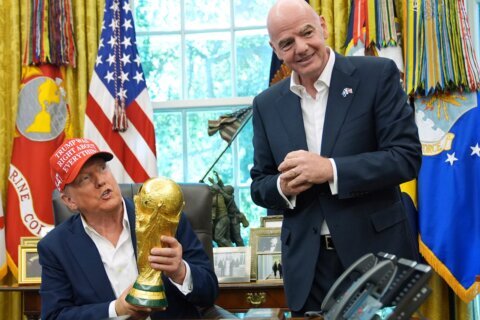
Rubio to attend World Cup opening ceremony and US-Paraguay match in LA
The State Department says the secretary of state will travel to Los Angeles for Friday’s U.S. opening ceremony of the World Cup 2026 soccer tournament and Team USA’s first match against Paraguay that night.
The department said in a statement that Rubio would lead the U.S. delegation to the opening and be accompanied by Secretaries of Transportation and Homeland Security Sean Duffy and Markwayne Mullin.
In addition to attending the World Cup events, Rubio will also meet with Paraguayan President Santiago Peña in Los Angeles.
US says it has boosted Ebola response funding by another $20 million
The State Department says that the Trump administration has contributed another $20 million toward efforts to counter the spread of the deadly Ebola virus in Africa, bringing the total U.S. contribution to more than $220 million since the outbreak began last month.
The department said the new funds would go to assist the most affected countries — Congo and Uganda — as well as Burundi, Kenya, Rwanda and South Sudan, to help them prepare for an outbreak and prevent its spread. That will cover support for national emergency operations centers, surveillance, testing and border screening, and infection prevention and control, as well as assistance in managing potential victims of the virus.
The announcement came a day after Secretary of State Marco Rubio told EU Commission President Ursula von der Leyen that Europe needed to step up its response to Ebola.
Hegseth tells US troops in Cuba: ‘We are taking back our hemisphere’
Speaking to American troops in Cuba on Wednesday, Defense Secretary Pete Hegseth said the U.S. is “defending the homeland. And we are taking back our hemisphere.”
Hegseth cited the 19th-century Monroe Doctrine, which is often invoked to justify U.S. intervention in the Western Hemisphere. He also mentioned the “Donroe Doctrine” to reference Trump’s aggressive focus on Latin America and drug cartels.
Trump has been trying to bring about regime change in Cuba with a punishing oil blockade on the island nation and federal charges against former Cuban President Raúl Castro. Trump has also threatened military intervention while pointing to the U.S. capture of former Venezuelan President Nicolás Maduro in January.
UN chief warns escalating attacks and rhetoric risk ‘full war’ in Iran and Gulf region
Secretary-General António Guterres told the U.N. Security Council on Wednesday that the ceasefire in the Gulf region “is more like a lesser fire,” as the world has witnessed in the last 48 hours, with the downing of a U.S. helicopter, U.S. retaliatory attacks on Iranian targets, and the Iranians firing at U.S. bases and facilities in the Gulf.
“The world needs to see a complete ceasefire, with navigational rights and freedoms restored … and serious negotiations on the nuclear issues — ensuring that Iran’s nuclear program is exclusively peaceful,” he said.
Guterres also called for full implementation of the ceasefires in Lebanon and Gaza and an end to settler violence in the West Bank, now averaging six attacks a day.
He said, “It’s time to get serious about the only credible way forward” — moving toward a two-state solution where Israel and Palestine live side by side in peace.
GCC condemns Iranian strikes on Gulf states and Jordan
The Gulf Cooperation Council, or GCC, condemned Iranian air attacks on Bahrain, Kuwait and Jordan on Wednesday, saying the “new heinous Iranian aggression” doesn’t create stability or build relations.
“The Council affirms that these hostile acts do not serve any understanding or rapprochement, but rather distance people from one another, undermine the foundations of trust, sow discord, and close the doors of dialogue to which the GCC states have always called,” the GCC said in a statement on the sidelines of a meeting it held in Bahrain’s capital of Manama.
The GCC blamed Iran for destabilizing the region and impacting international navigation and energy supplies through these “hostile acts.”
The ministerial council said GCC states remain committed to diplomacy and good-neighborly relations, but questioned how future ties could be built while the attacks continue.
Treasury sanctions Chinese and Hong Kong-based people and companies for supporting Iran
The U.S. Treasury imposed sanctions on nine people and firms allegedly associated with supporting Iran’s weapons procurement program.
Among those hit with sanctions is Hong Kong‑based firm Mustad and its leadership, who are accused of acting as an intermediary to facilitate transactions that would help Iran procure weapons.
Treasury Secretary Scott Bessent said in a statement that his agency is “disrupting the foreign procurement networks that support the Iranian military’s efforts to acquire weapons.”
Speaker Mike Johnson says Pulte is coming ‘short term’ to renovate and downsize intelligence office
The Republican leader spent another morning with Trump at the White House and said the president is “working very hard” to name a more permanent pick to lead the Office of the Director of National Intelligence – perhaps even by the time Pulte takes over June 19.
Johnson called it a “good faith gesture” from Trump that Democrats should accept as part of an agreement for a short-term extension of the Foreign Intelligence Surveillance Act, known as FISA. The spy tool expires on Friday if Congress fails to act, but lawmakers object to Pulte in the role, saying he is unqualified.
Trump made it very clear, Johnson said, that Pulte will serve a “very short term – a sort of renovation role” to help the Office of the Director of National Intelligence be “renovated and downsized.”
US military disables merchant vessel trying to transport oil from Iran
The U.S. military disabled an eighth merchant vessel in the waters off Iran on Tuesday, U.S. Central Command announced in a social media post on Wednesday.
According to U.S. Central Command, U.S. forces disabled Palau-flagged M/T Settebello, which they say was trying to transport oil from Iran, after their crew failed to comply with their directions. “A U.S. aircraft fired precision munitions into the ship’s engine room,” the statement said.
In a black-and-white video accompanying the statement, a small object can be seen slamming into the back of the ship before a large explosion erupts. Afterward, the video zooms out, and the ship is seen floating, but with smoke billowing from the back.
Trump seems to suggest the US is ferrying oil out of the Strait of Hormuz
The U.S. president seemed to say that “millions of barrels of oil” have been secreted past Iranian forces in the Strait of Hormuz, helping to ease energy price pressures.
“Do you know, we’ve been taking out millions of barrels of oil?” Trump said. “Nobody knows it. You know who doesn’t know about it? Iran. Until right now. We took out the other night, 22 ships late at night with no lights, because they don’t have any radar, because we blasted the crap out of it.”
The president said that U.S. forces have been removing millions of barrels of oil on a nightly basis, and he had previously “wanted to say it so badly.”
Inflation just climbed to 4.2% annually, and Trump calls those numbers ‘great’
As affordability concerns hurt his popularity, the U.S. president declared that he loves the figures in the latest consumer price index report, which showed inflation hitting 4.2%, the highest level since April 2023.
“I love it,” Trump said without irony. “The numbers were great.”
The president said that he thought the numbers were good because he believes that they’ve been driven by higher energy costs tied to the Iran war, suggesting that inflation would ease “as soon as this war is over.”
Inflation has worsened under Trump’s watch, initially because of last year’s tariffs and now because of a conflict that has blocked oil and natural gas shipments through the Strait of Hormuz.
Trump piles on about Platner, saying ‘he’s just an outright pig’
The president continued his sharp criticism of Platner in subsequent comments, saying, “He’s like a pig.”
“I watched him a couple of times,” the president said. “He’s like a pig. That’s what he reminds me of.”
Trump added, “You know, I come up with good names for people. I don’t want to stick him with that one, although I think pigs would be very upset,” drawing laughter from Republican lawmakers in the Oval Office with him.
Trump has used “pig” or variations of it as insults before against reporters and political opponents.
Trump signs $70 billion immigration enforcement bill
Trump has signed a bill into law that gives his immigration and deportation agenda a nearly $70 billion boost for the rest of his time in the White House.
The bill provides $38 billion for U.S. Immigration and Customs Enforcement and $26 billion for the Border Patrol. An additional $5 billion would cover unforeseen costs, according to the White House.
Trump signed the legislation in the Oval Office on Wednesday, a day after House Republicans pushed the measure through by a 214-212 vote over the objections of Democrats. His signature ended a nearly six-month fight over Department of Homeland Security funding that began with the shooting deaths of two U.S. citizens, Alex Pretti and Renee Good, in January during federal immigration enforcement operations in Minneapolis.
Trump says he does not want to renew trade pact with Canada and Mexico
The U.S. president told reporters that he’s “not looking to renew” the United States-Mexico-Canada Agreement, a trade deal that, without a commitment by July 1, would face annual reviews of its status and possibly expire in 2036.
“I’m not looking to renew it,” Trump said, even though he originally negotiated the pact to replace an earlier trade deal for North America.
Trump said that the earlier agreement was worse than the USMCA. Still, he was displeased with the results.
“You know, with Mexico and Canada, we have trade deficits,” Trump said. “We should have surpluses with them. We don’t need their cars. We don’t need their lumber. We don’t need their energy. We don’t need anything that they have.”
Trump says Maine’s Collins is ‘not my best friend’ but he’s backing her
Trump said that Republican Sen. Susan Collins of Maine has his backing in her reelection campaign this year, even though she voted in 2021 to convict him of impeachment for the Jan. 6, 2021, riot at the U.S. Capitol.
After repeatedly insulting Collins’ Democratic opponent, Graham Platner, Trump said he was backing Collins “because she’s a sane woman.”
“She’s not my best friend at all,” the president added.
Trump said that Collins has “maybe a little different ideology than me,” but she’s “a respected person” and a better choice than Platner.
Iran says the US bombed 2 of its water reservoirs
Water supply to thousands of residents was cut off on Wednesday after two reservoirs in the city of Sirik were damaged by a U.S. strike, according to Hashem Amini, the head of the state-owned National Water and Wastewater Engineering Company, and the head of the local water company.
Iran’s state media published a video of what it said was a damaged water reservoir in southern Iran. The Associated Press could not immediately verify the footage or the claims.
U.S. Central Command had no immediate comment. Central Command said earlier Wednesday that it had “struck Iranian air defense, ground control stations, and surveillance radar sites near the Strait of Hormuz.” Sirik is at the eastern end of the strait.
Trump announces more strikes against Iran
Trump told reporters in the Oval Office that the U.S. would be striking Iran again on Wednesday after a helicopter collision with an Iranian drone.
“We’re going to hit them again hard today,” Trump said. He wouldn’t say if he planned to follow through on threats he made earlier in the war to attack bridges and utility plants in Iran.
He urged Iran to sign a deal with the U.S., saying “we were really close to a deal but they keep tapping us along.”
Copyright © 2026 The Associated Press. All rights reserved. This material may not be published, broadcast, written or redistributed.