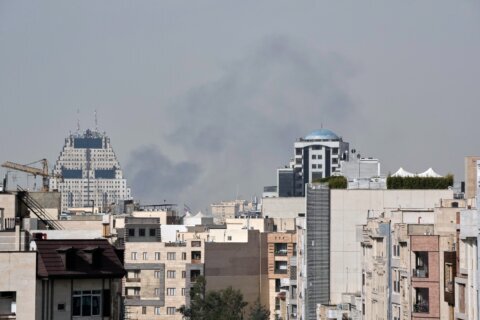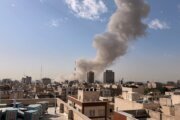
The U.S. and Israel attacked Iran on Saturday in what President Donald Trump said was a massive operation to destroy the country’s military capabilities and eliminate the threat of it creating a nuclear weapon.
Iran’s Foreign Ministry said it would defend its homeland and its Revolutionary Guard said it launched counterattacks, firing drones and missiles at Israel and strikes aimed at U.S. military installations in Bahrain, Kuwait and Qatar.
The strikes came after Trump has pressured Tehran for a deal to constrain its nuclear program, building up a fleet of American warships in the region as the country struggles with growing dissent following nationwide protests.
At least 40 people were reported killed at girls’ school in southern Iran in the Israeli-U.S. strikes, according to Iran’s state-run IRNA news agency. Shrapnel from an Iranian missile attack on the capital of the United Arab Emirates killed one person, state media said.
Explosions in Tehran are the first signs of an attack
Israel announced it had launched an attack on Iran shortly after explosions were heard in Tehran on Saturday morning. One of the first strikes hit near the offices of Supreme Leader Ayatollah Ali Khamenei. It wasn’t immediately clear where Khamenei was at the time; he hasn’t been seen for days.
Israeli Defense Minister Israel Katz described the attack as being done “to remove threats.” Iran’s military, symbols of government and intelligence sites were targeted, according to an official briefed on the operation, who spoke on condition of anonymity to discuss nonpublic information.
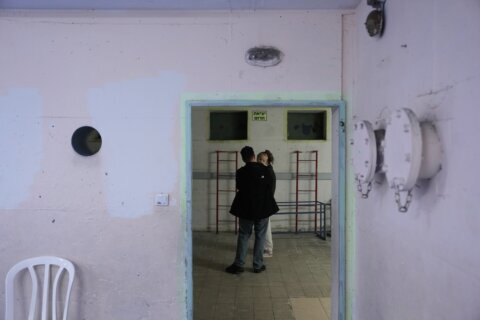
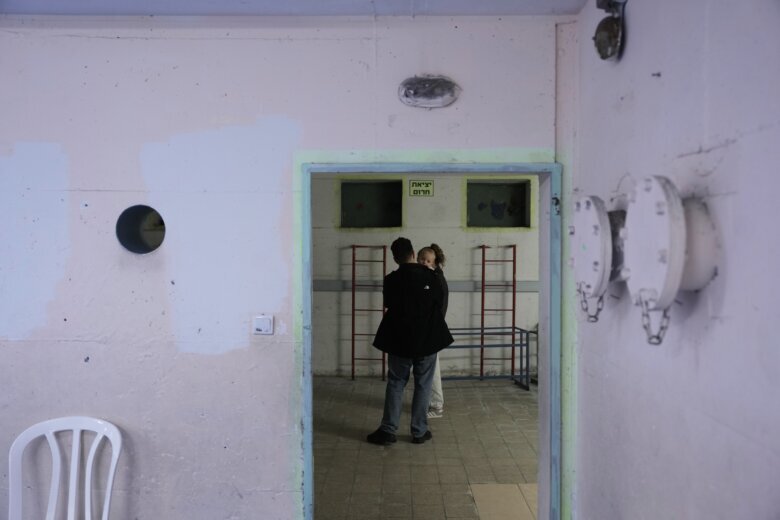
Sirens wailed across Israel to warn the public about possible incoming missile strikes.
Iran strikes back
Bahrain said a missile attack targeted the U.S. Navy’s 5th Fleet headquarters in the island kingdom. Witnesses heard sirens and explosions in Kuwait, home to U.S. Army Central. Explosions could be also be heard in Qatar, where Al Udeid Air Base hosts thousands of service members.
Iraq and the United Arab Emirates closed their airspace, and sirens sounded in Jordan.
An apartment building in northern Israel was damaged and shrapnel fell in multiple sites, according to media and police. But Lt. Col. Nadav Shoshani said there had been no significant hits in Israel and rescue services said there were no injuries reported from missile barrages across the country.
Iranian-backed Houthis in Yemen, meanwhile, have vowed to resume attacks on Red Sea shipping routes and on Israel, according to two senior Houthi officials who spoke on condition of anonymity because there was no official announcement from leadership.
Trump urges Iranians to rise up
It took over an hour for Trump to make an official announcement on the U.S. involvement in what he termed “major combat operations.”
In an 8-minute video on social media, Trump indicated the U.S. was striking for reasons far beyond the nuclear program, listing grievances stretching back to the beginning of the Islamic Republic following a revolution in 1979 that turned Iran from one of America’s closest allies in the Middle East into a fierce foe.
Trump told Iranians to take cover but urged them to later rise up and topple the Islamic leadership.
“When we are finished, take over your government,” Trump said. “It will be yours to take. This will be probably your only chance for generations.”
The attacks came a day after Trump voiced frustration over lack of progress in negotiations to stop Iran’s ability to develop nuclear weapons.
Building up forces
Israel said it had worked with the U.S. for months to plan the attacks.
Before U.S.-Iran negotiations were underway in Geneva, the U.S. had assembled a vast fleet of fighter jets and warships in the region to try to pressure Iran into a deal over its nuclear program.
The aircraft carrier USS Abraham Lincoln and three guided-missile destroyers arrived in January to bolster the number of warships in the region. The world’s largest aircraft carrier, the USS Gerald R. Ford, and four accompanying destroyers later were dispatched from the Caribbean to head to the Middle East and are now in the Mediterranean.
The fleet has added more than 10,000 U.S. troops to the region.
Flights canceled or rerouted
The fighting disrupted air travel in the region.
Israel and the United Arab Emirates, home to both the long-haul carriers Emirates and Etihad, closed their airspace Saturday. Qatar Airways Group said it has temporarily canceled flights to and from Doha because Qatari airspace also was closed.
Planes en route to Israel were rerouted to other airports.
Virgin Atlantic canceled its flight from London’s Heathrow Airport to Dubai and said it would avoid flying over Iraq, meaning flights to and from India, the Maldives, Dubai and Riyadh could take slightly longer. Virgin Atlantic said all flights would carry appropriate fuel in case they need to reroute on short notice.
Turkish Airlines said on X that flights to Lebanon, Syria, Iraq, Iran and Jordan will be suspended until Monday and flights to Qatar, Kuwait, Bahrain, the United Arab Emirates and Oman would be suspended on Saturday.
Dutch airline KLM previously said it was suspending Tel Aviv flights starting Sunday.
Copyright © 2026 The Associated Press. All rights reserved. This material may not be published, broadcast, written or redistributed.