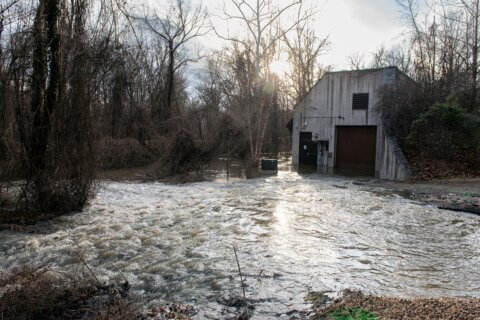
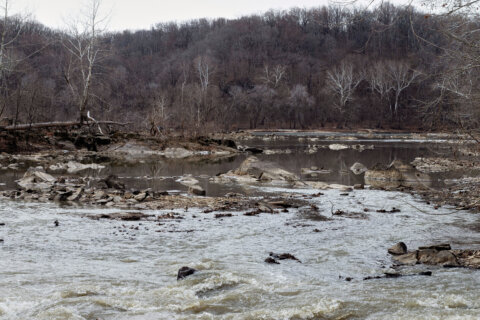
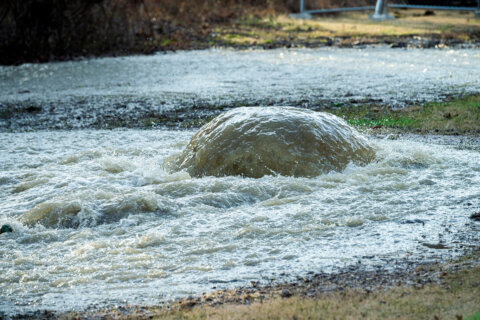
Rain slowed down D.C. Water’s environmental restoration work Tuesday along the C&O Canal and Potomac River, but cleanup efforts are well underway after January’s massive sewage spill.
A special use permit issued by the National Park Service over the weekend cleared the way for D.C. Water to launch the first phase of its environmental restoration plan.
During a tour of the site, Sherri Lewis with D.C. Water pointed out areas where contaminated soil and debris had already been removed and showed the fencing put in place to keep material from washing back into the drainage channel.
“You don’t see work going on right now because we can’t do it when it’s raining,” Lewis said.
Even with the wet weather, she said piles of contaminated material have already been dug out and are ready to be hauled away.
Lewis said the restoration will unfold in stages.
“We’re going to take care of clearing the brush, the debris and contaminated soil … and then we’ll have to come in and revegetate it as part of a second phase,” Lewis said.
Along parts of the work site, trees have been marked for removal where necessary.
She said D.C. Water wants to return the area as closely as possible to its previous condition.
“We care about the Potomac as much as anyone else does, and we want to restore this shared treasure to our region,” she said.
While the cleanup moves forward, as weather allows, the repair work beneath the ground is extensive and still ongoing.
Lewis said crews are preparing the upstream section of the damaged sewer line for geopolymer, a concrete‑strength material that will be sprayed inside the pipe to stabilize it.
“We’ve completed the cleaning in there. They came in, they power washed it to prepare it for the geopolymer,” she said.
She said geopolymer is strong enough to restore the pipe for the immediate emergency fix, and longer‑term work will include slip lining the pipe with fiberglass.
“It’ll be sprayed on in layers until it reaches the desired thickness. And it’ll basically strengthen the pipe and rehabilitate that section until we can come in and slip line,” she said.
Once that step is finished, the same work will move downstream, where cleaning crews are still removing debris left behind by the collapse.
“We are still cleaning the downstream section of the pipe,” Lewis said.
The collapse left a major blockage inside the Potomac Interceptor, and Lewis said crews had to cut off the crown of the pipe and remove a large buildup of rock and debris.
“We ended up clearing about 50 feet of rocks and debris from inside the pipe once we took off the crown,” she said.
To keep sewage out of the Potomac River while those repairs continue, D.C. Water has dramatically increased pumping at the site. Lewis said the team nearly doubled capacity and now has pumps running around the clock.
“We have to constantly pump because the ground is really saturated,” she said.
Despite the challenges, Lewis said the utility remains on track to complete the emergency repair by mid-March, but the environmental restoration will take longer to complete.
Get breaking news and daily headlines delivered to your email inbox by signing up here.
© 2026 WTOP. All Rights Reserved. This website is not intended for users located within the European Economic Area.