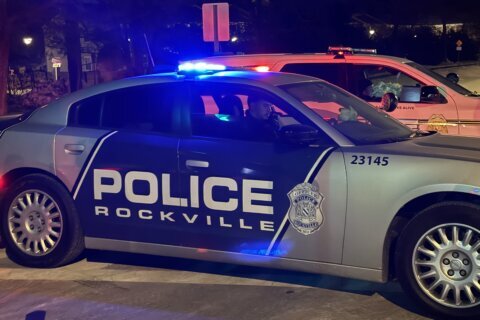
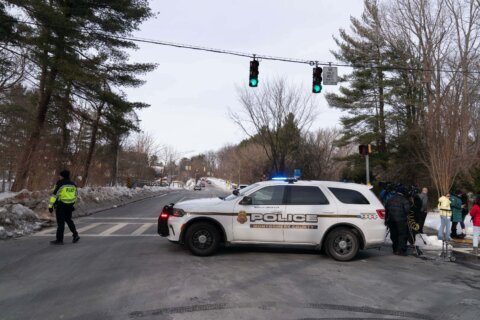
Montgomery County, Maryland, officials are examining ways to improve school safety after a student was shot inside Thomas S. Wootton High School by another student Monday.
The 16-year-old boy accused in the shooting has been charged with attempted second-degree murder and will remain in jail after a judge ordered him held without bond Wednesday.
A concern that has come to the forefront following the shooting was the removal of school resource officers, or SROs, in county schools.
In 2021, Montgomery County ended the SRO program, which embedded an officer at each of the county’s 25 high schools. Instead, the school system entered into the Community Engagement Officer model, where police are assigned to a cluster of schools.
Montgomery County State’s Attorney John McCarthy renewed his criticism of that decision, saying it was detrimental to school safety.
“It was a terrible mistake to take the SROs out of our schools,” McCarthy said, adding that SROs built strong relationships with students and deterred crimes on campuses.
He noted that Montgomery County has seen two school shootings involving ghost guns since SROs were removed.
Montgomery County Schools Superintendent Thomas Taylor said Tuesday night that when it comes to school safety, “Everything’s on the table.”
“We’re evaluating everything, in terms of its effectiveness and what has worked and what has been most effective,” Taylor said of the possibility of bringing SROs back.
Mo Canady, the executive director of the National Association of School Resource Officers, told WTOP how SROs help with building relationships in the school community.
“When you talk about keeping firearms out of school, dealing with these types of incidents, if you’ve got a carefully selected and specifically trained SRO on the campus, that officer — if they’re doing the job the right way — is building relationships within that building with students, faculty members, parents,” Canady said.
AI weapons‑detection programs under review
McCarthy said school leaders are evaluating new technologies to detect weapons earlier, including artificial intelligence tools.
“There are some enhanced AI programs that they are doing within the schools to try to see if they could identify weapons when they’re being brought into the schools,” McCarthy said.
Superintendent Taylor said Tuesday that there are plans to pilot a weapons detection system at three schools starting in March. But he added that improving school security will include measures beyond new security technology.
“We may be looking at a lot of different other countermeasures, as well as how we can bolster a really safe school culture and climate where kids feel welcome to — if they see something, they say something. And having that school environment where kids are invested in community safety to the point that they are looking and being their brother’s or their sister’s keeper,” he said.
McCarthy said that while the school system is leading that effort, improving detection and prevention must be part of a broader strategy.
Layered approach to school safety
Canady said there’s no single measure to ensure school safety. School districts need to take a layered approach, coordinating with the school community, including school security staff, administrators and local law enforcement.
“The goal there is to stop the weapon from coming on campus before it even makes it to the door,” Canady said, adding that good intelligence, delivered through relationships built by SROs, can be a key part of that process.
State’s Attorney McCarthy said both the school system and the justice system must strengthen safety measures to prevent future violence.
McCarthy pointed to major changes on how juvenile cases will be handled, including violent offenses, that Maryland lawmakers are considering.
Two sister bills, introduced in Maryland’s House and Senate, would move many serious juvenile cases so they start in juvenile court instead of adult court and leave only the most serious charges in automatic adult jurisdiction. Currently, 33 offenses automatically place 16 and 17-year-olds in adult court, and this legislation would sharply reduce that number.
McCarthy said a majority of Maryland’s state’s attorneys are against the proposed change, and many plan to testify against it on Thursday.
“We do not believe that the juvenile system is prepared to handle more violent juvenile offenders, particularly concerned with handguns, as we saw in this case,” McCarthy said.
He emphasized that many prosecutors statewide, regardless of their political affiliation, share concerns that moving more cases into juvenile court would strain an already limited system, particularly when firearms are involved.
A call to parents
Another issue that has to be emphasized, Canady, with the National Association of School Resource Officers, said is the fact that so many weapons that show up on school campuses come from homes where firearms are left unsecured.
“We constantly and loudly call on parents to please secure their firearms,” Canady said. “This is not a Second Amendment issue; this is a common sense issue.”
Canady acknowledged the challenges presented by privately made firearms, including 3D printed weapons. He also noted the growth of security firms working with schools to provide technology to detect weapons.
However, Canady emphasized the need to tap into the human element of coordinating security procedures to keep students safe.
WTOP’s Abigail Constantino contributed to this report.
Editor’s Note: This story has been updated to correct a reference to the number of public high schools in Montgomery County.
Get breaking news and daily headlines delivered to your email inbox by signing up here.
© 2026 WTOP. All Rights Reserved. This website is not intended for users located within the European Economic Area.