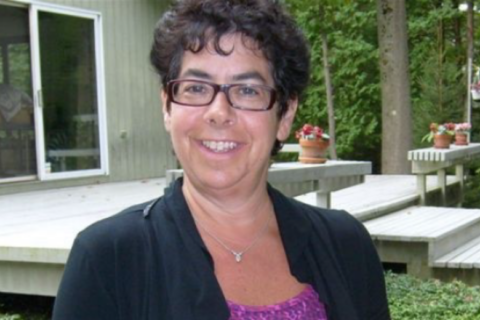
Approximately 15 years after the death of American University professor Sue Ann Marcum, her alleged killer is arguing Montgomery County jurors shouldn’t learn that he spent 12 years in Mexico on the FBI’s “Most Wanted List,” and that he changed his name.
Jorge Rueda Landeros is charged with first-degree murder in Marcum’s 2010 death in her Maryland home on Massachusetts Avenue, located between Goldsboro Road and Westmoreland Circle, on the border with D.C.
Jury selection is set to begin Oct. 20, in what is expected to be a five-day trial in Montgomery County Circuit Court.
Montgomery County prosecutors have said Landeros, who had dual citizenship, fled to Mexico after Marcum’s death. He spent a dozen years on the FBI’s “Most Wanted List,” before he was arrested in Guadalajara, Mexico, in December 2022 and extradited to the U.S.
In a motion filed this week, public defenders Meghan Brennan and Tatiana David asked the judge to exclude any suggestion from prosecutors that Landeros fled to Mexico to avoid being prosecuted in Marcum’s death. And, they argued that prosecutors should not be allowed to mention Landeros changed his name, because it would suggest he had something to hide.
The defense said Landeros had traveled freely between the U.S. and Mexico for years, including after Marcum’s death.
However, on March 2, 2011, Landeros was stopped at the border, and signed a release form to provide a buccal swab, in which DNA was taken from the interior of his cheek.
In this week’s motion, the defense said, according to charging documents in the case, the scene of Marcum’s killing initially bore signs of a robbery. A rear window appeared to have been pried open, and the house was partially ransacked. However, several expensive items were left behind and investigators said evidence of a struggle indicated Marcum possibly knew her attacker.
The defense said several electronics items of value were stacked in the home, and that the facts are consistent with the modus operandi in approximately 60 to 80 homes that occurred in the Northwest quadrant of D.C. and in Bethesda, within several months of Marcum’s death.
“Despite these facts, the state still alleges that Mr. Landeros killed Ms. Marcum,” according to this week’s defense motion.
The defense said it will challenge the prosecutorial argument that by not making himself available to Maryland officials, Landeros was demonstrating consciousness of guilt. The defense said four factors must be present to make a consciousness of guilt argument, and that prosecutors haven’t reached that standard.
“There are a number of reasons why Mr. Landeros would avoid turning himself in to the authorities, including potential Internal Revenue Service penalties, that exist completely independent of the murder of Sue Marcum,” wrote the defense.
Prosecutors Deborah Feinstein and Ryan Wechsler said Landeros knew since May 2011 that police had a filed an arrest warrant for him. A county police detective offered to meet Landeros at the Mexican border to facilitate his arrest. Landeros declined via email.
In its motion, prosecutors said in November 2022 the FBI got an online tip that Landeros was living in Guadalajara, Mexico, and was using the name Sadu Leon. Prosecutors said Landeros had a Facebook profile under the name “Sadu.Leon.1.”
“The evidence supports a direct connection between the Defendant’s name change and the murder of the victim, Sue Marcum,” prosecutors wrote. “The Defendant’s name change is related to his desire to avoid arrest for this specific crime and is therefore probative of consciousness of guilt.”
Suspicion eventually landed on Rueda Landeros, a yoga instructor and Spanish teacher, who developed a personal and financial relationship with Marcum sometime in the mid-2000s. Police have not detailed exactly how the two knew each other.
According to police, Rueda Landeros was the sole beneficiary of a $500,000 life insurance policy on Marcum, and the two also shared a joint investment fund.
In addition, a 1099 form in Marcum’s name from 2008 listed proceeds of over $100 million from the fund, which investigators believed to be “very unusual,” given her occupation as a university professor, according to the charging documents.
Police declined to say during the news conference whether the fund actually had $100 million in it or if the tax form was bogus.
Investigators also uncovered emails showing Marcum had become “increasingly concerned and uneasy” about the way Rueda Landeros was handling the money from the account, and spoke of “not being able sleep” over it.
According to police, Rueda Landeros’ DNA matched DNA recovered from items in Marcum’s house, including the weapon police believe was used to bludgeon her and scrapings from under her fingernails.
Editor’s note: Corrects story to say jury selection begins Oct. 20.
Get breaking news and daily headlines delivered to your email inbox by signing up here.
© 2025 WTOP. All Rights Reserved. This website is not intended for users located within the European Economic Area.