In the D.C. region, conversations often start with, “What do you do?” WTOP’s “Working Capital” series profiles the people whose jobs make the D.C. region run.
What is it like to store and care for old photos and reels of film from more than a century ago?
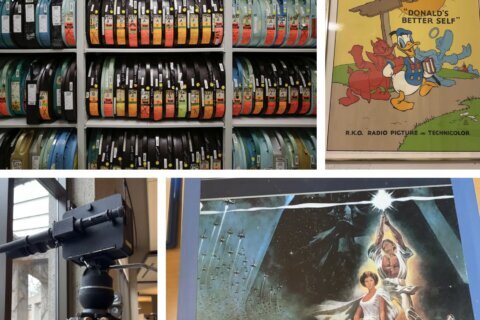
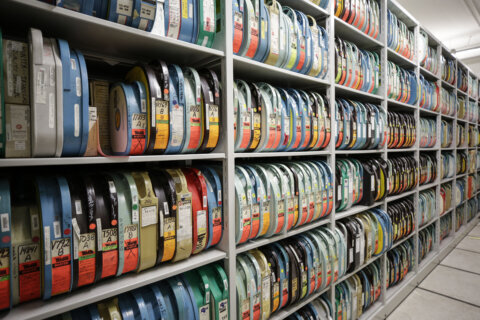
“We avoid having them for long periods of time in harsh light exposure,” said Meghan Holly, an archives technician at the Library of Congress Packard Campus in Culpeper, Virginia. “They live in our climate-controlled vaults.”
Squinting down at a roll of film from the early 1900s, it’s evident that caring for materials like this is a delicate art. And the Library of Congress Packard Campus has some of the best qualified individuals for this job.
Holly and fellow archives technician Erin Palombi work in the Moving Image Section of the 45-acre campus, which stores 135-plus years of physical media, from film to TV to radio broadcasts and much more.
Their job is to make sure the assets the library has accumulated, particularly films, stand the test of time.
“We’re inspecting the film to send it out on loan to venues for screenings,” Holly explained.
Palombi and Holly both went to school for film preservation. It’s what gives them the ability to handle items like the library’s first-ever film copyright deposit from 1893, “Edison Kinetoscopic Record of a Sneeze.”
Registered in 1893, this five-second film was added to the list of copyrighted material in 1894, making it a priceless artifact of media history.
“It feels amazing to just even be able to handle this material,” Palombi said. “I like the sort of romantic idea of interacting with the past.”
Palombi and Holly told WTOP that in 1912, an amendment to the U.S. Copyright Act of 1909 changed the game for film. The Townshend Amendment officially added motion pictures as a distinct category of protected works, allowing for submissions of moving image material on celluloid film to the Library of Congress for the first time.
Before 1912, studios only submitted duplicate copies of movies for copyright purposes in paper form. That means that at Packard, there’s still a vast collection of pre-1912 material that looks like film reels, but is actually just photos of the film on paper — often kept in special boxes.
“(They’re) acid-free materials to keep the paper safe, and then they just have a little soft lining in them,” Holly said.
In different wings of Packard, like the Moving Image Section, technicians can carefully take rolls of film, or film paper, and lay them out at work stations. They wrap the paper around a wheel, and then hand-crank it to carefully look over every inch.
Despite being so old, Holly told WTOP that film paper in particular holds up incredibly well. She held up a paper print of Edwin S. Porter’s “The Great Train Robbery” from 1903, a film that transcended anything before it and become integral to the art of non-linear, dramatic storytelling.
WTOP got a rare glimpse at the paper print of the famous shot at the end of the film, where one of the bandits points a gun at the camera and fires.
Technicians here aren’t just preserving this material to keep it intact in storage — or to loan it out occasionally.
“They’re being sent out to be digitized,” Holly said.
At the Packard Campus, they’re working to digitize every single media asset the Library of Congress has in storage. It’s a huge undertaking, but the ultimate goal — to make all these assets available to the public anywhere in the world — is a mission that fuels staff like Holly and Palombi.
In the next episode of “Matt About Town,” we’re going to show you how the Packard Campus makes movie magic: by using the latest technology to convert some of their oldest stored film, and even photos, into high-definition digital motion pictures.
Learn more about the Library’s Packard Campus, and the National Audiovisual Conservation Center, online here.
You can also visit “Matt About Town” to see all episodes in the Packard Campus exploration series, an exclusive all-access collaboration with the Library of Congress you wont’ find anywhere else.
Hear “Matt About Town” first every Tuesday and Thursday on 103.5 FM!
If you have a story idea you’d like Matt to cover, email him or chat with him on Instagram and TikTok.
Check out all “Matt About Town” episodes here!
Get breaking news and daily headlines delivered to your email inbox by signing up here.
© 2026 WTOP. All Rights Reserved. This website is not intended for users located within the European Economic Area.