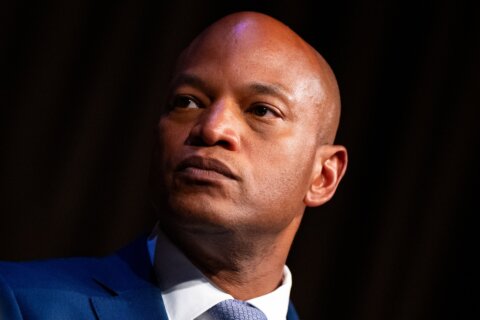
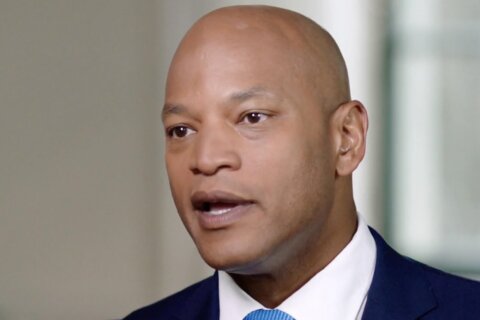
Maryland Gov. Wes Moore on Tuesday outlined his budget priorities, stressing no new taxes while focusing on affordability, competitiveness and key investments.
He said he inherited a $2 billion structural deficit and has worked to significantly reduce it. Moore also criticized the Trump administration over election-related moves.
Moore joined WTOP’s Shawn Anderson and Anne Kramer to break down his position and what the state could see in the future.
This interview has been lightly edited for clarity.
- Shawn Anderson:
(The budget) takes care of next year. What about the years that follow? Is the state back into that billion-dollars deficit range again?
- Gov. Wes Moore:
I think the thing that we saw from this budget was that we do what we say we’re going to do. And what the people saw was that when I said we were going to focus on making sure we can make our state more affordable, that we’re going to focus on being able to make our state more competitive, that we’re going to protect our people from the ravages that we’re seeing from the Trump-Vance administration, and that we are going to do it and not raise taxes or fees and that we’re still going to make the kind of investments we need to make in child care and public education, public safety. We did all that.
And what we’re saying right now is that when I came in, I inherited a multi-billion-dollar structural deficit. And what we are also doing is making sure that I do not plan on passing off to my successor that same dynamic that I want to make sure that we are cleaning up our finances, that in this year’s budget, we actually cut hundreds of millions of dollars from the structural deficit that I inherited.
And the plan is that we’re going to continue doing that to make sure that we are getting our fiscal house in order in the state of Maryland.
- Anne Kramer:
Governor, you pushed hard for gerrymandering, redistricting of the congressional maps. That did not make it through, did not get approved. It stalled in the Senate where Senate President Bill Ferguson stood his ground and said he didn’t have the votes. He was worried about the legal challenges there. What is your reaction today to that?
- Gov. Wes Moore:
My reaction today is what it was before. I mean, we just have a fundamental disagreement of the moment that we are in, of the challenges that we are facing and the threats that we are facing. And I do want to be clear that this is not over because Donald Trump will continue to try to work and manipulate going into the November elections and beyond. Just last week, we had to sue the Trump administration because they tried to do an executive order eliminating mail-in balloting, which is not just illegal, it will disenfranchise people.
And so we know and one thing I’m very clear on is that while the president, I might have had a fundamental disagreement on this issue, I am still willing to work with anybody to make sure that we are protecting the issues for Marylanders. And if you look at the budget, the bills that we introduced, not only were we able to come up with utility reform, not only able to end price gouging in supermarkets.
Not only were we able to increase housing, we were also able to do it where all of our bills actually passed and were passed on a bipartisan basis, with both Democratic and Republican support.
- Shawn Anderson:
Staying on the redistricting subject, across the river in Virginia, there’s a very tight race going on in this referendum that comes up next week on Virginia trying to gain four extra Democratic seats. Are you going to go to Virginia and perhaps campaign in favor of Virginia’s effort by Democrats to redistrict?
- Gov. Wes Moore:
Yeah, I’m willing to go support this effort because I think this is a very dangerous moment inside this country. And to be clear, what we are watching from the president is not a singular effort to manipulate these elections. This is also coming on the heels of him ordering federal forces to do things like watching over ballot boxes to dissuade fraud, which he knows is voter disenfranchisement. This is coming on the heels of him turning around and saying that we need to nationalize elections and take this away from states, which is not just illegal, but it is unconstitutional.
And so we are watching how the president, in addition to then asking certain states to go through mid-decade redistricting and asking other states not to, is coming up with creative and, in many ways, illegal ways of being able to manipulate and adjust the elections in November and beyond. And so I want to be helpful to make sure that people understand what is going on in broad daylight and know that this moment does require fight.
And if Virginia has an opportunity that Maryland doesn’t have constitutionally, which is actually take it to the voters, because we didn’t have that as an option, I want to make sure that the voters understand what’s at stake.
- Anne Kramer:
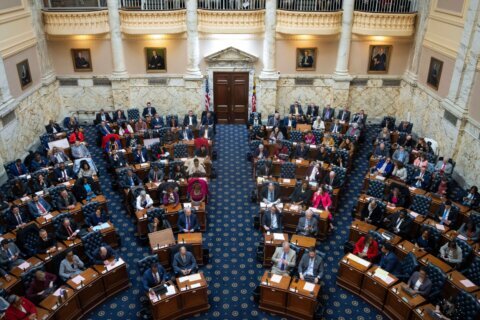
Let’s talk about energy prices in Maryland. You spearheaded the move to try and cut them back for customers, at least give them some kind of relief. Explosion of data centers in our region helping to push that higher. Talk to us about what happened in the General Assembly as a result.
- Gov. Wes Moore:
Absolutely. We’re very thankful to have the opportunity to work in partnership with the General Assembly because our focus this year has been very clear. We’ve got to lower cost. Lower cost, lower cost, lower cost. And a huge part of that was going to be on energy, where in the past year, we’ve seen how energy prices have increased by 13% in the state of Maryland, that gas prices have gone up now by over $1 just in the past month. And so we know that these are things and the reason is because of national issues that are coming up, going on, it’s not just Maryland, it’s the entire country. We understand that, but we’re going to do everything in our power to be able to address it.
And so if you look at the legislation that we introduced and got passed, not only is it going to save Marylanders hundreds of dollars every single year, but also what it’s going to do, it’s going to make sure that we are capping the compensation for some of these and for these energy executives, because it was Marylanders who were basically paying for it. It was making sure that we can better streamline projects and energy projects so we can get them done faster and get more on the grid. And is making sure we’re sourcing more local energy and not having to import so much energy from other states.
And so we’re proud that this work doesn’t just deal with a short term but it really deals with the midterm and the long-term challenges. But just fundamentally focusing on lower costs for the people of the state of Maryland.
- Shawn Anderson:
Governor, you talked about the Trump administration, the war in Iran, gas prices, other issues that many presidential hopefuls would address when you were part of Al Sharpton’s National Action Network last week. You told us in the past year on WTOP you are not running for president in 2028, but you are sure up there on those last couple of days with some folks who are thinking about running for president. Still holding on to the ‘I’m not running,’ or is there some wiggle room here?
- Gov. Wes Moore:
I’m still holding on to it. I’m focused on making sure we’re going to win reelection in November and listen, I’m grateful that the that the country is paying attention to how resilient Maryland has been, that no state has had a greater onslaught by the Trump-Vance administration than Maryland. We’ve had now over 31,000 Marylanders, federal workers, fired, over 40,000 if you include federally-adjacent jobs. So no state has had the kind of direct hit that the Trump-Vance administration is giving us and despite that, we’re now seeing Maryland have one of the fastest drops in violent crime anywhere in the United States.
That in education, third grade reading has jumped 20 states in a year and a half, and math and reading is up virtually every grade in Maryland that we have now added over 35,000 new businesses inside the state of Maryland, small and large businesses, and that includes things like the Samsung Biologics announcement, the sphere coming to the state of Maryland, while watching AstraZeneca making the largest private investment in the state of Maryland in over a decade. So people are paying attention and I’m proud of that.
But I know that that’s what I’m hoping that Marylanders will continue to see come November when I’m up for reelection.
Get breaking news and daily headlines delivered to your email inbox by signing up here.
© 2026 WTOP. All Rights Reserved. This website is not intended for users located within the European Economic Area.