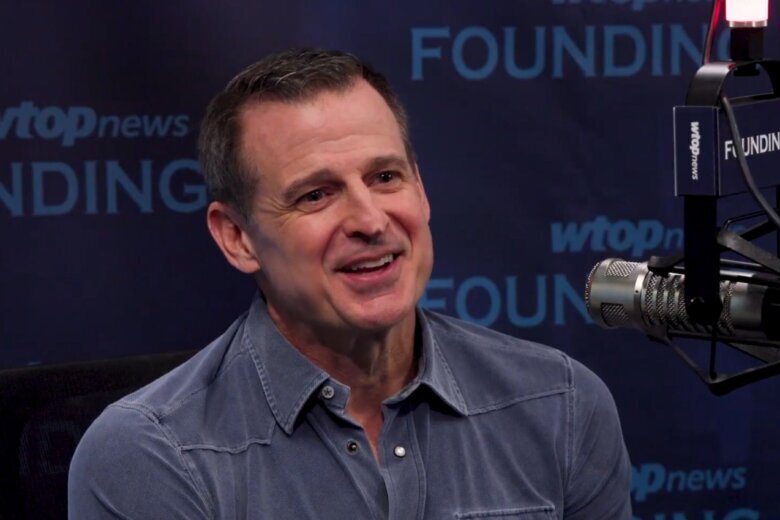
Twenty-five years ago, Michael O’Neil was a graduate student at Georgetown University, engaged to be married and lying in a hospital bed being treated for cancer.
Little did O’Neil know that his diagnosis would inspire him to revolutionize the way patients would receive information during their hospital stay by creating a digital health company that provides patients with education tools.
During an interview with Dan Simons on the newest episode of WTOP’s Founding DC, O’Neil looked back at that time in his life.
“I waited eight days for pathology to come back when I was laying in that bed so uncomfortable from the surgery, confused and afraid, like all of us actually are, and truly starving for information,” O’Neil said.
Finally, O’Neil thought he was going to learn about his diagnosis, thanks to a tip from his nurse.
O’Neil said the nurse told him, “I know you’re nervous about these, you know about CHOP chemotherapy. But hey, listen, we have an education channel on Channel 12.”
Instead of finding out information about cancer, the channel displayed a program geared for another type of patient: “There is, like, a mother-baby breastfeeding video. I’m like, what in the world is actually happening,” O’Neil said.
That was what O’Neil described as a “light bulb” moment. He was going to spend whatever limited time he may have left to make sure other cancer patients don’t experience a moment like he had.
Shortly after, O’Neil grabbed a pen from a nurse and started jotting down his plans for Get Well, a now Bethesda, Maryland-based digital health information provider..
“I’m literally drawing on the napkin a picture of the TV that was in a corner of my room,” he said. “I start just drawing these icons, and one said, ‘my education,’ and one said, ‘my entertainment,’ and one said, ‘my family and friends.’”
O’Neil compared it to the experience people have with hotel TVs, where you can order room service or contact housekeeping or order a movie.
At the time, O’Neil was 28 years old, and his idea was to take what he called “old, crappy TVs” off the hospital wall and turn them into desktop computers that would work on behalf of the patient.
“We wrote software that would convert this, like, TV, piece of glass, basically into a computer. We would tie the software to the electronic health record,” O’Neil said. “We would take that data and then turn it into content that was incredibly personal to the patient to become a digital care navigator for the patient.”
O’Neil said his team measured the impact of the patient engagement on things like outcomes, length of stay reductions, reducing readmissions and patient satisfaction.
From there, O’Neil established Get Well.
“We sell the software to the health system or the hospital, but the software touches the patient,” O’Neil said. “We’ve had a chance to touch 85 million people at an incredibly vulnerable moment in their lives with our software.”
Get breaking news and daily headlines delivered to your email inbox by signing up here.
© 2025 WTOP. All Rights Reserved. This website is not intended for users located within the European Economic Area.