This article was republished with permission from WTOP’s news partners at Maryland Matters. Sign up for Maryland Matters’ free email subscription today.
Jerry Fleming drives a green-and-yellow John Deere tractor around Butler’s Orchard, circling the rows upon rows of Christmas trees — planted in fields he personally pulled the stumps from years ago and hand-sheared by him and his co-workers recently as they prepared for the holiday rush.
“It’s never cold here — the weather might be cold, but the way we work, it’s never cold,” said Fleming, sporting overalls, a black-and-yellow flannel and sunglasses perched on his hat
Fleming is one of the many workers at Butler’s Orchard in Germantown who work months, and years, for a couple of weeks of sales between Thanksgiving and Christmas — when they start all over again.
Ben Butler, the farm’s finance and farm manager, calls the Christmas tree farm industry an “old man’s game” in reference to the time it takes to get a tree farm to the point where a farmer can begin selling trees.
Butler’s Orchard is home to more than 44,000 trees — with 45 acres of land growing about 980 trees each. It typically takes about 10 years to get one of those fields to market size.
A field at Butler’s is cleared for replanting each year. That includes adjusting the pH of the soil and removing old stumps. It takes a few weeks to clear each stump of the 2,000-2,500 cut-your-own trees the farm sells per holiday season.
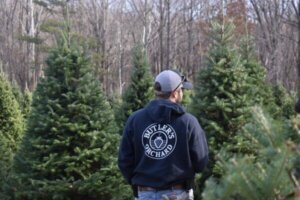
A cover crop is planted to rehabilitate the soil during the summer, followed by grass seed in September. New trees are finally planted in the spring and then tended for the next seven to eight years for the trees to get large enough to be sold.
“We are hoping we can have enough [trees] to make everyone happy, but not enough to keep in this lot,” Butler said about selling enough trees to clear out the field after the holiday season.
As they grow, trees are sheared by workers to keep the proper shape. Workers individually shear trees at sunrise in the warmer months, to avoid the heat, though sometimes work stretches through hotter times of the day. They wear shin and thigh guards to protect themselves from getting hurt from the shears, and are sometimes stung by bees who hang around the trees.
“Every tree you see is hand sheared by somebody, somewhere — it’s a tough job,” Butler said.
But Fleming says there are few complaints about the work. The mood is upbeat, said Fleming, who is known to bring a speaker to play Christmas music while he and his co-workers shape up the farm.
“People beg us to come back to work here,” Fleming said. “You never even think about what time it is.”
Fleming has worked at the farm since 2017, learning all he knows about trees during those eight years. He said the holiday season is his favorite time on the farm — bringing a nostalgic feeling of the “old days” when he would cut down a tree from the woods with his grandfather.
Christmas trees are far from the only business at Butler’s Orchard, a pick-your-own farm with a calendar that starts in April for asparagus and continues through the end of October for apples and pumpkins, and hosts seasonal festivals throughout the year. That means workers spent recent weeks from autumn-themed attractions to the holiday season, with workers shoveling thousands of pounds of corn kernels out of a play area for kids on a Friday morning, and mowing paths between the rows of trees.
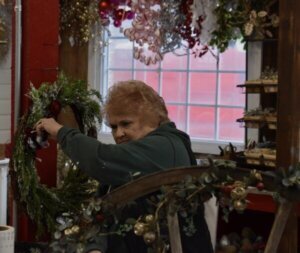
The area that now holds 750 pre-cut trees was changed over from Halloween decorations in a matter of days. It now boasts a holiday themed welcome sign and a Christmas tree made from stacked painted tires, along with a playground and petting zoo. The makeover was mostly done from Nov. 10-14 — even though Agritainment Manager Gina Giantonio called her team off work on Nov. 11, when a brisk wind made the temperatures feel below freezing.
Giantonio was confident that her team would still be able to finish before the pre-cut trees arrived Nov. 19. Most of the pre-cut trees are shipped from North Carolina or Pennsylvania, to ensure taller trees are available for purchase, and the rest are grown at Butler’s.
Workers get training each year on how to load trees onto the baler, which wraps trees in netting before customers take them home, and safely manage the trees each year during training. The cut-your-own workers go through similar training, with the addition of evening out the cut end of a tree and tying it to the customer’s car.
“It takes a team — it takes a village,” Giantonio said. “You can’t just do it by yourself.”
She recalled one day during a previous season when her team worked through pouring rain and slippery ice, yet still had at least 25 customers come to the pre-cut area to purchase trees.
“You work around the elements, you’re here rain or shine — you’re a farmer,” Giantonio said.
It’s not just the elements: Christmas tree farmers have been competing artificial trees, too.
“We’re up against the fake tree — the fake tree industry has done a great job of marketing their trees and we need to combat that,” said Joncie Underwood, treasurer for the Maryland Christmas Tree Association.