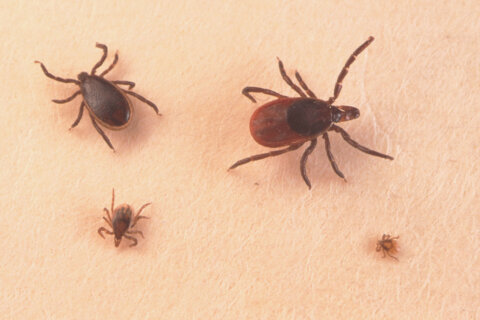
With the number of tick bite-related emergency room visits at a five-year high, according to the U.S. Centers for Disease Control and Prevention, a Maryland-based infectious diseases doctor is offering suggestions on what to do if you find a tick on a family member.
“I think one of the reasons there’s more visits, is that people are more aware that it’s something that can pass disease,” said Dr. Brandon Eilertson, an infectious diseases physician with Kaiser Permanente, based in Timonium.
While tick-borne diseases in the mid-Atlantic region, including Lyme disease and anaplasmosis can cause serious infections, Eilertson said the mere sight of a tick shouldn’t prompt an overreaction since most don’t carry diseases.
“Generally, I’d say it’s worth talking to a doctor if a tick has been attached for more than 24 hours,” Eilertson told WTOP. “Twenty-four hours is the amount of time it generally takes for Lyme disease to be passed from a tick’s mouthparts to a person.”
“If it’s less than 24 hours, it’s totally fine to remove the tick and observe,” Eilertson said.
What if you’re not sure how long a tick has been on you or a family member?
“One hint that it’s been there a while is, the tick does feed on blood,” he said. “So, as a tick drinks more blood, it fills up like a balloon. So, you see that they look much different, when they’ve had a meal or not.”
To remove a tick, use fine-tipped tweezers and grab the tick as close to it’s mouth — the part that’s stuck to your skin — as possible. If the tick breaks, and part of it stays under the skin, don’t try to remove the rest by digging under the skin, which causes more skin damage, according to the Kaiser Permanente resource page.
After removing a tick, “wash with soap and water,” Eilertson said, with no need to apply alcohol or ointments.
The most common initial symptoms of Lyme disease and other tick-borne diseases are “a rash of any kind that’s unusual for them,” and a fever. Either is good reason to contact a doctor, Eilertson said.
Prompt reporting of the rash or fever can head off neurological manifestations of tick-borne illness, he said.
“Lyme disease mostly comes to our attention when people come in, with a nerve paralysis, or they might have a drooping side of their face,” he said.
Get breaking news and daily headlines delivered to your email inbox by signing up here.
© 2025 WTOP. All Rights Reserved. This website is not intended for users located within the European Economic Area.