WASHINGTON (AP) — Venezuelan opposition leader María Corina Machado said on Friday she’s confident of her country’s eventual transition to democracy after the U.S. military ousted former President Nicolás Maduro.
But she acknowledged the challenge of holding free elections after decades of autocratic rule and declined to set any timetable. When pressed, she also took pains to avoid giving any details on her plans to return home, saying only that she would return “as soon as possible.”
Her struggle to offer clear answers in Friday’s news conference reflects how President Donald Trump’s endorsement of a Maduro loyalist to lead Venezuela for now has frozen out the nation’s Nobel Peace Prize -winning crusader for democracy.
With little choice but to put her faith in the U.S. and hope for an eventual transition, Machado has sought to cozy up to Trump, presenting her Nobel medal to him a day earlier at the White House.
As Machado was meeting with Trump, CIA Director John Ratcliffe was in Venezuela meeting with acting President Delcy Rodríguez, further confirmation that Maduro’s longtime second in command was the woman that Washington preferred to see managing Venezuela at the moment.
Speaking to reporters at the Heritage Foundation, a conservative think tank in Washington, Machado said she was “profoundly, profoundly confident that we will have an orderly transition” to democracy that would also transform Venezuela’s self-proclaimed socialist government long hostile to the U.S. into a strong U.S. ally.
She dismissed the perception that, in choosing to work with Rodríguez, Trump had snubbed her opposition movement, whose candidate was widely believed to have beaten Maduro in the 2024 presidential election.
“This has nothing to do with a tension or decision between Delcy Rodríguez and myself,” she said, but avoided elaborating in favor of more general assertions about her party’s popular mandate and the government’s dismal human rights record.
“The only thing they have is terror,” she said of Maduro’s government.
Machado waved away the suggestion that her movement wouldn’t be able to assert authority over security forces that remain loyal to Maduro and have long benefited from corruption under his government.
“There are not religious tensions within the Venezuelan society or racial or regional or political or social tensions,” she said.
But she also acknowledged “the difficulty of destroying a 27-year structure allied with the Russians and the Iranians.”
“We are facing challenging times ahead,” she said.
In apparent deference to Trump, she provided almost no details on Friday about what they discussed or even what she thought the U.S. should do in Venezuela, saying, “I think I don’t need to urge the president on specific things.”
Trump has said little about his administration’s plans for holding new elections in Venezuela and far more about its vision for reviving the nation’s crumbling oil infrastructure. He’s relying on a crippling oil blockade and threats of further military action to keep the interim government in line.
In a sign that the U.S. is exploring the restoration of relations with Venezuela, U.S. officials are considering reopening the U.S. Embassy in Caracas, which Trump closed during his first administration.
Machado traveled to Washington looking to rekindle the support for democracy in Venezuela that Trump showed during his first administration. She presented him with the prize she won last year, praising him for what she said was his commitment to Venezuela’s freedom. The Nobel Institute has been clear, however, that the prize cannot be shared or transferred.
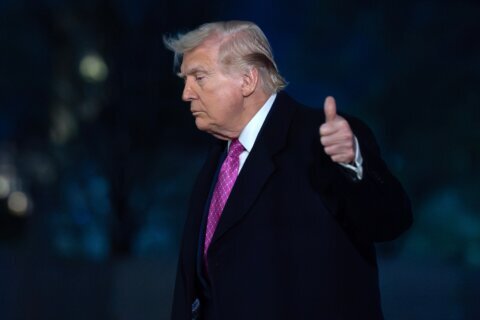
Trump, who has actively campaigned to be awarded the prize, said Machado left the medal for him to keep. “And by the way, I think she’s a very fine woman,” he said. “And we’ll be talking again.”
That was of small comfort after Trump said it would be difficult for Machado to lead because she “doesn’t have the support within or the respect within the country.”
Machado crisscrossed Venezuela ahead of the 2024 presidential elections, rallying millions of voters looking to end 25 years of single party rule. When she was barred from the race, a previously unknown former diplomat, Edmundo Gonzalez, replaced her on the ballot. But election officials loyal to the ruling party declared Maduro the winner despite ample credible evidence to the contrary.
Machado, revered by millions in Venezuela, went into hiding but vowed to continue fighting until democracy was restored. She reemerged in December to pick up her Nobel Peace Prize in Norway, the first time in more than a decade that she had left Venezuela.
___
DeBre reported from Buenos Aires, Argentina. Darlene Superville in Washington and Meg Kinnard in Columbia, South Carolina, contributed.
Copyright © 2026 The Associated Press. All rights reserved. This material may not be published, broadcast, written or redistributed.