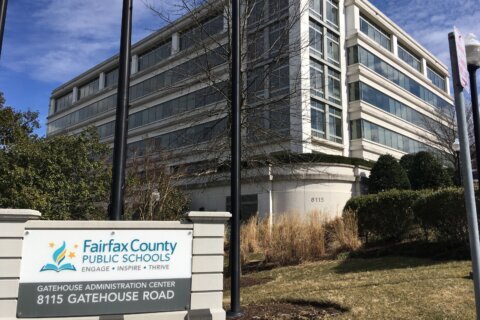
EDITOR’S NOTE: This is the first in a three-part series focused on Fairfax County Public Schools’ vote on new school boundaries, the district’s first boundary revision in 40 years. Part one focuses on what led school officials to the decision to redraw its boundaries.
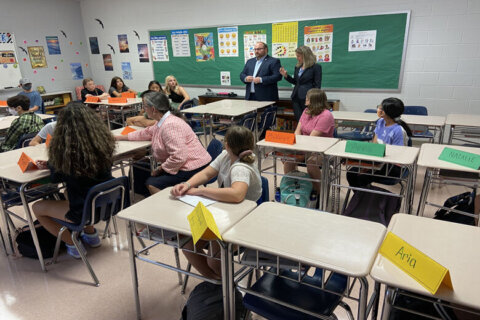
Fairfax County Public Schools has been working on its first comprehensive boundary review in decades, a step school leaders expect will help ease overcrowding in some places and reduce circumstances that lead to kids at the same elementary schools attending different middle and high schools.
The process has been ongoing for over a year, and the district hired the group Thru Consulting to lead the effort. In 2024, the school board updated a policy to mandate the superintendent review school boundaries across the county every five years.
After months of community meetings and public hearings, the school board is scheduled to vote on Superintendent Michelle Reid’s recommendations Thursday.
“It’s kind of like magnets on a board,” School Board Chair Sandy Anderson told WTOP. “So if you move one group of kids, then you create a problem somewhere else. And that’s kind of been what’s happening overall. What I’m hoping that we could have done with it, what I feel like we did do with this process, is move the minimal number of children possible in order to even out enrollment.”
Broadly, school boundaries are used to determine which residential addresses are zoned to attend a specific set of schools.
School Board Member Melanie Meren said while some changes have been made to school boundaries in the Northern Virginia suburb in the past, they weren’t comprehensive. They were administrative in nature, Meren said, suggesting that someone could call the superintendent or a school board member to discuss a boundary change, and “it just created a lot of inconsistency.”
During the summer of 2025, the school board made another policy change, allowing students in high school the option to remain at their current school, even if the boundary changes. There is flexibility for some elementary and middle school kids, too.
However, Meren said, students choosing to stay at their current school won’t get transportation, “because there’s a different process for that.”
The boundary review was necessary, Anderson told WTOP, because there are some Fairfax County schools that are over capacity or have a higher membership next to other schools without those constraints.
“And there are really budgetary implications that happen when you have a school that is either over or under capacity,” Anderson said, adding the changes will let division leaders determine where there are opportunities to expand programs.
In making decisions about school boundaries, division leaders, based on school board policy, have to consider access to programming, enrollment and capacity, proximity to school and transportation.
Currently, 42 schools serve as “split feeders” — elementary schools that feed into multiple middle or high schools and middle schools that feed into multiple high schools. And over 20 schools have “attendance islands,” which the county defines as a geographic area assigned to a school, even though it is not directly connected to that school’s boundary.
Reid previously said her recommended plan would reduce those scenarios. The original proposal would have impacted about 2,200 kids, but the one the board will vote on impacts about 1,700.
Nicole Meade, president of the Herndon Middle School PTA, said it’s surprising it’s taken so long for a full boundary review.
“Forty years seems like a really, really long time, and it’s way overdue,” Meade said.
Willow Rosenthal, a junior at Justice High School, said she first learned about the review process before winter break. She overheard discussions at the bus stop and spoke to her parents about it.
“We were all kind of anxious, worried,” Rosenthal said. “We were like, ‘Oh, we really hope we go to the school we’ve been going to for the past couple years now.”
At a public hearing on Jan. 10, Tamara O’Neil said for the last 18 months, “our families and most importantly, students, have lived with uncertainty and stress caused by this convoluted and disruptive boundary process. Children have worried about where they will attend school. Families have hesitated to make plans, and we are finally relieved that we are almost at the end of this process.”
Meanwhile, Anderson, the school board chair, said while community members often recommend increasing capacity at schools to meet growing needs, “we can’t build our way out of this problem.”
In the context of boundary reviews, Meren said demographic details cannot be used as part of the process, and often, people bring up the impact boundary changes can have on property values.
“The school board and the school system are not responsible for property values,” Meren said. “We don’t look at that data as part of this work.”
Maryland’s largest school system, Montgomery County Public Schools, is looking at some of its boundaries, too.
Get breaking news and daily headlines delivered to your email inbox by signing up here.
© 2026 WTOP. All Rights Reserved. This website is not intended for users located within the European Economic Area.