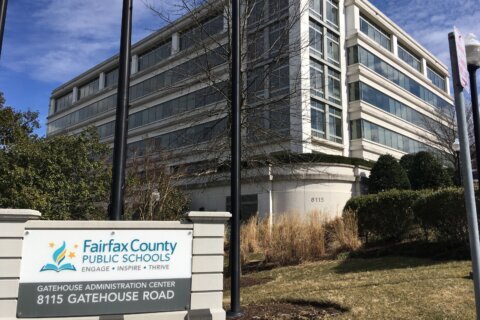
This is the third story in Pushing Boundaries — WTOP’s three-part series on Fairfax County Public Schools’ vote on new school boundaries for the first time in 40 years.
As Fairfax County’s school board prepares to vote on new boundaries as part of the division’s first comprehensive boundary review in four decades, some parents say the changes are long overdue and don’t go far enough.
But others are worrying about the impact the shifts will have on students and school communities.
In an attempt to address capacity concerns, Superintendent Michelle Reid has endorsed a proposal that will impact 1,697 students. It’s a drop from the original plan, which would have affected 2,210.
Almost 100 speakers lined up to share their thoughts during a Jan. 10 public hearing. Another such hearing is scheduled before the school board’s vote Thursday. If approved, the new boundaries would go into effect this fall.
“I heard about them right before winter break, and my first thought on it was, ‘This is gonna really be a big hassle for my parents,'” Glasgow Middle School sixth grader James Sinclair said.
Sinclair worried about the initial proposal, which may have caused his brother to attend a different school.
“He has a hard time making friends, so I want to be there to try and help him,” Sinclair said.
Odessa Jansen, a rising senior at Justice High School, worried about a proposal that would have changed her house’s boundary from Justice to Falls Church High.
She wondered whether she’d have to stop working toward an International Baccalaureate diploma, because she said IB courses aren’t offered at Falls Church. Her friends considered the impact a change would have on their ability to play certain sports.
“Through every assignment that we’ve been working on, and at every lunch, it came up as a topic,” Jansen said. “We made group chats online, through text, to talk about everything that’s been happening with the boundary changes.”
But Reid’s latest proposal reverses the possible changes for Sinclair and Jansen, they said, a move they suspect is in part the result of their advocacy.
“We are happy that decision was made at the ninth hour,” said Kris Griffin, a parent of two Fairfax County students. “That gives us time to be able to figure out, ‘OK, where do we go from here?’ Obviously, we’re not scrambling. I have a kid who’s a junior in an IB program. It is just unthinkable to think that I would have her move to another high school that doesn’t even have the same program she has.”
Reid’s proposal sends some students to Herndon Elementary.
Melissa Morrison, a PTA committee member at Herndon High School, called the review process a positive exercise but said there are still some changes that should be considered to save money on transportation costs.
In Herndon, there are nearby neighborhoods “that really should be going to Herndon High. They’re two and a half miles away, and still, you get transported and we’re paying multimillions of dollars in transportation costs,” Morrison said.
Nicole Meade, president of Herndon Middle School’s PTA, said while many people seem upset that boundary changes could impact home value, “I’m not a realtor, but I do know that in Fairfax County, even where I live, which is Reston/Herndon, the value of my house has not gone down in 10 years.”
During a public hearing, a fifth grader at Rolling Valley Elementary said the proposed changes reduce but don’t eliminate a split feeder, “which really makes it worse. Now we will have even fewer community members continuing onward with us toward middle and high school. That’s a very lonely path.”
A high schooler worried about possible changes before the final proposal was announced, meanwhile, said the decisions “are not just data points on a map. They affect real students, real families and real lives. Changing schools at this point would be extremely disruptive, emotionally detrimental, and during the most critical years in my education, I would be separated from my friends, my support system, and the community I’ve built over several years.”
Cathy Hosek said boundaries shouldn’t be handled “in isolation from programming,” adding each school pyramid “needs to have a common base of what is available, as these choices directly affect capacity, staffing, transportation.”
Cheryl Schoenberg, a parent of two Fairfax County students, said, “No community should have to be split up to take a couple students here and a couple students there to try and deal with capacity. That’s not a real solution.”
Read part one of the series here. Read part two here.
Get breaking news and daily headlines delivered to your email inbox by signing up here.
© 2026 WTOP. All Rights Reserved. This website is not intended for users located within the European Economic Area.