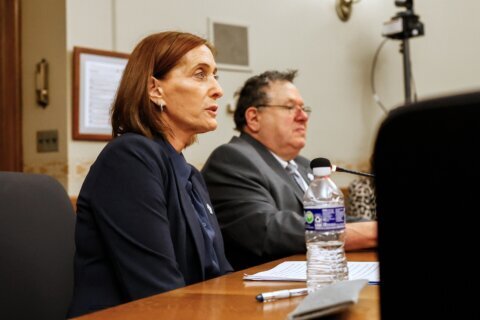
Parents, teachers, administrators and school district leaders from across Northern Virginia gathered in Alexandria on Wednesday night, brainstorming ways schools can better support students and families and retain teachers.
The meeting at Alexandria City High School’s Minnie Howard Campus was the last stop on a Virginia Department of Education listening tour. As part of Executive Order Four, Gov. Abigail Spanberger directed the education secretary and superintendent of public instruction to host a statewide listening tour and summarize findings from the community sessions.
The Wednesday meeting marked the last stop on the tour, and brought together public school leaders including Loudoun County Superintendent Aaron Spence, Fairfax County School Board Chair Sandy Anderson, Arlington Chief Academic Officer Gerald Mann and Alexandria City School Board Chair Michelle Rief, among others.
During the 90-minute session, small groups discussed strategies for retaining educators, ways to help students and families and how the state’s new school performance framework has been working.
“We need to figure out what works, and we need to continue to try to build on what works,” said John Porter, a former teacher, assistant principal and principal with Alexandria City Public Schools. “Sometimes, because of the nature of the turnover over the years, we tend to reinvent the wheel more than we probably need to, and therefore we’re going back to the drawing board from time to time.”
Jenna Conway, Virginia’s new Superintendent of Public Instruction, said throughout the listening tour, families encouraged staff to consider what changes get made.
“They have also asked us to be thoughtful about change and the pace of change, and so there are places where they want us to stay the course,” Conway said.
As for some of the recent literacy changes, “we’re going to stay the course on that,” Conway said.
Part of Spanberger’s executive order calls for a working group that will help strengthen implementation of the Virginia Literacy Act. The General Assembly passed the act in 2022, and it went into effect for the 2024-25 school year. It requires schools to use an evidence-based literacy curriculum.
Virginia has changed English language arts, math, science and social studies standards recently, and Conway said families have urged the state to avoid changing them again.
Changes to the school accountability system will be made based on what Virginia’s Joint Legislative Audit and Review Commission said needed to be tweaked, Conway told WTOP. A report from the commission found the system approved in 2024 to be more effective and useful than the one previously used, but recommended a series of changes.
As for statewide testing, Conway said, “We do want to see some changes as it relates to testing and figuring out what our next assessment system will be, and how do we support all of our schools to implement testing in a way that works better for kids and for educators.”
On topics such as technology use in schools, Conway said community feedback across the state varied.
“They have incredible needs, from mental health needs to students who are new to this country to students who might not be engaged in school,” Conway said. “We have students who think we need more technology, and we have students who think we need less technology.”
Broadly, Porter, the former principal, said one of the biggest challenges for education leaders is making decisions “based on elections and budget cycles. Nobody’s looking 15 years out to see the results they’re looking at. Let’s look at the results this year. We’re going to implement something now, and we want the results right now, because we got to develop another budget, and somebody else is going to get elected in four years or two years.”
Get breaking news and daily headlines delivered to your email inbox by signing up here.
© 2026 WTOP. All Rights Reserved. This website is not intended for users located within the European Economic Area.