They bounced from one table to another, rolling dice, flipping coins and adding up the numbers on playing cards. Their parents watched over their shoulders.
During D.C. Public Schools’ Family Math Night, parents got a firsthand look at how to help their students with math concepts at home. Many appreciated the refresher.
“The way that I was taught math, even though we will derive the same answer, but he has to articulate now and be more expressive,” Denise Govan said.
Fifth grader Cayden White said he enjoys long division and fractions, and he uses math for homework, but also notices it in football and soccer situations.
“Everything is math,” White said.
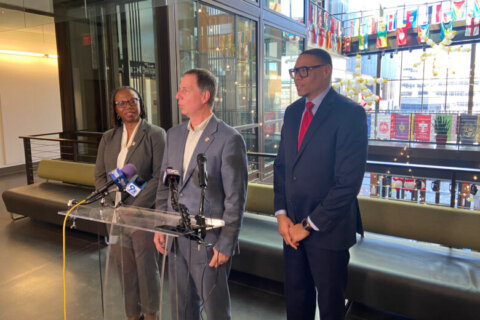
The event came as D.C. Public Schools Chancellor Lewis Ferebee said the city reported positive progress on its standardized test scores last year. And on stage, he announced funding that he anticipates will help maintain it.
A national foundation made an anonymous $20 million donation to the DC Public Education Fund, which is the nonprofit philanthropic partner to the city’s public school system. The money will cover professional development, including ensuring almost all teachers are in some way trained in how to teach math.
Notably, the funding will also cover the cost of high-impact tutoring for over 6,000 students the next two years. D.C. Mayor Muriel Bowser and other city leaders have attributed students’ success after the pandemic to that approach.
The gift will allow the city to open two math hubs that will serve as a centralized location for students to be tutored and educators to be trained.
The goal, Ferebee said, “is to ensure that every DCPS student is a math person, and we know how critical those skills are.”
Tequilla Hockaday-Bey said she has 6-year-old twins, and their teachers are starting to introduce math lessons. She attended math night “looking for tips and tools (about what) they’re learning at school to help me better understand how to teach their curriculum.”
Even as the crowd dwindled, some students remained focused, rolling dice and coloring in the corresponding number of boxes on a grid. Others continued flipping coins.
“It’s so fun, so cool, and I also get treats from it,” Da’yon Taylor said.
Meanwhile, Ferebee said, “We know oftentimes there’s a generational divide between what we hear as ‘old math’ and ‘new math.’ The more we can get parents and family members comfortable around the math concepts and the way they’re being taught in the classroom, ultimately, our students are going to benefit.”
Get breaking news and daily headlines delivered to your email inbox by signing up here.
© 2025 WTOP. All Rights Reserved. This website is not intended for users located within the European Economic Area.