From saving on school supplies to the impact of federal cuts, the WTOP team is studying up on hot-button topics in education across the D.C. region. Follow on air and online in our series, “WTOP Goes Back to School” this August and September.
This video is no longer available.
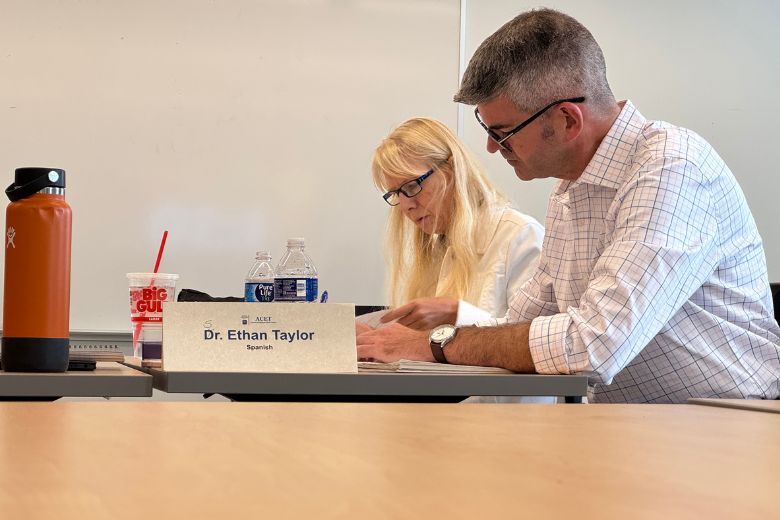
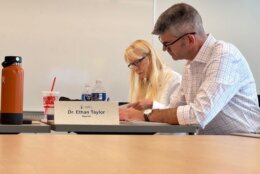
Ethan Taylor used to work for the U.S. Department of the Interior.
Abigail Norris used to work at the General Services Administration.
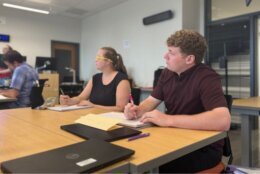
Jacob Baroch planned on a career in federal service while he was working at the National Institutes of Health.
But all three lost their jobs in the massive cuts carried out by Department of Government Efficiency under the Trump administration.
Now, they’re days away from starting new careers in classrooms. Taylor and Baroch were hired as full-time teachers with the Montgomery County Public Schools system.
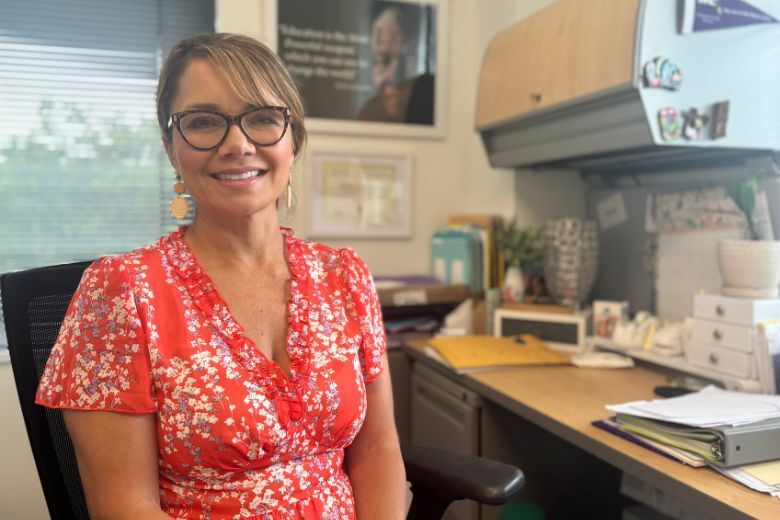
Glenda Hernandez Tittle with the School of Education at Montgomery College leads the school’s Alternative Certification for Effective Teachers program (ACET).
Tittle explained there were 18 members in the accelerated ACET program created to help former federal workers make the transition to careers in education.
“Out of the 18, we have 14 who have been hired already as teachers with Montgomery County Public Schools,” she said. Tittle said that outcome was “very, very exciting considering we just started the program in June.”
Taylor told WTOP: “I was recently offered — and accepted — a teaching position at Quince Orchard High School in Gaithersburg, Maryland. I will be teaching high school Spanish.”
It was on the day WTOP visited the ACET classroom in at Montgomery College’s Rockville campus, when Baroch learned he’d been hired.
“I was going to teach high school Bio, and now I’m switching to middle school science at Takoma Park,” middle school, Baroch said.
Baroch explained that there were few openings at the high school level, but more opportunities in middle schools. So he shifted his course of study.
Norris has had a slightly different experience than Taylor and Baroch.
“I’m still putting out applications,” Norris said. “I’ve gotten a couple of callbacks, but nothing concrete yet, which is fine. I’m still early in the process.”
Since then, Norris has been hired as a long-term substitute teacher at Springbrook High School in Silver Spring, where she’ll be teaching English language learners.
Learning how to teach
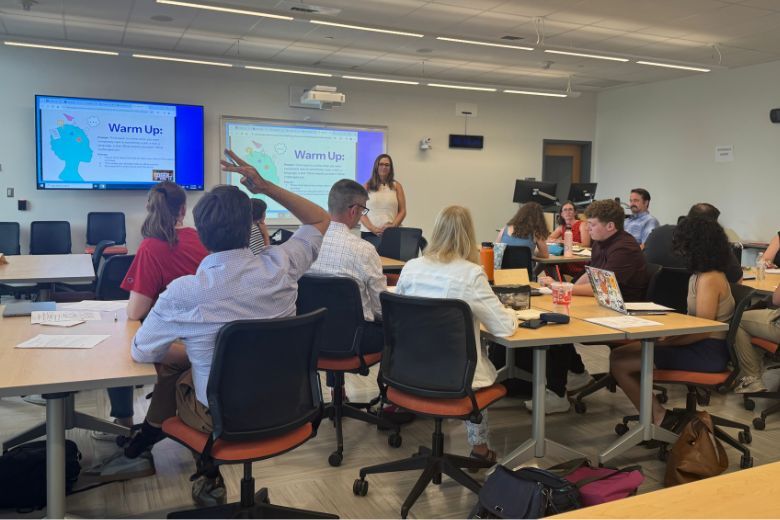
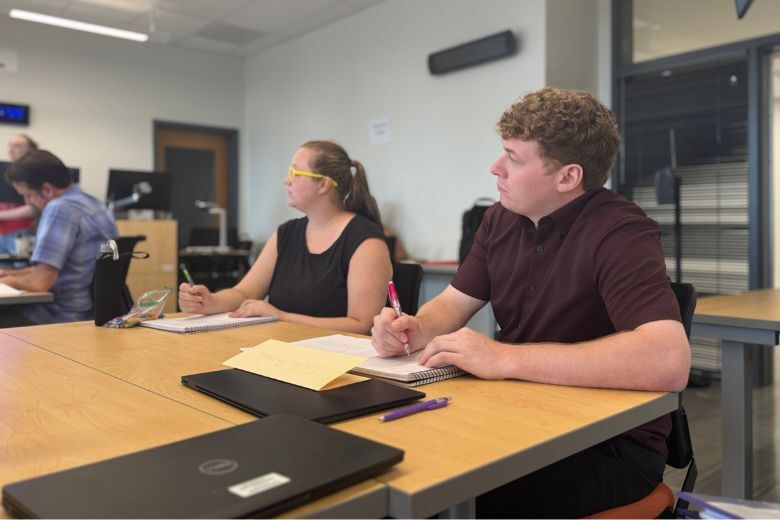

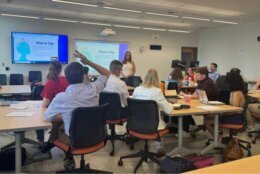

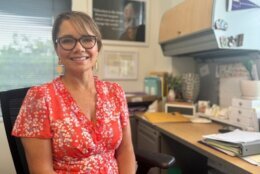
The three are now classmates in a Montgomery College course taught by Paula Martindill, a veteran of the ACET program and now an assistant principal at Springbrook High School.
In front of the class, Martindill models the kind of teaching practices that are designed to create classrooms where students can succeed, and teachers foster engagement and connection.
After a task where students were given a set time to complete a discussion, Martindill calls out “OK!” And pauses. “That’s time!”
A student asks for a bit more time.
“Thirty more seconds?” Martindill shakes her head, smiles and repeats, “That’s time,” signaling that she’s holding to the schedule she’d laid out for them.
Martindill then gives the class time to shift from their discussions and waits for them to give her their attention.
“Thank you,” she said, before explaining the next step in the lesson.
“Peer presentations are happening today, so exciting!” she said.
This evening, Taylor was among those presenting. He and his partner mirrored the practices Martindill had modeled. Clear instructions. Pauses between directions to make sure students had time to process the information they were getting. And breaking up the content into easy-to-understand pieces.
In his lesson, Taylor and his partner had students stand up and move to different parts of the room depending on whether they agreed or disagreed with a statement in the lesson.
It’s a strategy that allows students who spend much of their days sitting at desks, a chance to stretch their legs and literally get a new perspective in the classroom.
Taylor calls out, “There aren’t any necessarily right or wrong answers,” as students exchange ideas while they take their positions in the classroom.
Reflecting on the challenges he sees in the field he’s chosen, Taylor said, “To be honest with you, I’m not as concerned about classroom management as I am just the sheer level of preparation that goes into teaching.”
Martindill said any new classroom teacher can feel overwhelmed as they try to produce lesson plans that will actually hold up when a teacher has as many as 35 students before them.
‘A whirlwind’: Steep learning curve for former federal workers

The ACET program for federal workers, dubbed “Feds to Eds” by the Maryland State Superintendent of Education Carey Wright, has, said Martindill, “been a whirlwind. It started in June, it’s a very fast-paced program, even faster than the regular ACET.”
Baroch, who will be teaching middle school science, said when friends and family learned he was switching from high school to middle school science, some questioned his choice. Middle schoolers have a reputation for being a tough audience, especially for new teachers.
“Some people think that they’re not the easiest to teach, not the most willing to learn,” Baroch said. “I’m looking forward to the challenge, I think it will be good.”
But he also acknowledged that there was a fairly steep learning curve as he balanced brushing up on the content he’ll be teaching, while taking in how to convey the information to slightly younger students.
Norris said the program has taught her just how much has changed in education. There’s been a shift away from a top-down model with lots of lecturing, for example.
“Now there’s so much more project-based learning and students working with each other to learn about a certain topic,” Norris said. “It’s a whole different world now, and I think a better one for learners.”
‘I hope to inspire them’
Martindill was asked what tips she gives new teachers. One she said, is to avoid isolation. The first year of teaching is challenging, and in the first weeks, teachers face a fire hose of new information.
“The grading policy, the technology, the student code of conduct, the employee contract, you’re learning so many things,” she said. “You just have to take a deep breath, find your people,” and she added, “Ask for help.”
Taylor agreed, saying “Before, I thought I was sort of being thrown to the wolves and would not have the support that I felt I would need to be a successful first year teacher, and I’ve learned quickly that is not the case at all.”
He’s met with other Spanish teachers in the high school.
“I’m feeling much better about that than I was, say, four or five weeks ago,” Taylor said.
Every teacher develops their own style, often based on their personalities. Some veterans advise on leading with a tough exterior. Martindill is not a fan of the “never-let-them-see-you-smile-until-December” approach.
“I think we need to smile all the time,” Martindill said. “Our children need to know that we’re human, that we’re here for them, that we’re happy they’re here.”
Norris, who says it’s likely she will substitute for a while before finding a full-time slot, is eager to get to work.
“For me the privilege of getting to speak French every single day and have fun with the students and help make it engaging for them — that’s like, that’s my why,” she said.
Baroch agreed with part of the attraction to teaching is based on coming up with ways to make a topic — in his case science — interesting to students.
“Having fun with like, making my own activities that I think the students will enjoy,” Baroch said.
Baroch said he has taken the lessons on child development to heart, and wants to make sure that every student — no matter what challenges they face — feels welcome and valued.
“I want to make their day at school just as easy as possible,” he said.
Taylor said as he gains more confidence in tackling the challenges that teaching offers, he looks forward to getting started.
“And I hope to be inspired by my students just as much as I hope to inspire them,” Taylor said.
Martindill offered one more piece of advice — one that’s not restricted to new teachers. When a lesson plan bombs, when technology fails, when students prove challenging, “Always be kind, and always smile to the children. Even when you’re having a bad day, it makes you have a better day.”
Get breaking news and daily headlines delivered to your email inbox by signing up here.
© 2025 WTOP. All Rights Reserved. This website is not intended for users located within the European Economic Area.