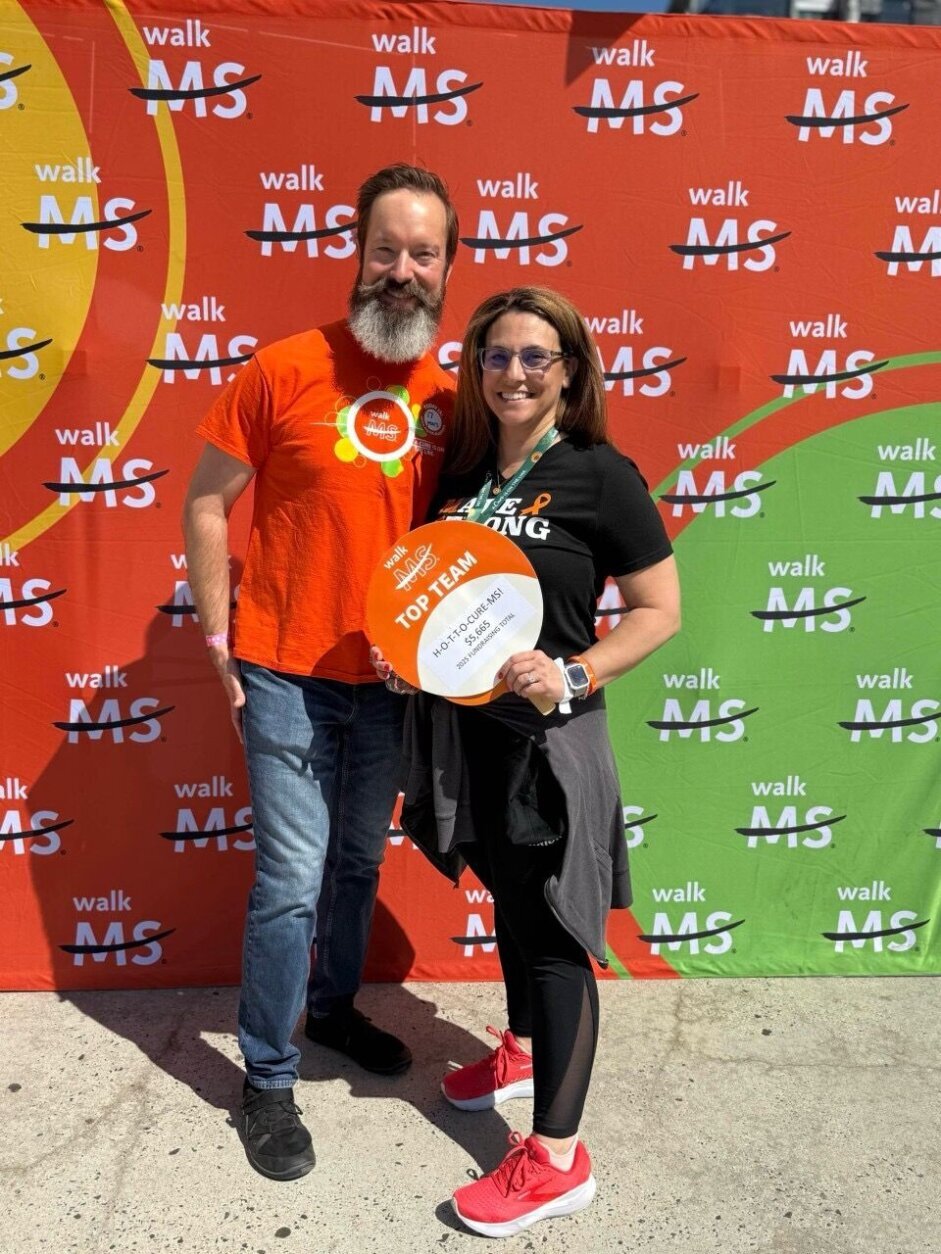
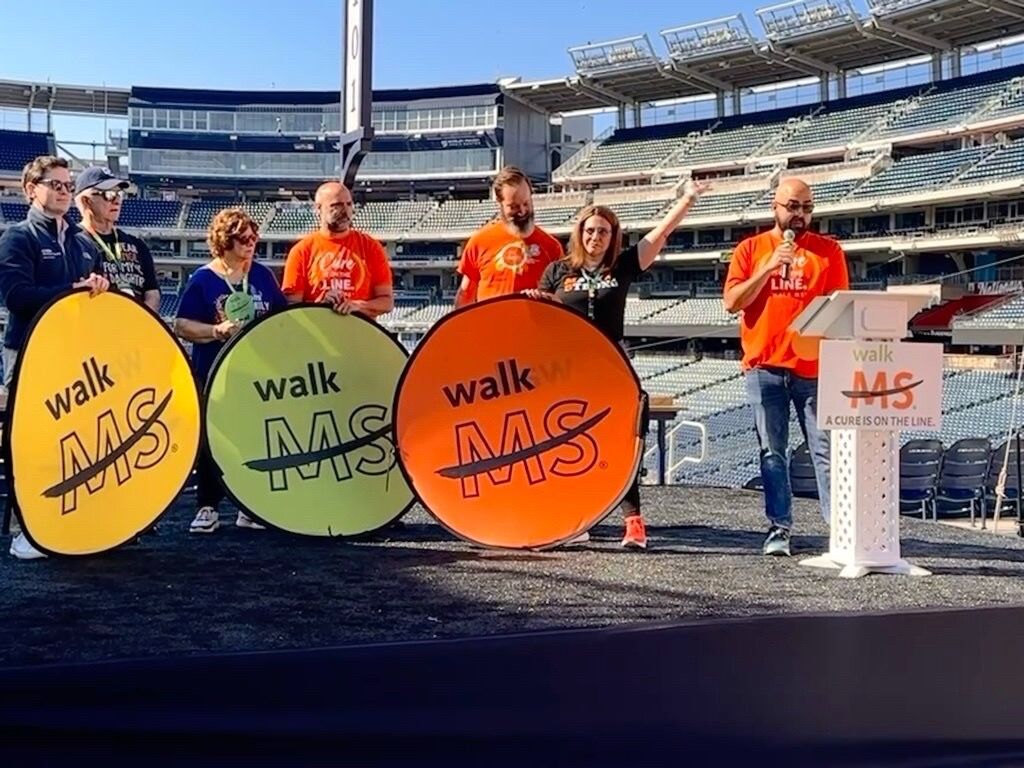



At Nationals Park on Sunday, the National MS Society hosted Walk MS D.C., an event aimed at raising awareness about multiple sclerosis and the importance of early diagnosis and treatment.
For Jenny Nieto, a D.C. resident, her diagnosis followed a sudden and frightening change in how she felt after finishing a 5K run more than two years ago.
She said she initially felt unusually wobbly and dehydrated. Instead of easing, those symptoms lingered. In the days that followed, new and more serious symptoms appeared.
“I was having trouble with my vision. I started getting very severe vertigo symptoms, nausea, vomiting — kind of uncontrollable. And I realized something is very seriously wrong,” Nieto told WTOP.
Concerned she might be having a stroke, Nieto went to the emergency room.
“I went eventually to the ER for a suspected stroke, and they said, ‘No, it’s not a stroke, but you have MS,’” she said.
Multiple sclerosis is a neurological disease in which the immune system attacks the protective covering of nerves, disrupting how the brain communicates with the rest of the body. Symptoms can vary widely from person to person, according to Dr. Brian Barry, who leads the MS clinic at MedStar Washington Hospital Center.
“They can be something as subtle as fatigue or brain fog, but they could be something as striking as vision loss in one eye, causing you to go blind for a few weeks,” Barry told WTOP.
Barry said numbness, weakness and trouble walking are also common warning signs.
In Nieto’s case, imaging later revealed she may have been living with MS for years without realizing it. She said her doctor told her MRI scans suggested signs of the disease dating back decades, though she had never experienced a major medical episode until after the race.
“MS affects one in 300 people, and if you think about that number, you know people who have MS, who might not even know that they have MS,” Barry said.
He said that is why events like Walk MS D.C. are important for raising awareness about the illness.
Barry said early diagnosis and treatment are key, especially now that patients have far more options than in the past.
“We didn’t have any treatment for MS until 1993, and I would argue that we didn’t get our first very effective treatments until more than a decade after that,” he said.
Barry said there are now dozens of FDA‑approved therapies, including oral medications, injections and infusions, and outcomes improve when treatment starts sooner.
“If we can get somebody started on highly effective treatment in 2026 at a time when they have little to no disability from this condition, my expectation is that they’re going to meet all of their goals, personal goals, professional goals, family goals,” he said.
After her diagnosis, Nieto began treatment and said she is doing well. She has also found community and connection in unexpected ways.
On her very first date with the man who would later become her fiance, she learned they shared the same diagnosis.
“He said, what? And we realized we both had MS in common,” Nieto said.
Their connection did not end there. On their fourth date, they went to the doctor’s office together.
“I took Mike (her fiance) to meet Dr. Barry,” she said.
Now, the couple not only share their lives together, but also their neurologist, and that is something Nieto calls an important part of the couple’s “love story.”
As she walked at National Park surrounded by others living with MS, Nieto said she refuses to let the disease define her.
“I may have MS, but MS does not have me,” she said.
WTOP’s Mike Murillo, who lives with MS, served as the host for Walk MS DC on Sunday. More information about MS is available through the National MS Society.
Get breaking news and daily headlines delivered to your email inbox by signing up here.
© 2026 WTOP. All Rights Reserved. This website is not intended for users located within the European Economic Area.