Mayor Muriel Bowser said the D.C. Council’s decision to hold off on an extension of the city’s targeted youth curfew for three weeks is a signal the council is “soft on crime.”
The mayor told reporters at an unrelated event Wednesday that because of the council’s action to postpone the vote until April 21, there will be six days — April 15 through April 21 — where there will be no targeted curfew on the books. That comes during spring break for students attending D.C. Public Schools, and as the weather warms up, when more young people are expected to spend time outside.
Bowser said the council’s move leaves her with limited options, but ones she said she’s ready to take, including declaring a public safety emergency so a curfew could remain in effect during spring break.
“I will put all options on the table,” Bowser said.
The mayor said when it comes to crime-related issues, there is a pattern among decisions made by the D.C. Council. Bowser said the council is slow to recognize the issue; it eventually reacts and passes legislation that works and the crime numbers come down, then it declares the problem solved and changes the laws back to the way they were before the crime problem started.
She said it’s happening again.
“I can’t be the only one speaking up for public safety in D.C.,” Bowser said.
Under the citywide curfew, kids under 18 can’t be out in public or at an establishment in D.C. from 11 p.m. to 6 a.m., with some exceptions.
The curfew extension that’s now on hold would have lasted until Sept. 25. Bowser said the council’s decision to postpone a vote for three weeks complicates things.
“Because it seems like the council is listening to a very narrow interest group and is very influenced by the election calendar, and not by what we need,” she said. “So the council will say they’ve driven crime down, so ‘let’s start going back to soft-on-crime policies.'”
The emergency law also gives the chief of D.C. police the authority to designate certain areas as juvenile curfew zones. In those areas, people under 18 cannot gather in a group of nine or more. Those zones can prohibit minors from gathering after 8 p.m., ahead of the general citywide curfew.
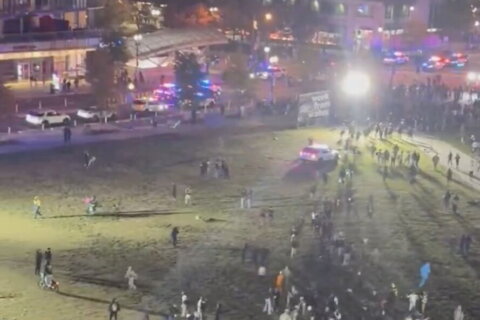
The mayor said she is concerned because of a March 14 disturbance near the Navy Yard turned violent when an estimated 200 young people congregated and someone fired a gun; there were multiple robberies and two teens were arrested.
Council member Brooke Pinto, who chairs the Judiciary and Public Safety Committee, has said she believes the council would support a permanent curfew.
Before the council postponed the vote, Pinto argued gaps in the curfew could create unsafe conditions in the District.
“It is unacceptable for our neighbors to face outbreaks of violence,” Pinto said. “It’s unacceptable to put our young people in harm’s way, and we’ve seen this in recent weeks in Navy Yard, Hill East and U Street, in particular.”
There have been 19 youth curfew zones declared over the last eight months. Pinto argued the zones prevent a strain on resources for D.C. police.
On Tuesday afternoon, Council Chairman Phil Mendelson called to postpone the vote until the council’s next legislative meeting.
“The Chairman moved to postpone the vote because some members voiced concerns/questions about the legislation and he wanted to give them more time to speak with Councilmember Pinto and the Mayor about those concerns,” Mendelson’s office wrote in an email to WTOP.
Some council members have opposed the curfews in the past, arguing they’re a temporary fix instead of investing in youth services.
Nine council members would need to approve the emergency legislation for it to pass and extend the curfew through the summer.
WTOP’s Jessica Kronzer and Thomas Robertson contributed to this report.
Get breaking news and daily headlines delivered to your email inbox by signing up here.
© 2026 WTOP. All Rights Reserved. This website is not intended for users located within the European Economic Area.