A federal judge will consider a request Thursday afternoon to block President Donald Trump from closing the Kennedy Center for two years, as part of his plan to renovate the performing arts center, to which he has added his name.
The request for a temporary restraining order seeks to stop — at least for now — the firings of employees, the canceling of performances, and any steps toward closing, demolishing or renovating the Kennedy Center.
Thursday’s hearing in U.S. District Court in Washington is part of the lawsuit filed in December 2025 by Ohio Democratic Congresswoman Joyce Beatty to stop Trump’s efforts to rename the Kennedy Center.
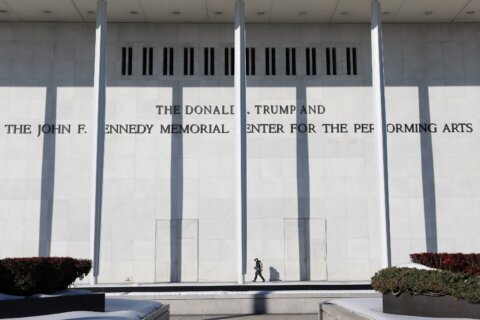
On Dec. 19, one day after the center’s board of trustees, made up of Trump allies, voted to make the change, workers added the current president’s name to the exterior of the facility, which now reads The Donald J. Trump and the John F. Kennedy Memorial Center for the Performing Arts.
Beatty’s filing also requests the judge grant an order to ensure that Beatty, who is a trustee, can participate in an upcoming March 16 meeting of the Kennedy Center Board, which will be held at the White House.
On Feb. 1, 2026, President Donald Trump announced in a Truth Social post that he will be shuttering the Kennedy Center for two years of renovations, starting in July.
According to the suit, in public remarks since then, Trump has said he plans to reuse “the steel” and “some of the marble” from the current facility, and create a “brand new” building.
The suit alleges that Trump is abandoning the Kennedy Center’s operating plans to conduct routine repairs and capital maintenance while the performing arts center continued to operate.
“The sudden closure appears designed to hide the embarrassing flight of patrons and performances precipitated by President Donald Trump’s turning the Kennedy Center in a personal vanity project,” according to the filing.
While the closure of the Kennedy Center is still pending the board’s approval, Beatty’s filing says if the facility is closed, it would be extremely difficult to revive the institution: “Performances will move elsewhere, staff will depart and the Center’s reputation will be harmed.”
The request for a temporary restraining order asks the judge to act immediately to prevent irreparable harm.
The filing asks the court to prohibit the Trump administration “from physically destroying the Center and require notice to the Court well before an construction begins. The President’s tactics with respect to the Kennedy Center are unfortunately reminiscent of his previous demolition of the East Wing of the White House,” as part of his plans to build a ballroom.
Beatty’s filing raises concern that the Kennedy Center will be torn down quickly: “There is every reason to believe that past will be prologue.”
According to Beatty’s attorneys, including the Washington Litigation Group, “The court should not wait until the bulldozers are at the door. It should issue an order that preserves the status quo until the rule of law — not unilateral executive action — determines the Kennedy Center’s ultimate fate.”
What the Trump administration says
In its response to the request for a temporary restraining order, the Trump Administration says Beatty will be allowed to attend the March 16 meeting, but doesn’t address the issue of whether there are plans to move forward with tearing down the Kennedy Center.
“She will be entitled to speak at that meeting,” according to the administration’s response to Beatty’s request for a temporary restraining order. “To be sure, plaintiff will not be permitted to vote. But that is because, under the Center’s bylaws and established procedure, ex officio trustees have no right to vote.”
Beatty is an “ex officio” board member by virtue of her position as a U.S. Representative.
Intervention by the court at this point “Would significantly prejudice defendants’ interests managing their internal affairs and, further, would harm the public interest in the effective administration of federally chartered charitable trust instrumentalities,” according to Justice Department attorneys.