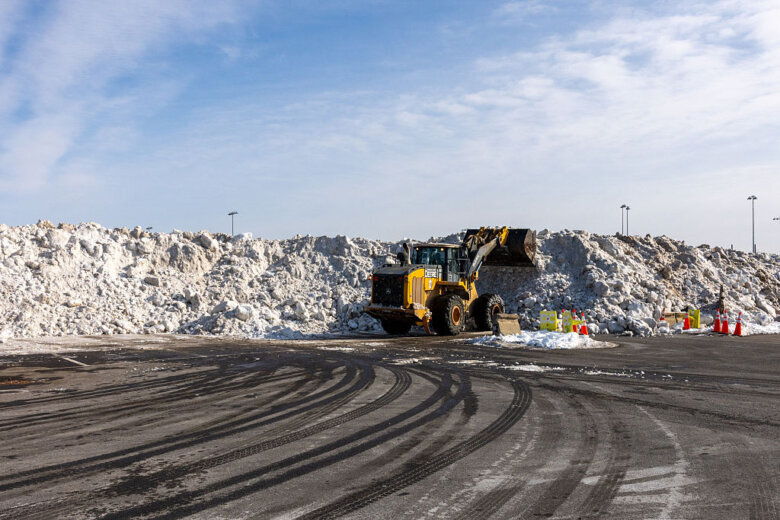
Piles of rock-hard snow continue to narrow roadways and sidewalks in the District, more than a week after a winter storm coated the D.C. region in snow and ice.
District officials are making a push to get life back to normal, announcing plans Monday to reopen schools on time, pick up trash on schedule and mapping out a game plan to continue dumping truckloads of icy stuff at drop-off spots around the city.
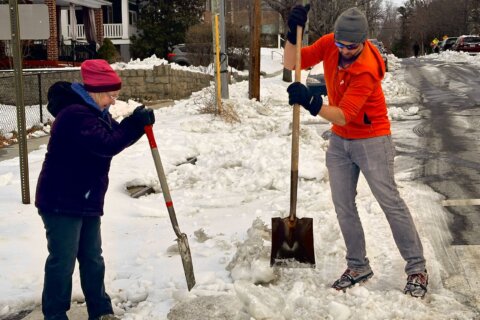
They’re also putting the heat on residents and business owners to get icy sidewalks cleaned up — sharing reminders about potential fines for sidewalks, alleys and entryways that aren’t cleared.
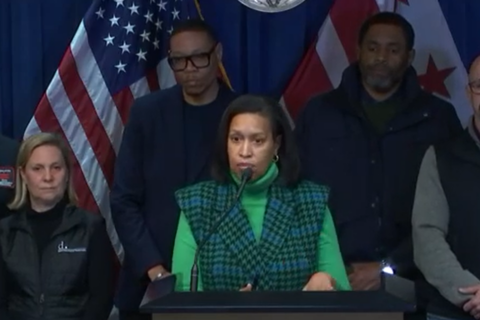
D.C. Mayor Muriel Bowser called it an “unprecedented snow event.”
“In the context of how the snow came down, the snow then multiple hours of sleet and freezing rain, followed by a historic run in our city of below freezing temperatures,” Bowser said. “Those are the conditions we are responding to. I remain very grateful for the Herculean efforts of our snow team.”
There’s hope from D.C. officials that the week’s forecast will be more forgiving, with higher temperatures expected during the day that could melt snow. But nighttime temperatures will still be bitterly cold this week, and there’s a chance for some flurries overnight Tuesday.
Schools to reopen on time Tuesday
For the first time since the winter storm, officials said public schools will open on time Tuesday in the District.
D.C. students have been navigating slick pathways while heading back to in-person classes over the past several days. The District’s public schools reopened Thursday, several days earlier than most other school systems.
In fact, a few neighboring counties closed schools through Monday, including Montgomery and Prince George’s counties in Maryland and Fairfax County in Virginia.
Bowser was asked Monday about reported outages at some D.C. schools amid the bitterly cold temperatures last week and whether families are owed an apology.
“We don’t owe an apology for opening schools, and when it’s record cold weather and facilities this large, there are frequently heating failures,” Bowser said. “We work quickly to respond. And I don’t think that we’ve had to close because of heating.”
Delano Hunter, the director of the D.C. Department of General Services, said the storm was a “one-two punch,” first with the wintry mix nicknamed “snowcrete,” which has been mostly cleaned up from public areas, such as schools and bus depots.
“But the second punch is really the extended cold weather, so it has been hand-to-hand combat for our HVAC systems and our boiler systems,” Hunter said.
He said the extreme cold temperatures can cause systems to fail at older facilities.
“With aging infrastructure, we’ve been able to install contingencies, bring some of those systems back online, and then relay that information to our partners so they can make operational decisions,” Hunter said.
Possible fines for messy sidewalks
More than 4,000 residents picked up free salt from the city over the weekend as D.C. pushes for clear sidewalks.
A rule on the books in D.C. says residents and businesses must clear their sidewalks within the first eight hours after a storm — or face fines.
That law was temporarily suspended last week, but D.C. officials said they’ve begun passing out flyers Monday with reminders about the regulation.
City officials did not commit to a deadline before they’d enforce fines for messy paths, up to $25 for residents and $150 for business owners.
According to the city, the enforcement teams are starting out with areas near public schools, libraries, senior homes and commercial corridors.
Residents with disabilities or are 65 years old or older can apply for an exemption to the shoveling law.
Strategy for clearing roadways, collecting trash
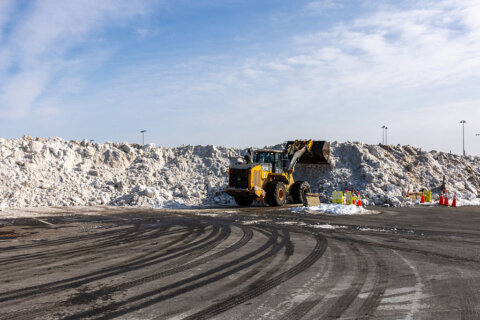
Crews have already filled a 22-acre lot on United Medical Center’s campus with snow and ice. An estimated 900 loads of so called “snowcrete” are being hauled to drop-off sites at the old RFK stadium site and Carter Barron Amphitheater.
“We know salting and plowing, in some cases, is having limited impact,” Sharon Kershbaum, director of the District Department of Transportation, said.
Kershbaum said DDOT will add bobcats, as necessary, to dig out the wintry mix.
“But for the most part, things are accessible, and as soon as you get to the collectors and arterials, you’re really able to get where you need to go,” Kershbaum said.
All that effort has been targeted at reopening major routes and eventually secondary roadways.
“We’re trying to open up all of the travel lanes on this next tranche of major arterials,” Kershbaum said. “Downtown, we’re continuing to clear out other segments again to help for pedestrian and transit access. The hauling operation has been considerable.”
Interstates 295, 695 and 395 were cleared by Sunday, Kershbaum said.
Crews will first focus on clearing snow off Connecticut Avenue, Wisconsin Avenue, Georgia Avenue and 16th Street. The goal is to clear those roads from now through Wednesday.
Meanwhile crews are also looking to clear what DDOT described as major north-south and east-west routes from now through Sunday. Those routes include 14th Street NW, North Capitol Street, H Street NE, Massachusetts Avenue, Rhode Island Avenue, Military Road and Missouri Avenue.
Bobcats have been clearing alleys, with a special focus on areas where trash is collected on Monday and Tuesday.
Bowser said households that put out their trash in the alley or out front had collections as usual Monday. This week, crews will collect trash and recycling together.
D.C. officials advised that if your trash isn’t picked up on its typical day, leave it out and it should be picked up the following day. Trash that hasn’t been picked up after two days can be reported to 311.
Get breaking news and daily headlines delivered to your email inbox by signing up here.
© 2026 WTOP. All Rights Reserved. This website is not intended for users located within the European Economic Area.