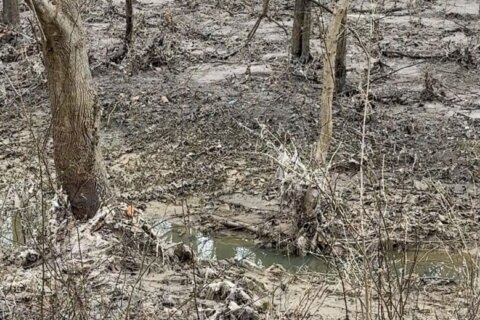
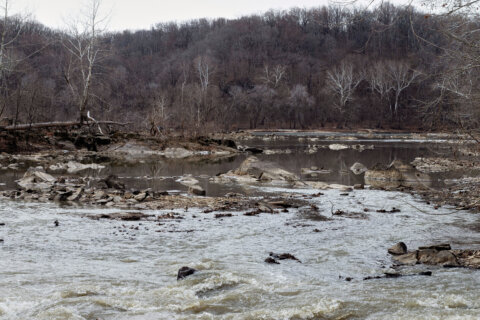
Mayor Muriel Bowser has issued a request for federal support and is seeking reimbursement for costs to D.C. and its agencies dealing with a ruptured pipe that has dumped over 200 million gallons of wastewater into the Potomac River.
Bowser declared a public emergency Wednesday night, saying D.C. agencies have coordinated to manage the incident under the District Emergency Operations Plan.
“The main piece of that is that the District is requesting reimbursement for costs that have been incurred by the District and D.C. Water, for both the repairs that are going on and remediation,” D.C. Deputy Mayor for Public Safety and Justice Lindsey Appiah said during a news briefing Wednesday.
In the mayor’s request for federal support, she asked for “100% reimbursement for costs incurred” by the District and D.C. Water.
Appiah added that city government has been coordinating support from federal agencies, such as the Federal Emergency Management Agency, the National Park Service and the Environmental Protection Agency.
D.C.’s Homeland Security and Emergency Management Agency has been working since Feb. 6 to conduct water testing, provide guidance to the community, coordinate with other agencies and evaluate the economic impacts, according to the mayor’s emergency declaration.
“We’re making the specific requests that we know that the District needs to ensure the safety of our waterways,” Appiah said. “Federal entities do exist to support this type of activity, and District residents deserve that.”
Appiah said federal agencies and President Donald Trump’s administration have been “operating within their lane,” but the D.C. government is in a unique position where they “often have to coordinate lots of federal entities.”
“One of the reasons that the mayor has made the decision to make this request of a presidential declaration is because it allows the president to really direct FEMA to provide those funds, and that’s a little bit different from kind of the normal grant process of determining what jurisdictions are going to get,” Appiah said.
When asked why the request is coming now, about a month after the pipe broke, Appiah said the decision was based on ongoing assessments of what would help the city speed up repairs and cleanup, especially with spring approaching and more people expected to use water recreationally.
Appiah, who is the acting incident commander in this case, said city agencies and regional partners in Maryland and Virginia are working to respond to the incident, calling it a regional effort.
“It’s a regional system and a regional response,” she said.
Lawmakers in neighboring Maryland — where the section of the sewer pipe broke along Clara Barton Parkway in Montgomery County — sent a letter to D.C. Water on Wednesday, pushing for an environmental remediation plan that includes continued testing and an evaluation for human impact.
In the letter to D.C. Water, congressional lawmakers from Maryland and Virginia have also called for a strong environmental remediation plan, public briefings and vigilant monitoring of bacteria.
The lawmakers requested that D.C. Water provide regular updates on the state of repairs, work on a comprehensive assessment and “commit to sustained water quality monitoring well into the spring.”
President Trump said Monday he is directing federal authorities to step in to coordinate the response and protect the region’s water supply. In a post on social media, he faulted Maryland Gov. Wes Moore and other “local Democrat leaders” who he said have “mismanaged” the “ecological disaster.”
Moore pushed back, saying the president has been responsible for the Potomac Interceptor sewer line for decades, adding that the Trump administration has failed to act for the last four weeks and has put people’s lives at risk.
Local reporter Martin Austermuhle with the 51st told WTOP’s Nick Iannelli on Wednesday night that the mayor’s request opens “the spigot of federal funding.”
“That could be for everything from actual fixes that D.C. Water is doing on the sewage pipe to any sort of impacts that local businesses in the District could suffer,” he said.
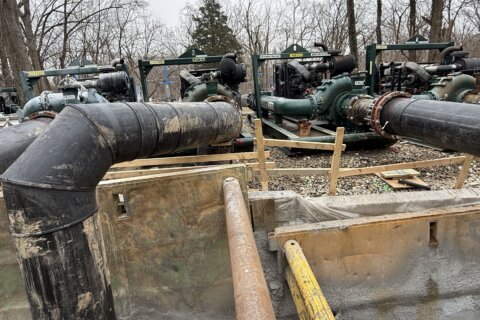
As of Wednesday morning, D.C. Water has installed six of seven high-capacity pumps, a few hundred yards above the collapse site, under the exit ramp off the American Legion Bridge onto the Clara Barton Parkway.
The pumps are diverting sewage from above the collapse point to an isolated section of the C&O Canal, to bypass the break, before being steered back into the Interceptor below the damaged pipe.
This week, after blocking wastewater flow to the collapse site, D.C. Water will finally be able to see the extent of the damage, remove the rock dam and replace the pipe. The utility estimated it will be 4 to 6 weeks until normal flow is returned to the Interceptor.
“They’re just realizing how serious the situation is. And the more cynical way to look at it is that the president made a very loud case this week that something needs to be done, and the mayor is responding,” Austermuhle said of the seemingly late response from the Bowser administration.
Austermuhle noted that there have long been health advisories surrounding D.C.’s river, but ” this is much more significant than that.”
Get breaking news and daily headlines delivered to your email inbox by signing up here.
© 2026 WTOP. All Rights Reserved. This website is not intended for users located within the European Economic Area.