The U.S. House of Representatives officially approved the 2026 National Defense Authorization Act in a 312-112 vote late Wednesday, advancing the policy bill to the U.S. Senate for possible clearance by next week.
The 3,000-plus page bill includes legislation that offers a pay hike to service members, increasing congressional oversight over the U.S. Department of Defense and language in favor of reopening up the District’s airspace to the military.
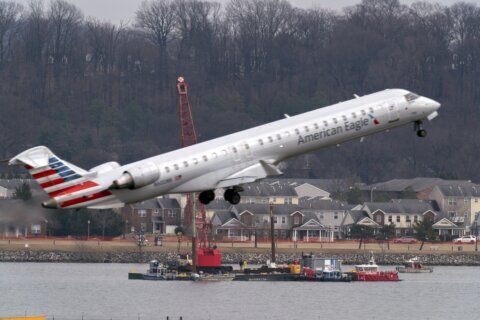
Restrictions for military flyovers were put in place in January following the midair collision between an American Airlines Flight 5342 and an Army helicopter near D.C.’s Reagan National Airport. The fatal collision killed 67 people.
Ahead of the NDAA’s passage in the lower congressional house, National Transportation Safety Board Chair Jennifer Homendy said she “vehemently” opposed the Section 373 provision, explaining it rolls back essential safety measures.
“This section to the lay reader is drafted to seemingly enhance safety,” she said. “I want to be very clear that it does not, in any way, enhance safety.”
Adam Tuss, the transportation reporter with NBC4, told WTOP that a key question surrounding the legislation is how it wound up in the defense bill in the first place.
“Nobody has the answers. So, in the days and weeks coming up here, we’re going to have to start digging and see who really wants that provision in there for military training operations around our airports, and why?” Tuss said.
Reaction from families of Flight 5342
In a joint statement, the families of Flight 5342 said Section 373 “does not resolve the visibility and coordination failures that contributed” to the January midair collision.
“Section 373 applies only to training missions — even though military helicopters in the National Capital Region fly a wide range of missions that routinely place them near commercial aircraft. It focuses narrowly on TCAS-compatible alerts rather than true visibility and broadcast requirements, and it preserves broad national-security exceptions similar to those in place at the time of the Flight 5342 collision,” the statement reads.
“These gaps mean the provision does not meaningfully mitigate the risks that proved fatal for our loved ones,” the families wrote in the statement.
“We urge Congress to strengthen Section 373 by requiring real, enforceable visibility standards for all military aircraft operating near civilian traffic,” it continues.
In separate remarks, Tim and Sheri Lilley, whose son, Sam, was the first officer of the jetliner, said the current version of the provision that was cleared by the U.S. House “has several unsatisfactory provisions related to aviation safety.”
“Safety that depends on exemptions cannot be the foundation of a secure airspace system,” their statement reads. “The flying public and all those that utilize our airspace deserve better than what this bill provides.”
DC Mayor Muriel Bowser
D.C. Mayor Muriel Bowser blasted the inclusion of Section 373, saying the measure “disregards” airspace restrictions and safety factors that were implemented in the wake of the midair collision.
“It is now clear that this provision was included without consultation from the NTSB, the agency leading the investigation into the crash, and without regard for the safety of D.C. residents, visitors, and our military personnel,” she said in a statement.
“I urge Congress to strike Section 373 from the NDAA and to follow the recommendations of safety experts. I will continue working alongside our federal partners to ensure compliance with safety protocols and to protect the integrity of our airspace,” her statement added.
Virgina Senators
U.S. Sen. Mark Warner (D-Va.) shared similar sentiments and concerns about the NDAA’s impact on D.C.’s airspace safety.
“The language in this provision could allow rolling back crucial new safety practices I fought to implement after the Jan. 29 tragedy and give the Department of Defense more discretion over safety procedures in the region,” Warner said in a statement.
He added that the Department of Defense needs more supervision and regulation, not less.
“It’s clear that we cannot rely on the DoD alone to be the safety authority over its flights in this area,” he stressed in the statement.
U.S. Sen. Tim Kaine (D-Va.), who also serves on the Senate Armed Services Committee and the Subcommittee on Seapower, weighed in on the NDAA’s failure to include language on restoring the names of military bases, an action that was backed by a bipartisan commission.
“I’m glad that the House voted to pass this year’s defense bill, which includes important provisions that will support service members, military families, Virginia’s defense community, and our allies,” he said in a statement.
“However, I’m extremely disappointed that a provision I fought for to restore a bipartisan commission’s names of our military bases was taken out at the last minute because President Trump threatened to veto the entire defense bill — just like he did in 2020, even though it included a pay raise for service members — to prevent changes to bases named for Confederates.”
“Virginians were proud to honor Tech. Sgt. Van T. Barfoot, Lt. Gen. Arthur J. Gregg, Lt. Col. Charity Adams, and Dr. Mary Walker. It’s shameful that the Virginia bases won’t continue to be named after these four amazing individuals,” Kaine’s statement added.
Kaine’s statement notes that both a bipartisan committee and the House Armed Services Committee cleared the language in efforts to restore the names of the Virginia bases.
Get breaking news and daily headlines delivered to your email inbox by signing up here.
© 2025 WTOP. All Rights Reserved. This website is not intended for users located within the European Economic Area.