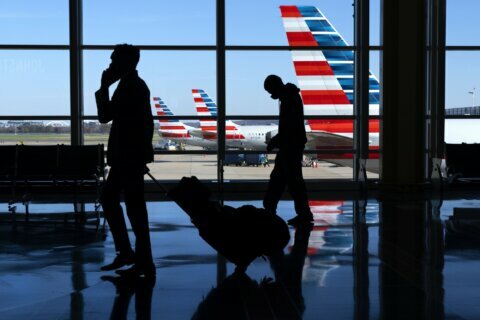
This story is part of WTOP’s series “Five stories that defined the DC-area in 2025.” You can hear it on air all this week and read it online.
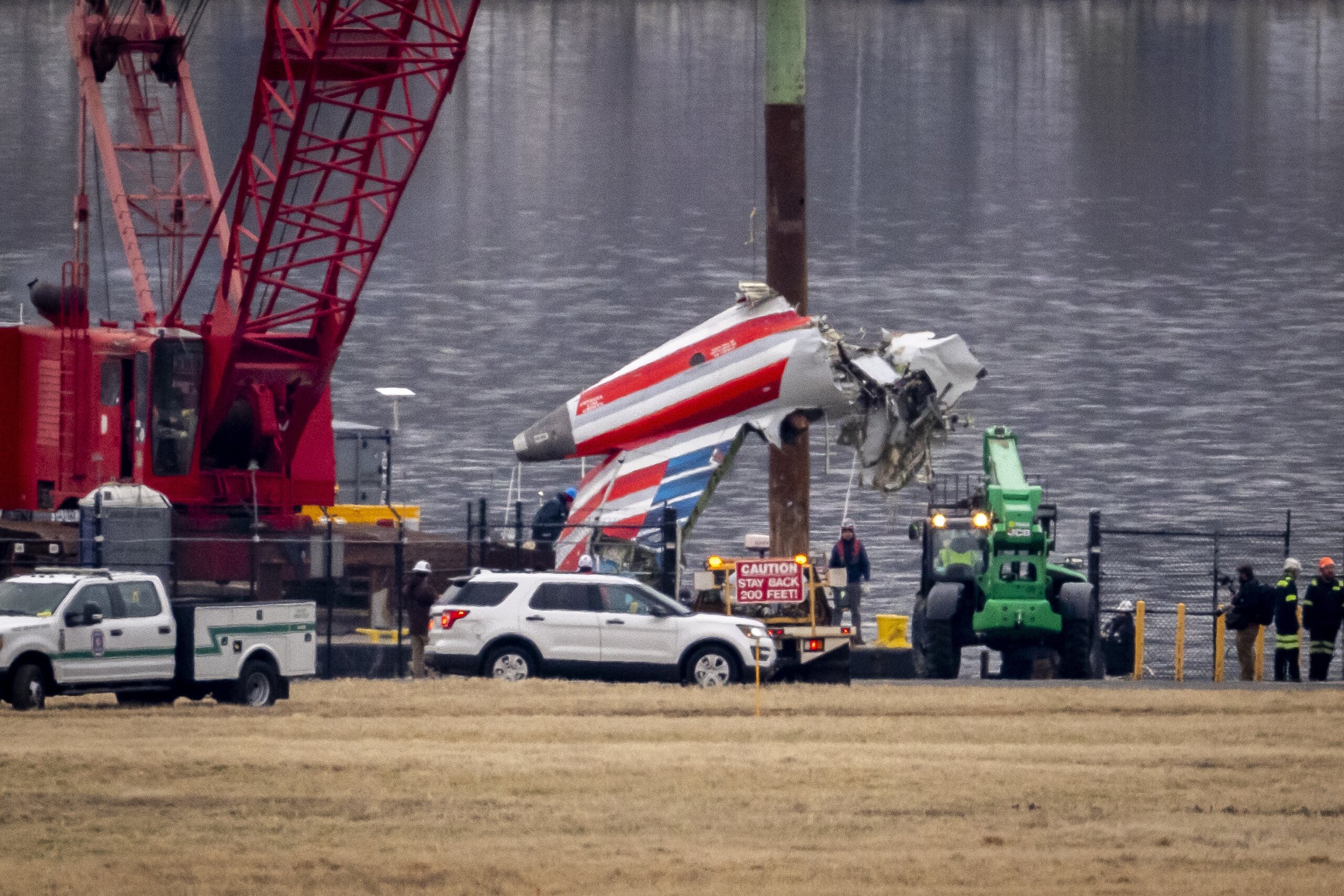
Almost a year after the midair collision between an American Airlines passenger jet and a U.S. Army Black Hawk helicopter, the congested airspace around Reagan National Airport continues to be the focus of attention.
“This was a wake-up call for not only the folks who go in and out of Reagan National all the time, but the whole country, finding out that this airspace was so conflicted between planes and choppers,” Tom Costello, senior correspondent with NBC News, said.
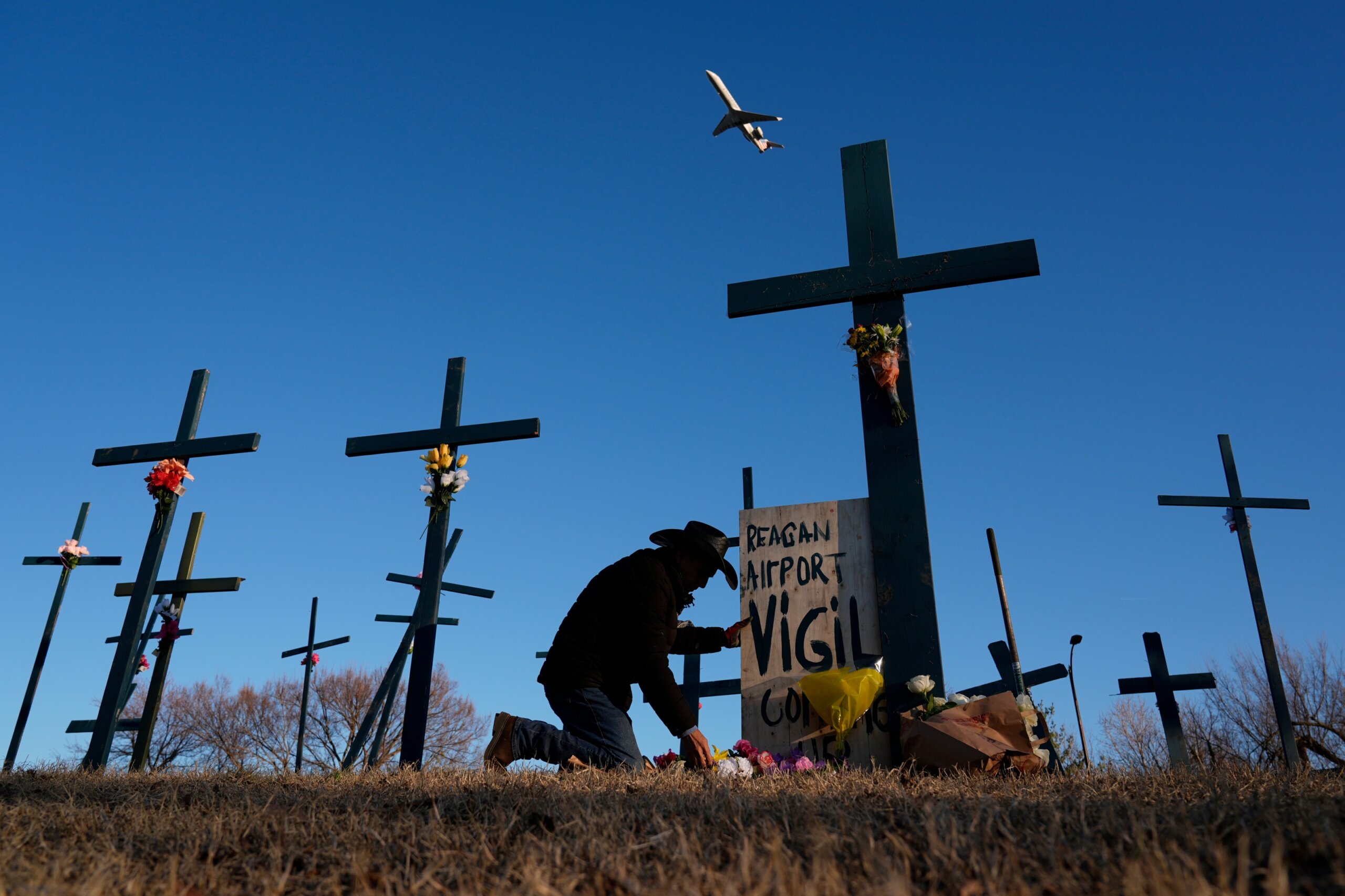
A total of 67 people — all 64 passengers on the commercial flight and three soldiers in the helicopter — died in the Jan. 29 crash.
In mid-December, the federal government admitted failures by the pilots of the Army Black Hawk helicopter and a controller in the Reagan National Airport tower contributed to the deadly crash.
The admission, which was first reported Dec. 17, is part of court documents filed by the Department of Justice in U.S. District Court in D.C., in a lawsuit brought earlier this year by the family of a passenger killed on American Eagle flight 5342.
“The United States admits pilots flying PAT25 failed to maintain proper and safe visual separation from AE5342,” according to the court filing, which also said air traffic controllers failed to alert the jet of the approaching chopper.
While allegations of liability and damages regarding the January collision continue in the court system, safety provisions to prevent future tragedies are still evolving.
Within days of the collision, the Federal Aviation Administration banned nearly all nonessential helicopter flights near Reagan National, requiring air traffic controllers and pilots to rely on radar to ensure separation.
- How much of an impact did DOGE have on the DC region?
- The DC area’s chaotic 2025 in pictures
- Five stories that defined the DC-area in 2025
The airport’s main runway — 01/19 — is the single busiest runway in the country, averaging 820 arrivals and departures per day, according to the Metropolitan Washington Airports Authority. The next busiest airport runways are at Los Angeles International Airport, with 781 flights, Newark Liberty International, with 607 flights, and Chicago O’Hare, with 599.
The Airports Authority and local politicians have continually challenged proposals to add additional flights at Reagan.
Takeoff and landing capacity at Reagan National and other busy airports is managed with a slot-controlled system. Airports have a limited number of slots per hour or day, set by the FAA to prevent overcrowding and maintain safety.
In May 2024, five new round-trip slots were added, as part of the FAA Reauthorization Act.
Virginia Sens. Mark Warner and Tim Kaine issued a joint statement in September: “Unfortunately, Congress added more flights into DCA’s already chaotic airspace just months before this tragic crash over the objections of the region’s Senate delegation and the Metropolitan Washington Airports Authority, disregarding the concerns of numerous pilots, air traffic controllers, and FAA and DOT personnel.”
The airspace over D.C. is the most restricted in the country. Since World War II, during the Cold War, and after Sept. 11, 2001, security measures have continued to increase.
The 15-mile Flight Restricted Zone around D.C. allows only military and government flights, emergency flights and scheduled commercial flights.
By March, the FAA imposed permanent rules, closing helicopter Route 4 between Hains Point and the Wilson Bridge and prohibiting the use of certain runways at Reagan National when helicopters are conducting urgent missions near the airport.
“I think the question is going to be, ‘Can the FAA and the military come to an agreement where they are able to keep this airspace deconflicted in the future — between the military choppers and the planes that are in and out of Reagan Airport?'” Costello said.
On Dec. 17, the Senate gave final passage to an annual military policy bill, the National Defense Authorization Act, which included provisions that critics — including National Transportation Safety Board Chair Jennifer Homendy — said would roll back safety restrictions imposed in 2025 and allow the military to operate as it did before the crash.
Senate Commerce Committee Chair and Texas Sen. Ted Cruz denounced those provisions in the massive National Defense Authorization bill that would allow military aircraft to get a waiver to return to operating without broadcasting their precise location.
Shortly after the NDAA’s passage, the Senate passed Cruz’s bill that would require military helicopters to signal their location in the D.C. area. The House has not yet voted on the bill.
The military, government and DC’s airspace
WTOP anchor and reporter Dan Ronan, a 25-year commercially-rated pilot, said the give-and-take between safety regulators and lawmakers was inevitable.
“It’s a job that is too big for 435 members of Congress to write rules about airspace in an area that’s 35 or 40 miles in circumference,” Ronan said.
In addition to the congested air space, Ronan said the military has opposed the FAA’s requirement that all aircraft use ADS-B location tracking technology, which broadcasts an aircraft’s location.
“The Pentagon doesn’t want to be tracked, because any hobbyist can go on a commercial website and track what an aircraft is, and go, ‘There’s a Blackhawk flying by Reagan National,'” Ronan said. “While we may not know who’s the cargo in the aircraft, if it’s flying over the river, one would naturally assume it’s high-value cargo.'”
At the time of the collision, the Black Hawk helicopter was on a training mission, using night goggles, “practicing for the continuity of government in the event of a national security emergency, in the event of an attack in the capital, and they needed to practice going in and out, getting people in and out of the capital,” Costello said.
Costello said the military “clearly wants to protect its interest” in D.C.’s airspace.
“It wants to protect the flexibility that it feels it needs to go in and out of the Pentagon, and to train chopper crews appropriately, up and down the Potomac,” he said.
Ronan can see the Pentagon’s point of view.
“They don’t want their aircraft showing up on FlightAware. And for issues of national security, that makes sense.”
However, the FAA and NTSB feel differently.
“The FAA is saying, ‘Wait a minute, we’re talking about one of the busiest airports, and one of the single busiest runways in the country,'” Costello said. “‘On a typical day when we’re not in a national security emergency, the priority has to be the civilian traffic going in and out of Reagan Airport.'”
According to Costello, while “nothing positive came from this terrible crash,” he believes it pointed out critical safety protocol improvements and investments were needed.
“Congress needs to spend the money to upgrade air traffic control, not just at Reagan Airport, but nationwide. Already, Congress has allocated more than $12 billion to do that,” Costello said. “Our ATC system has been antiquated and in desperate need of an upgrade.”
Get breaking news and daily headlines delivered to your email inbox by signing up here.
© 2025 WTOP. All Rights Reserved. This website is not intended for users located within the European Economic Area.