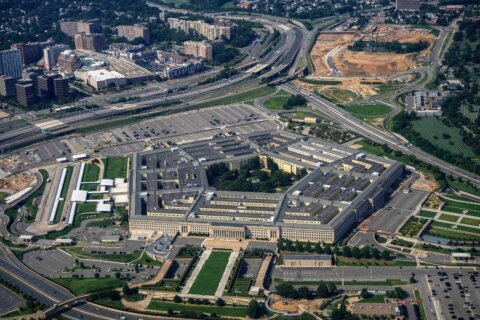
A $900 billion Pentagon spending bill that has passed the U.S. House and now heads to the Senate is raising concerns because of some language the chair of the National Transportation Safety Board, Jennifer Homendy, says weakens some of the reforms enacted in the aftermath of the Jan. 29 crash near Reagan National Airport.
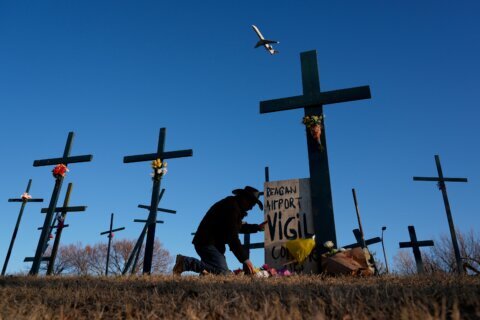
An Army Black Hawk helicopter and an American Airlines regional jet collided and 67 people in both aircraft died.
“It represents an unacceptable risk to the flying public to commercial and military aircraft, crews and to the residents in the region,” Homendy said Wednesday. “It’s also an unthinkable dismissal of our investigation and of 67 families … who lost loved ones in a tragedy that was entirely preventable. This is shameful.”
The NTSB has no regulatory authority and can only make recommendations about ways to improve transportation safety, and Homendy’s strong remarks about the legislation caught many people by surprise.
Aviation safety analyst Jeff Guzzetti is an independent transportation professional, having worked for both the NTSB and the FAA. He is now an analyst at NBC News. He said Homendy has put a stake in the ground when it comes to safety around Reagan National.
“This House language greatly weakens safety to the point where she believes the airspace around DCA will be unsafe,” he said. “Her interpretation of this legislation is that it rolls back things before the mid-air collision/accident, and she finds that unacceptable.”
Specifically, Homendy and several senators pointed to language in the House bill that includes exceptions that would allow military helicopters to fly through the crowded airspace around the nation’s capital without using technology called Automatic Dependent Surveillance Broadcast, or ADS-B, to broadcast aircraft location data to other planes and air traffic controllers.
ADS-B transmissions allow pilots in nearby airspace to track in real-time the exact locations of other commercial planes, helicopters and general aviation planes, providing an extra level of safety so aviators can avoid collisions.
However, the transmissions are not encrypted, and the information is available on numerous websites. And many in the military do not want the flights tracked, especially if they are carrying high-ranking government officials.
A little more than a month after the crash, the Federal Aviation Administration began requiring military pilots to use ADS-B when flying.
Homendy said when it comes to determining safety risks, the military aren’t the experts. In the years before the crash, there were 85 close calls near DCA between military helicopters and commercial jets, and neither the Pentagon nor the Army noticed the deteriorating safety situation. She also said that no one on Capitol Hill bothered to consult with the NTSB as they wrote the bill.
“Chair Homendy wasn’t getting satisfaction from the many phone calls she was attempting to make to the House committees,” Guzzetti said, adding the restrictions put in place after the crash that strictly limit military helicopter flights near DCA are working, because he said history has shown allowing low-flying helicopters at night near a crowded airport, as was the case in January, is too dangerous.
“She is using the bully pulpit of the NTSB to get her message across,” he said.
Officials react
Republican Sen. Jerry Moran of Kansas, the chairman of the Senate Commerce Subcommittee on Aviation, Space, and Innovation, said on Thursday the National Defense Authorization Act fails to implement minimum standards for military helicopters operating in mixed airspace, such as Reagan National. Moran wants the legislation amended.
Several of the people who died on the American Airlines plane were from his home state and the plane had departed from Wichita.
Two other senators, Maria Cantwell (D-WA) and Ted Cruz (R-TX) filed amendments to the legislation to remove the helicopter safety provisions.
“We owe it to the families to put into law actual safety improvements, not give the Department of Defense bigger loopholes to exploit,” the senators said.
Virginia’s two U.S. senators also criticized the proposed changes.
“The language in this provision could allow rolling back crucial new safety practices I fought to implement after the Jan. 29 tragedy and give the Department of Defense more discretion over safety procedures in the region,” Sen. Mark Warner said in a statement.
He added that the Department of Defense needs more supervision and regulation, not less.
“It’s clear that we cannot rely on the DoD alone to be the safety authority over its flights in this area,” he stressed in the statement.
Sen. Tim Kaine has been one of the leaders to tighten airspace and other flight restrictions at DCA.
Future movements
The NTSB’s final report on the cause of the collision is expected mid-2026. Investigators have already determined the Black Hawk was flying too low on a helicopter route that provided minimal separation between jets and helicopters approaching Reagan’s secondary Runway 33, which the regional jet was about to land on.
An estimated 20 seconds before the crash, the jet’s two pilots did get a warning. However, because the jet was at such a low altitude, just over 310 feet, the collision avoidance system is only partially enabled to prevent false alarms because there is little room to maneuver.
President Donald Trump said he wants to sign the bill because it advances many of his priorities and it also provides a 3.8% pay hike for many in the military.
The Senate could take up the legislation next week, and it appears unlikely that any final changes will be made. But Congress is leaving for a holiday break at the end of the week, and the defense bill is considered something that must pass by the end of the year.
WTOP’s Capitol Hill Correspondent Mitchell Miller, Gaby Arancibia and the Associated Press contributed to this report.
Get breaking news and daily headlines delivered to your email inbox by signing up here.
© 2025 WTOP. All Rights Reserved. This website is not intended for users located within the European Economic Area.