In the D.C. region, conversations often start with, “What do you do?” WTOP’s series “Working Capital” profiles the people doing the work that makes the region unique.
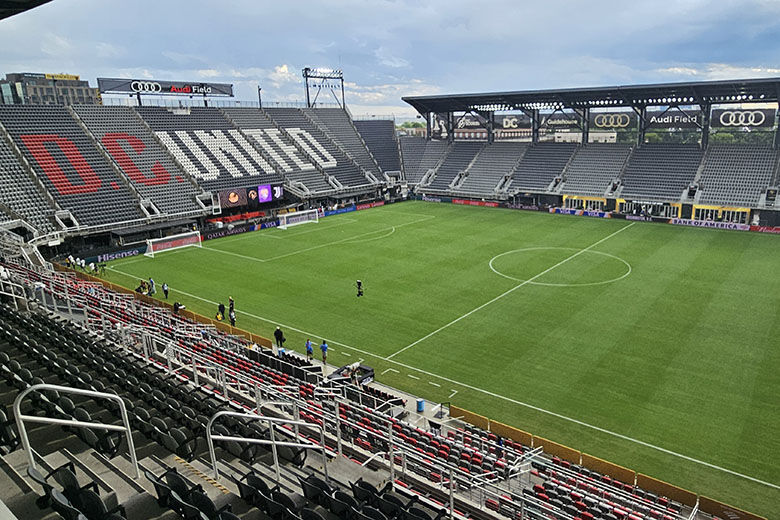
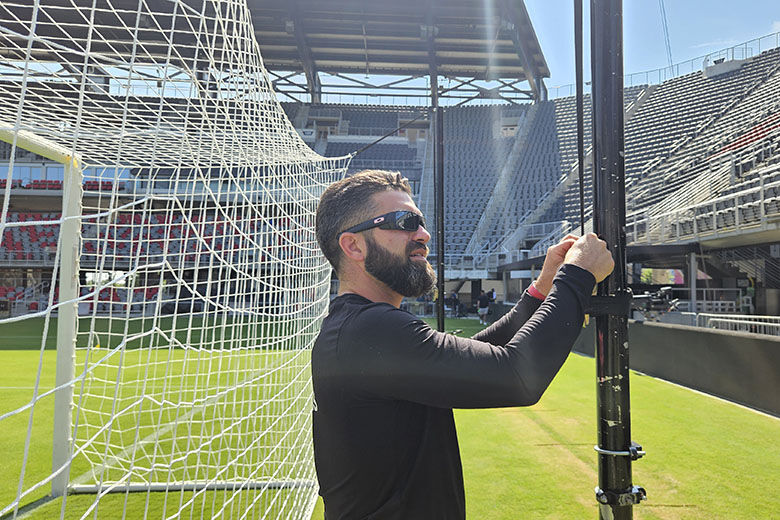
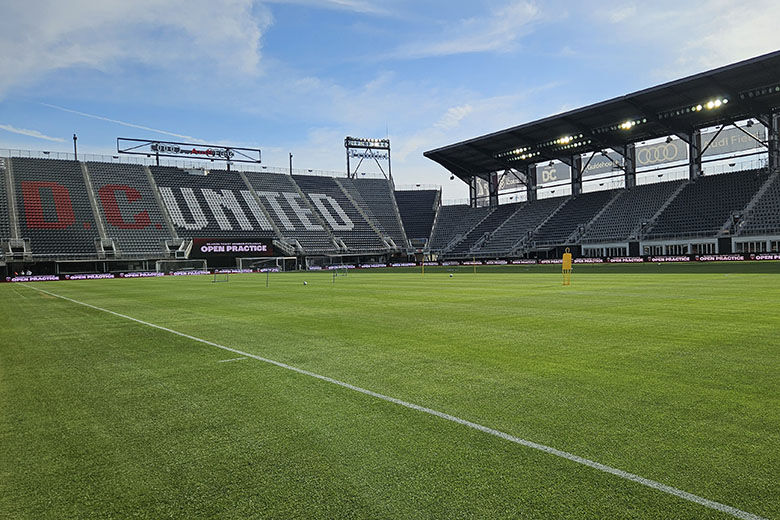
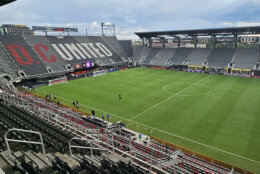
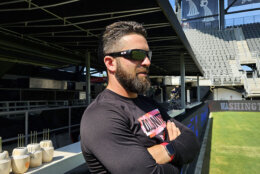
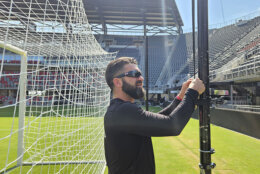
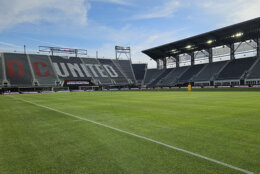
On a hot summer day in D.C., Blaise Restifo casually strolled around Audi Field, the region’s premier soccer stadium, looking at its grass pitch before starting to set up the goal nets.
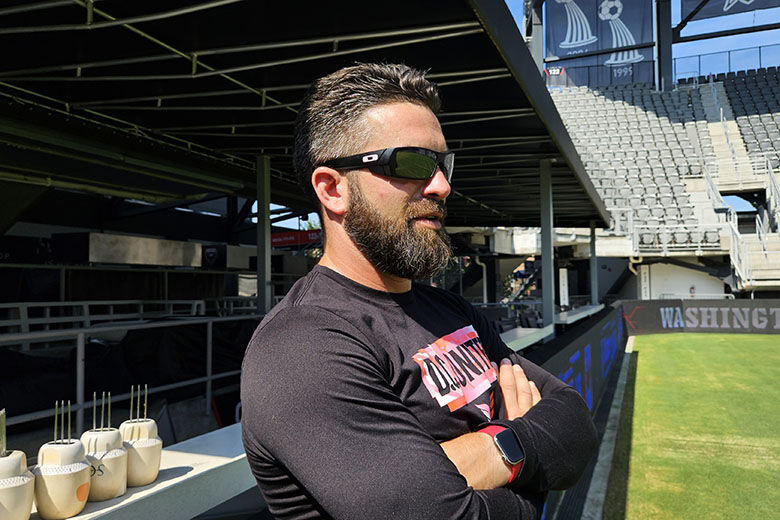
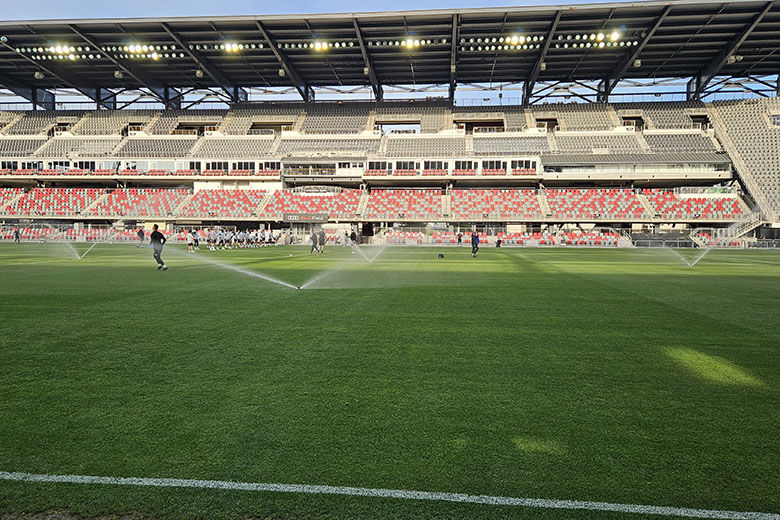
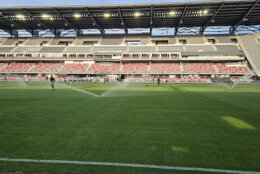
As he worked together with his field team, Restifo picked up multiple TurfPods, which helps track the soil’s temperature and moisture, and turned on the sprinklers. Moments later, players from the U.S. women’s national soccer team started warming up for an afternoon training. While they ran sprints, Restifo monitors how the field responds to the wear and tear from their cleats.
Restifo is in his first full year with D.C. United as its director of grounds, with his sole focus on maintaining its Bermuda grass field in top playing shape. In a conversation with WTOP’s José Umaña, Restifo says it takes more than watering and mowing to make the pitch ready for game day.
“There’s a lot we try to do,” Restifo told WTOP. “It’s probably not the most glamorous job sometimes, but it’s pretty cool.”
Entering ‘the turf world’
D.C. United started its search for a full-time groundskeeper who would manage both the playing surface at Audi Field and the team’s training facility in Leesburg, Virginia, in the spring of 2024. United had used a third-party contractor for field maintenance since the Southwest venue opened in 2018.
The stadium’s field had received mixed reviews on its condition while hosting several events throughout the year. Along with it serving as the primary home for D.C. United, it is also the home venue for the Washington Spirit and D.C. Power FC women’s soccer teams and the D.C. Defenders football team. The stadium has also hosted college football and lacrosse games.
Last July, United was forced to move a League Cup match to Pennsylvania after tournament organizers said there were “concerns with the condition of the playing surface” at Audi Field.
Meanwhile, Restifo, 41, was the director of sports turf at Stanford University in California at the time. He wanted to return to the D.C. region, where he previously worked during the 2010s at the Belmont Country Club and the Washington Commanders’ training facility in Ashburn, Virginia.
His interest in field management began in his 20s after working at the golf course in the Mayfield Sand Ridge Club in Lyndhurst, Ohio. At the time, an assistant manager taught him the inner workings of “the turf world.” That experience led him to take classes at Penn State University, specifically on field management.
“I found that this was kind of the path that I wanted to take,” Restifo said. “And then when I got into school for turf, I realized that I could go into sports, something that I really enjoy.”
After going through the interview process with United, he was hired in August 2024.
He arrived just after Audi Field replaced its field. That meant Restifo would be starting his new job with a new pitch to learn and study its tendencies.
‘Beating it up’
To maintain the field’s health, Restifo creates a grass fertility program that focuses on providing the proper nutrients to promote healthy growth. It is more than adding granular fertilizers that one uses for their backyard. The goal, he says, is to help boost the roots of the grass, which may require the use of greensand, which improves the field’s texture and helps with water filtration.
The program also includes an aeration process, which involves creating holes in the soil to improve air circulation and water penetration in the grassroots. Afterward, the field is top-dressed with either compost or topsoil to improve soil drainage and help level uneven grass.
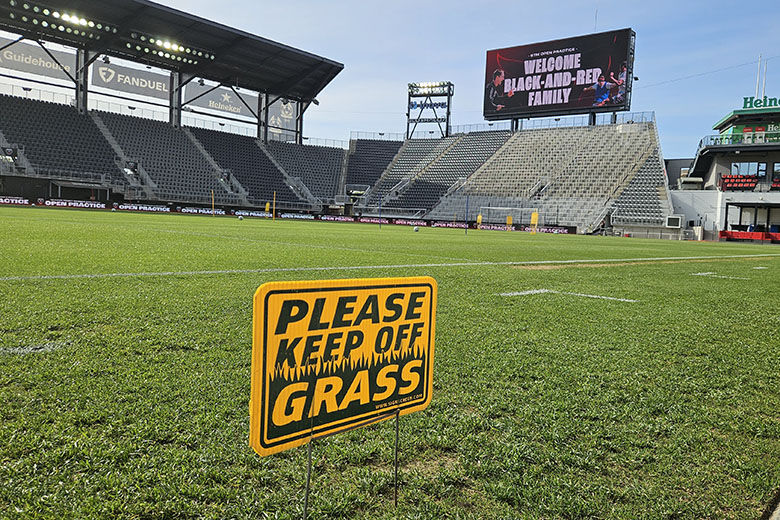
Every day at Audi Field is different, but it starts with a walk around the field, ensuring that there isn’t anything on the ground that could damage the mower, Restifo said. During this process, he checks for “disease pressure” — the likelihood that the grass will develop diseases — and its tensile strength.
“Can it hold up to a defensive end coming around the edge and putting that pressure?” He said about the field’s strength. “Is the field going to give out, or is his cleat going to just clamp in there and he’s going to be able to come around the edge and take on that quarterback?”
Once the field has completed the proper watering cycle, mowing can begin, a process that typically takes two hours. Once completed, the field crew can start painting the field. During this process, Restifo said he is monitoring high-usage areas, such as the goal area where goalkeepers stand and the warm-up areas, for additional treatment with sand.
“If we do that, then we’re going to limit the amount of wear that we get during a game,” he said. “Which then increases our recovery in a quicker time, and then we don’t wear out as quickly as we go through the season, which allows us to have a field that lasts longer and perform better.”
Restifo is a one-person crew that works together with an outside contractor for mowing and lining the field. On game days, he works together with United’s operations team to set up the corner flags and goal nets. Water is sprinkled before kickoff and at halftime to help the ball glide on the field. Greensand may be added to boost areas worn down before the second half begins.
Once the game is over, the goals are taken down, the corner flags are put away, and, depending on the upcoming schedule, the field is either watered or mowed down before the crew can go home.
“Ultimately, I can’t do it without the co-workers and the help that we have,” Restifo said. “I’m only one person, but it takes a whole team for us to build this thing out.”
Of the multiple sports played at Audi Field, football causes the most damage and takes the most time to treat, Restifo said. While he wouldn’t know what his hardest day at work was, Restifo admitted that heavy rain games “are never fun.”
The stadium’s drainage system does make it easier. Sitting at least a foot and a half below the surface, it allows enough room to suck up any standing water. The team also owns a machine that helps poke holes before and after rainy events, venting the grass and allowing it to breathe out the rainwater so it doesn’t build up algae or harmful bacteria.
“Whether that’s just punching some tiny holes to allow the water to have other spaces to go and then punching holes after a rainstorm to let the grass breathe again,” he said. “Venting that grass and letting that air get in there and it breathe, it’s so beneficial to your root zone.”
Aside from the cost of replacing a field, the groundskeeper has to set up a new program and start the learning process all over again, Restifo said. While it may look glamorous to start anew, it can be stressful to deal with new grass that may not be well-seamed or appropriately settled.
Comparing it to a human, Restifo prefers to build a relationship with his field, understanding its strengths and making it stronger through its fertility program.
“My approach is to not really want to have to replace the field,” Restifo said. “The fun part about this is beating it up and getting it to recover and basically regrowing the same field that you already have in existence.”
Friendly feedback
Between late February until the end of May, Audi Field hosted 26 games in 98 days from its four main teams. With a tight turnaround, Restifo said it led to some pretreatment to be done right after a game to prepare for the next day.
Yet, the responses have been largely positive. Former Washington Spirit head coach Jonatan Giráldez said the field is much better compared to last season. Former D.C. United head coach Troy Lesesne said the investment into Restifo was very important if the stadium plans to continue having the same amount of games a year.
“What I see so far is the fields are covering really well last year,” Lesesne said on April 24. “This time, with the same amount of traffic, it wasn’t.”
In June, FIFA, soccer’s world governing body, supplied the stadium with a brand new soccer field as part of its hosting duties during the Club World Cup. While a new field is nice, Restifo said that meant meeting a whole new pitch and understanding its behavior and acclimation to D.C.’s humid conditions all over again.
However, his work continues to receive positive feedback.
Last year, when the U.S. women’s national team played in Audi Field before the 2024 Summer Olympics, chunks of the playing surface came loose during corner kicks and field paint shot up in the air after slide tackles. Midfielder Sam Coffey said players noticed the field’s conditions, calling it “a little bumpy” to play on.
A year later, after playing in a friendly in D.C. on July 2, Coffey called the field conditions “fantastic.”
“Obviously, there’s wear and tear through the course of a season, but I think the field was amazing,” Coffey said. “I think it allowed us to play the kind of soccer that we want to play. I honestly didn’t notice (the wear and tear), which I think is a testament to how good it was.”
With all the events the venue has hosted so far and all that are coming soon, maintaining the field’s health through the rest of the year is Restifo’s main goal.
It’s a welcoming challenge, but Restifo asked for patience. He pointed to hearing broadcasters during football games calling out how a stadium’s field conditions looks or its affect on play without understanding the situation field managers are going through.
“Ultimately, we’re all doing the job to make sure that the athletes are safe and putting out the best possible product,” Restifo said. “Sometimes, don’t always judge a book by its cover in regards to what you see on TV.”
Get breaking news and daily headlines delivered to your email inbox by signing up here.
© 2025 WTOP. All Rights Reserved. This website is not intended for users located within the European Economic Area.