“If we don’t want people to die by suicide, we need to start talking about suicide.”
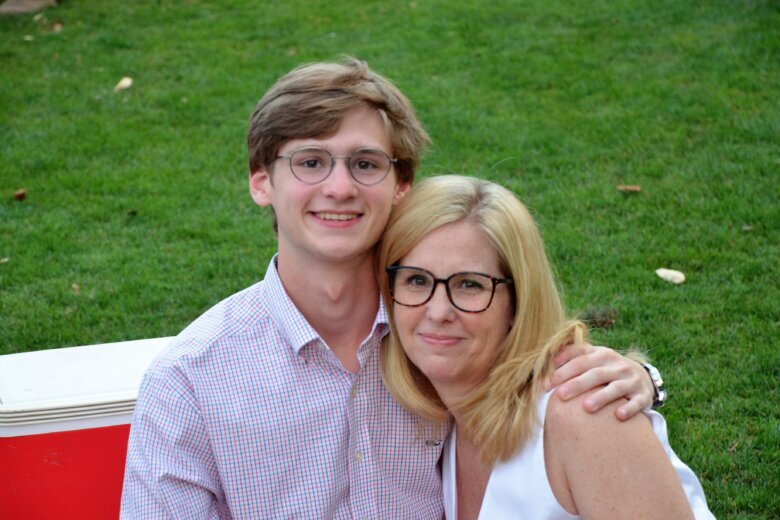
That’s how Betsy Thibaut Stephenson, an Alexandria mother and now an author, sees the topic that, for her family, went from being an abstraction to a shattering reality.
Stephenson is the author of a book titled “Blackbird, A Mother’s Reflections on Grief, Loss, and Life After Suicide.”
She introduces herself in clear, plain language.
“I’m a Virginia mother who lost my son to suicide three years ago,” she told WTOP. “I have committed myself to speaking openly about that loss and what we’ve learned about depression and why it’s important to take this very seriously.”
Her son Charlie was 21 and had finished his third year of university in Texas when he died by suicide.
“We found out that he was struggling in the spring,” she said. “Between the time that he first let us know that he was first considering self-harm and started getting help and when he died, it was 11 weeks.”
Charlie had two older sisters.
“He was always by far the most easygoing child in our family,” Stephenson said.
He was an observer, she added, with a quick wit and the kind of personality that led others to seek his advice when they needed it. That’s in part why his 2022 suicide was so devastating to his family.
“When I look at his high school and middle school and even early college,” she said, there were no signs that he was experiencing any problems with his mental health. And it’s not a topic the family had ever shied away from.
“I have been in and out of therapy my entire life,” Stephenson said, adding it was something the family spoke about openly.
The night before he took his own life, he’d spent the evening out with friends. Stephenson texted him, “Good night, bub. Hope you’re doing great. Love you.”
He replied, “I’m doing awesome. Love you good night.”
Hours later, he ended his life.
As agonizing as the loss was to the entire family, Stephenson, who lives in Alexandria, said her husband and daughters agreed, they would not try to hide the circumstances around Charlie’s death.
“We made the decision together to be forthcoming about cause of death, to be honest about the fact that Charlie died by suicide.”
But Stephenson said just because the family’s been honest and open about having experienced the loss of a loved one by suicide, doesn’t mean they aren’t free of the pain and feelings of guilt that can result.
“It is hard, but pretending like it didn’t happen or keeping secrets from people does not help it,” she said. “We need to do whatever we can to take the power away from suicide and to do that we need to make it less mysterious.”
Stephenson said her family makes clear to friends that talking about Charlie, sharing a memory, or simply missing him, is welcome.
“We carry him with us everywhere, we bring him up in conversations constantly, we tell stories about him, we refer to him,” she said. “I think that helps those around us be more comfortable with this loss.”
Dealing with the crushing weight of grief was something Stephenson approached as a kind of job. She made a conscious decision to learn about depression and hopefully, by sharing with others, help them avoid what her family experienced.
“I thought I knew a lot about depression. Then my son died by suicide. And I definitely underestimated how powerful depression can be — and how sneaky it can be,” she said.
Stephenson said she encourages people to have uncomfortable conversations, and not to avoid painful or difficult topics surrounding mental health.
“Uncomfortable conversations need to be handled gently, but don’t avoid it. I think it’s much better to talk things out.”
One of the things Stephenson emphasizes when she speaks to groups or in interviews, is the need to “remove every possible barrier to getting help.” That can be removing the “soft barriers” like the taboo of talking about suicide.
“And then there are the programmatic systems like 988 and other crisis lines,” Stephenson said. “Making those as available as possible and as easy to access, is only going to help people.”
Asked about the title of the book, she said her father played guitar, and often played the song “Blackbird” by the Beatles.
After her father died in 2009, she gave his guitar to Charlie, who learned to play it, including playing the song she’d loved so much as a child.
“Blackbird singing in the dead of night
Take these broken wings and learn to fly
All your life
You were only waiting for this moment to arise”
“We learned that he played it a lot around school and like, around the dorm,” and that people on campus had come to associate the song with Charlie.
Get breaking news and daily headlines delivered to your email inbox by signing up here.
© 2025 WTOP. All Rights Reserved. This website is not intended for users located within the European Economic Area.