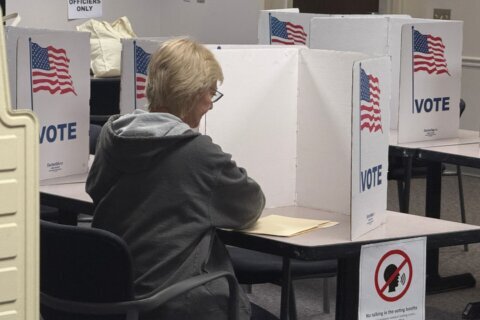
Virginia’s highest court will weigh in on several legal challenges to Democratic lawmakers’ redistricting plan, after voters approved the constitutional amendment during Tuesday’s special election.
The state’s Supreme Court had opted to wait until after election day to hear arguments. Multiple outlets have reported the Virginia Supreme Court is expected to hear some of the challenges in the next coming days.
Experts said the redrawn map could give Democrats a 10-1 edge in the U.S. House after this year’s midterm election. Currently, Virginia is represented in the U.S. House by six Democrats and five Republicans.
The new map will be in place for the next three election cycles, and then after a new census, the traditional bipartisan process would be used again, supporters of the redistricting measure said.
But Republicans have filed several lawsuits — some alleging the process of getting the amendment on the ballot wasn’t followed properly, and one particularly concerned with the language of the question itself.
“The court is going to be under some pressure to come back with a decision probably within the next month or so,” said J. Miles Coleman, associate editor of Sabato’s Crystal Ball at the University of Virginia Center for Politics.
Virginia has already pushed back its primary election from June to August, and some candidates have announced plans to pursue a seat once the new map is in place.
One legal challenge questions the language of the constitutional amendment itself.
David Ramadan, a former delegate and George Mason University professor, said Virginia’s constitution requires law and amendment language to be in plain English for voters to understand.
“Saying that this was a vote for fair elections is plain English, contrary to the ramification of the vote, and that is the argument that the opponents of the measure are making,” Ramadan said. “And I don’t think it’s going to fly. It did not fly in lower courts. It’s not going to fly in the upper court.”
A separate lawsuit questions the process used to get the question on the ballot. Amendments have to pass two sessions of the General Assembly and there has to be an election in between.
While Democrats said the 2025 gubernatorial election fell in between sessions, Republican challengers argued the process was initiated during the early voting period, and “’if you’re doing this during the early voting, that’s kind of during an election, so there wouldn’t be an election in between when you pass this,’” Coleman said.
There’s other state language, Coleman said, “that says the districts have to be somewhat fair. Obviously, a lot of people I don’t think would say that a 10-1 Democratic map drawn the way it is is fair.”
In a statement, Virginia House Republican Leader Terry Kilgore said, “Serious legal questions remain about both the wording of this referendum and the process used to put it before voters. Those questions have not been resolved, and they now move to where they belong: to the courts.”
Get breaking news and daily headlines delivered to your email inbox by signing up here.
© 2026 WTOP. All Rights Reserved. This website is not intended for users located within the European Economic Area.