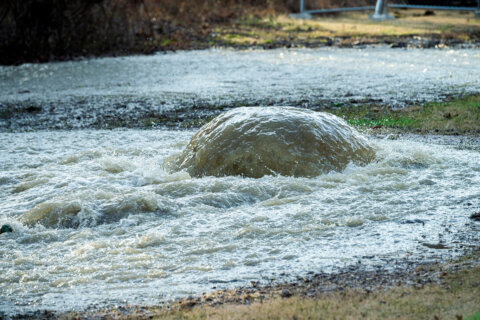
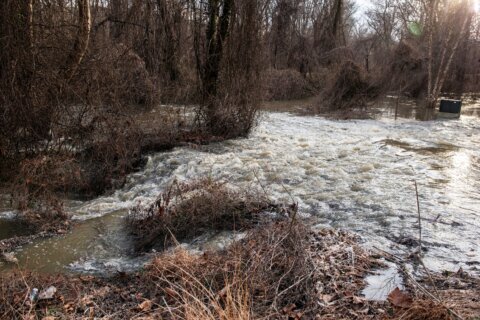
New information has emerged on the massive sewage spill in the Potomac River in January, when a sewer line in the C&O Canal National Historical Park in Montgomery County collapsed, sending more than 200 million gallons of untreated wastewater into the river.
In an exclusive report, The Washington Post has learned that D.C. Water had planned to reinforce that line years earlier, but construction was repeatedly delayed during a federal environmental review.
Now, D.C. Water and the National Park Service are blaming each other.
Washington Post investigative reporter Aaron Davis broke the story, and he joined WTOP’s Nick Iannelli to breakdown the latest.
Read and listen to the interview below.
The following transcript has been lightly edited for clarity.
- Nick Iannelli:
There were some concerns about this particular section of pipe have been in the air for a while. What did D.C. Water already know about this section of pipe?
- Aaron Davis:
When this first happened, back in January, we were all asking, ‘When did D.C. Water know about this spot? What did the inspections of this spot show?’
D.C. Water said, ‘Well, we’ve done inspections, and we weren’t expecting anything to be a problem anytime soon in this particular section.’
But the story goes back and starts around 2018, more than seven years ago, when D.C. Water had done a video inspection inside this pipe. Just a little bit upstream of the spot that ruptured, they saw something very concerning. They saw that the metal reinforcements through this concrete pipe were basically dangling, falling out of the top of the pipe, and they said, ‘We need to fix this.’
So they asked the National Park Service in 2018 to fix about a three-quarter-mile stretch to reinforce the whole thing, but almost from the beginning, that whole endeavor falls off the rails. By the following year, in 2019, the project is listed as 255 days behind schedule. D.C. Water says it’s because the National Park Service is doing an extended review.
One of the big roadblocks that happened in the whole scheme of that seven-year time period is in 2021, when it looks like D.C. Water got their approval. But they come back to the Park Service and say, ‘We’re going to have to cut down some more trees. We’re going to have to do a little bit more work to get down there in the pipe.’
And Park Service says, ‘Whoa, hang on. We need to take a more intensive look at this, do a bigger environmental review.’
And that really sets it on a course that is very laborious, and these delays keep compounding to the point where Jan. 19, when this pipe ruptured, they had still not approved the environmental review to conduct the repairs on the section that collapsed.
- Nick Iannelli:
What were some of the things under review during that environmental assessment?
- Aaron Davis:
They go through and they look at something called the ‘buttercup scorpionweed,’ which I’d never heard about, but that’s a blue flower, kind of a wildflower that blooms in this part of the C&O Canal. And they had to mitigate for that.
They said, ‘If we take down too many trees, and they were talking about 260 trees, that would impact something called the northern long-eared bat.’
And so, they had to come up with a mitigation plan for that.
- Nick Iannelli:
So D.C. Water literally said, in these documents that you’ve uncovered, that if this is left unaddressed, the corrosion in this pipe could ‘result in a catastrophic failure, leading to the release of raw sewage into the soil, groundwater and waterways.’ That is literally what happened.
What is the Park Service saying, and what is D.C. Water saying?
- Aaron Davis:
The Park Service tells us that they could never really begin to evaluate this because D.C. Water kept changing the plans, and that kept starting over the environmental process. And so it was really D.C. Water’s fault.
D.C. Water has been very careful in saying, ‘We’ve been following the Park Service’s direction and we’re trying to do and accomplish what they want.’
D.C. Water is in kind of a tough spot here, because so much of their infrastructure is on federal park land, and so they often need the approval of the National Park Service to do any construction on their own lines.
- Nick Iannelli:
In looking through these documents and the information from D.C. Water, as it relates to this specific portion of pipe that collapsed, is there any other information that would suggest that there are other parts of the pipe that are vulnerable to this sort of thing?
- Aaron Davis:
There’s a concerning slide that some of the engineers inside D.C. Water presented to the executives back in November of 2024, so this is a little over 18 months ago. And if you look at that map, which is the 50-mile-long Potomac Interceptor that stretches all the way out to Dulles Airport, there are a lot of sections that are either in orange or in red. And those two sections, by the color-coded system, are worse than the spot that ruptured back in January.
The spot that ruptured in January was listed as having a ‘moderate’ defect from corrosion. The other parts we’re seeing, there’s at least one spot in those other sections that is either rated as ‘very significant’ or ‘critical.’
There are many other places that are corroding inside the Potomac Interceptor, and you couple that with what the utility has said publicly since the disaster, which is that they’re now wondering if there are big boulders buried on top of other parts of the line that could create pressure points and lead to that kind of failure like what we just saw.
They were actually lucky that the rupture happened where it happened, because just a few 100 yards away was the C&O Canal that they could use as an open-air sewer and temporarily divert things. There’s a whole lot of stretches through Virginia, and even under the Potomac River itself, where there is no other redundancy, there’s no other canal they can put the sewage into. It ended up taking 54 days to repair that pipe this time.
Get breaking news and daily headlines delivered to your email inbox by signing up here.
© 2026 WTOP. All Rights Reserved. This website is not intended for users located within the European Economic Area.