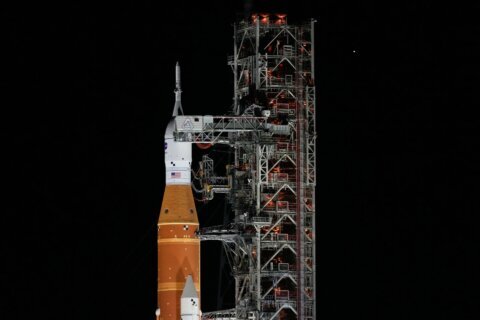
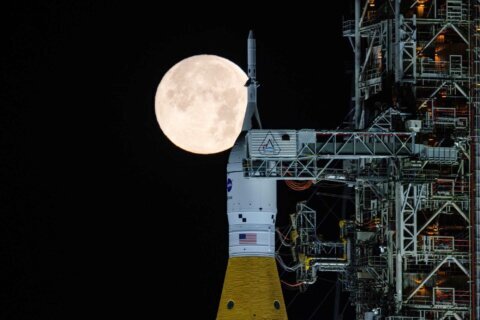
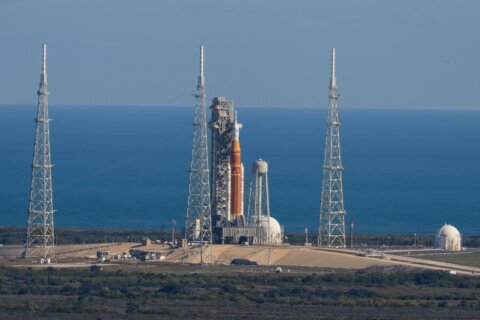
NASA engineers are examining data from their latest wet dress rehearsal after a hydrogen leak appeared during fueling at the Kennedy Space Center in Florida.
During the test, engineers loading liquid hydrogen into the Space Launch System noticed the leak was slightly larger than expected and didn’t behave the way they anticipated, according to Jeremy Pinier, the Space Launch System projects lead at NASA’s Langley Research Center in Virginia.
He said leaks like this are not unusual given the type of fuel involved.
“Hydrogen is the smallest molecule in the universe. It’s one atom. And hydrogen is notorious for finding its way through the smallest little cracks, and it’s very difficult to seal it,” Pinier told WTOP.
He said it’s like someone trying to seal their home from cold air, but “it’s impossible to do because the air is going to find its way in.”
Even with the issue, Pinier said the rehearsal still provided valuable information for the Artemis II’s mission around the moon.
“We ended up being able to fully fuel the rocket, which was really a success. Yesterday was a good day. We learned a lot,” he said.
Engineers are now focused on a seal in the hydrogen feed line. Pinier said the work to address it can be done on the launch pad because the area is accessible.
“The crews are incredibly talented, and they can do this work pretty quickly,” he said.
NASA is working through the fix as the new launch window shifts to March.
Virginia scientists preparing crew safety systems
At NASA’s Langley Research Center in Virginia, Pinier and his team are developing and refining the systems intended to keep astronauts safe as they travel farther around the moon than any crew has gone before.
“It’s an incredible time to be alive and to be part of the space program,” he said.
A major part of his job, he said, is anticipating what could go wrong.
“Failure of imagination is always what comes back and bites us,” Pinier said.
He said the crew has been training for the mission for years and is prepared to respond if something unexpected happens.
“We’ve got all these things planned and rehearsed, and the crew has been practicing and training for this mission for several years now, so they are also ready and are going to be able to deal with any abnormal situation as best they can,” he said.
One of the most important safety features is the launch abort system, designed to pull astronauts away from the rocket if something goes wrong during its ascent.
“In case something bad happens with the rocket, we can pull the crew away from the rocket at very high speed to get the crew to safety,” he said.
Pinier noted such a system existed on the Saturn V rocket, but not during the Space Shuttle era because “it was too complicated for that type of architecture.”
Another key protection comes when the crew returns to Earth at more than 40 times the speed of sound.
The Orion capsule’s heat shield, which saw some material come off during the unmanned Artemis I mission, has since undergone extensive investigation.
“We’re now feeling very confident that we are not taking any increased risk by flying the same heat shield on this second mission,” he said.
Pinier said the team is committed to ensuring the spacecraft is fully ready before any astronauts climb inside.
“We are making ensure that all the Ts are crossed and Is are dotted before we even think of putting a crew on board,” Pinier said.
Get breaking news and daily headlines delivered to your email inbox by signing up here.
© 2026 WTOP. All Rights Reserved. This website is not intended for users located within the European Economic Area.