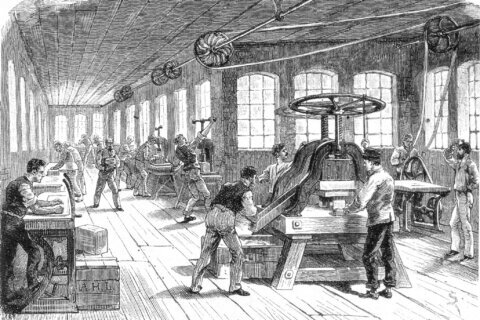
As the United States marks its 250th anniversary, WTOP presents “250 Years of America,” a multipart series examining the innovations, breakthroughs and pivotal moments that have shaped the nation since 1776.
The American Petroleum Institute is proud to partner with WTOP to bring you this series.
Long before plastic became something we use every day in our lives, petroleum was valued primarily because it could be used for fuel.
But over time, a quiet transformation began to take shape inside labs and industrial plants across the United States.
Chemists and engineers started to realize that crude oil could be more than a source of heat or motion.
It could be broken down, reassembled and transformed into entirely new materials.
That realization would reshape American industry and daily life.
A major breakthrough came in 1907, when Belgian-American chemist Leo Baekeland developed Bakelite, widely considered the first fully synthetic plastic.
At a time when natural materials like wood, metal and rubber dominated manufacturing, Bakelite offered something completely different.
What followed was a wave of innovation.
The birth of synthetic plastic
Throughout the 1920s and 1930s, American companies expanded their research into petrochemicals, which were compounds derived from oil and natural gas.
Those efforts accelerated during World War II, when shortages of natural materials forced industries to find alternatives.
By the end of the war, the U.S. had built a robust petrochemical infrastructure. And instead of scaling it back, manufacturers turned their attention to consumer markets.
The postwar boom of the 1950s and 1960s marked the true arrival of plastics in everyday American life.
What made plastics so revolutionary was not just their versatility, but their cost.
Petroleum-based materials could be mass-produced quickly and cheaply, helping fuel a culture of convenience.
Products that were once expensive or scarce became widely accessible.
Plastics in everyday life
By the late 20th century, plastics were everywhere.
They were in medical devices, such as disposable syringes and IV bags.
They were in automobiles, helping reduce weight and improve fuel efficiency.
They were in electronics, insulating wires and forming the casings of computers and, eventually, smartphones.
Even industries that seemed far removed from oil became deeply dependent on it.
Agriculture relied on plastic irrigation systems and packaging.
Construction used plastic piping, insulation and coatings.
The health care sector depended on specialized polymers for everything from prosthetics to life-saving equipment.
Petroleum had quietly become the backbone of modern materials.
Industries and researchers began exploring new ways to manage plastic waste, including systems designed to keep materials in use rather than discard them.
Some newer approaches aim to create a more circular life cycle where plastics can be broken down and returned to their original raw form or feedstock and then used again to make new products.
Instead of a one-way path from oil to product to trash, the goal is a loop.
Oil becomes a product, that product is recycled back into its basic building blocks and those materials are used again.
The rise of plastics represents one of the most significant and least visible chapters in the history of American energy.
What began as an effort to refine oil for fuel ultimately expanded into something far broader.
Oil was not just something to burn, but something to build with.
Petroleum moved beyond the gas tank, embedding itself in nearly every corner of modern life.
Get breaking news and daily headlines delivered to your email inbox by signing up here.
© 2026 WTOP. All Rights Reserved. This website is not intended for users located within the European Economic Area.