CAIRO (AP) — An engineer crouches under a park bench as fighter jets roar overhead. An athlete wracked by anxiety can’t sleep as explosions go off. With the internet shut down, families and friends rely on each other for news about the war and the latest damage caused by airstrikes.
Fierce U.S.-Israeli bombardment of Iran’s capital, Tehran, now at the end of its second week, has left residents in a state of shock. From central historic quarters to upscale northern areas, bombs are shaking the city day and night, with no sirens or warning systems to alert the public.
“The psychological pressure is real,” said the athlete, who lives in a northern area of the capital. He was among a half dozen Tehran residents reached by The Associated Press, all of whom spoke on condition of anonymity out of fear for their safety.
Widely respected national symbols have been threatened. The monumental archway of Azadi Square, often seen as the capital’s modern emblem, was enveloped by smoke after strikes nearby, while the 19th-century Golestan Palace, a landmark of historic pride, had its windows blasted out. At the same time, security forces have increased their presence in the streets to prevent any shows of dissent.
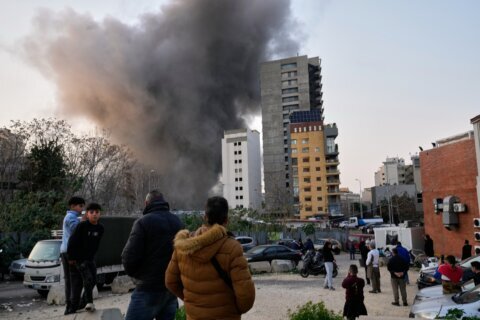
Israeli strikes on oil depots in Tehran last weekend had a particularly profound impact on residents’ psyches. After the blasts, giant fires raged, and toxic, black smoke filled the air — partially eased by rains in the following days.
“I could barely breathe and had to go buy an inhaler,” a 54-year-old Tehran resident who is a human-rights activist said. “People are worried it will affect their drinking water.” As she spoke to AP, a blast went off in the background.
In a later voice note on Tuesday, the activist said, “Last night the situation was really bad. Fighters as well as drones had taken over the whole sky. East, west, they hit everywhere they could. Today you see a lot of residential places that were damaged. It’s really painful.”
The war is fraying nerves across the region, as Iran fires waves of missiles and drones at Israel, U.S. military bases and its Persian Gulf neighbors.
‘Severe bombardment’
The U.S.-Israeli air campaign has struck thousands of sites across Iran, most belonging to the military and the paramilitary Revolutionary Guard. The Iranian Red Crescent says thousands of civilian sites have been damaged, including hospitals, schools, universities and homes. Iran has not publicly updated its death toll from the over 1,200 previously reported.
A 33-year-old engineer described the aftermath of the oil depot strikes as an “end-of-times scene.”
Iranians are finding it difficult to follow news of the war, he said, with internet access largely shut down since the first strikes on Feb. 28. Only a sliver of the public has limited access with virtual private networks, the engineer estimated.
He said he phones friends for news of where bombs are landing. Other residents said family and friends trade reports of strikes at anxious gatherings in homes and cafes.
Almost total Israeli and U.S. air superiority has opened up the capital to attack at any moment. The engineer said he was on his street when he heard fighter jets, then a strike nearby. He ducked under a park bench.
A university student said fear of attacks is rising even among those who do not live near clearly marked government and military targets.
“Every moment, without any warning sirens or announcement, some part of the city is under attack,” he said, describing some streets as full of broken glass from surrounding buildings.
Hit without warning
Normally a vibrant city of over 9 million people, Tehran’s streets — in between airstrikes — are now eerily quiet. Many shops and supermarkets are open. But the traditional bazaar is closed, and many streets are empty as people hunker down at home. Families tape windows to prevent flying glass and they shelter in interior rooms when they hear the roar of strikes.
A teacher who lives in the northern Tehran district of Vanak said the home of a friend in eastern Tehran was damaged by a nearby strike that blew windows out of the frames, broke the sink and wrenched the door of the building’s garage out of place. When the friend called to tell her the news, “I was in a very bad shock,” the teacher said.
The teacher said she spends most of her time at home, hosting family members who fled another part of Tehran because they live near positions of the Basij, the feared all-volunteer wing of the Guard. She paces and spends a lot of time trying to get on the internet.
“I try to keep myself calm and tell myself, ‘This is the price we have to pay for getting rid of the Islamic Republic,’” she said.
U.S.-Israeli strikes have heavily targeted positions of the Guard, Basij and police forces, the main enforcers of the Islamic Republic that suppressed protests earlier this year, killing thousands and arresting tens of thousands. This week, strikes turned to roadblocks and checkpoints set up by the Basij, with at least 18 hit on Wednesday, mostly in Tehran, according to Armed Conflict Location and Event Data, a U.S.-based monitoring group.
On Friday, a large explosion hit a main Tehran square as government supporters held a large demonstration there.
So far, authorities appear to have been able to maintain their grip. Residents described a heightened presence of security forces and Basij on the streets One resident sent the AP video she took of a procession of Basij on motorcycles and cars waving flags on her street in a northern Tehran neighborhood. Mosques blared pro-government slogans, she said.
On state TV Monday night, Ahmad-Reza Radan, the commander-in-chief of the Islamic Republic’s security forces, warned that anyone taking to the streets in protests will be seen “as enemies, and we will deal with them as we would with the enemy. All our guys are ready to fire.”
The government has also encouraged its supporters to gather in street demonstrations, especially following the announcement of the new supreme leader, Ayatollah Mojtaba Khamenei. He succeeds his father, Ayatollah Ali Khamenei, who was killed by Israel’s opening strikes in the war.
The younger Khamenei’s selection is widely seen as a further sign that hard-liners are keeping a close grip on power. He issued his first statement Thursday, but has not appeared in public.
‘A scorched country’
As the war rages, many Iranians are still reeling from the crackdown after the massive anti-government protests in January.
A 27-year-old nurse said the surgery unit where she works in a Tehran hospital was still treating protesters with serious wounds.
She described the U.S. and Israeli targeting of Iran’s leadership and security forces as “revenge” for the killings of protesters and said she was happy to see the security forces hit.
But the damage from the air campaign is worrying some of those who want to see the Islamic Republic fall.
“It’s no longer about weakening the government. It’s gone toward weakening the people of Iran,” said the activist, who has been imprisoned in the past. “Do you really want to turn us into a scorched country, something the Islamic Republic couldn’t do itself?”
__
El Deeb reported from Beirut. Associated Press writer Shirin Hakim in New York City contributed to this report.
Copyright © 2026 The Associated Press. All rights reserved. This material may not be published, broadcast, written or redistributed.